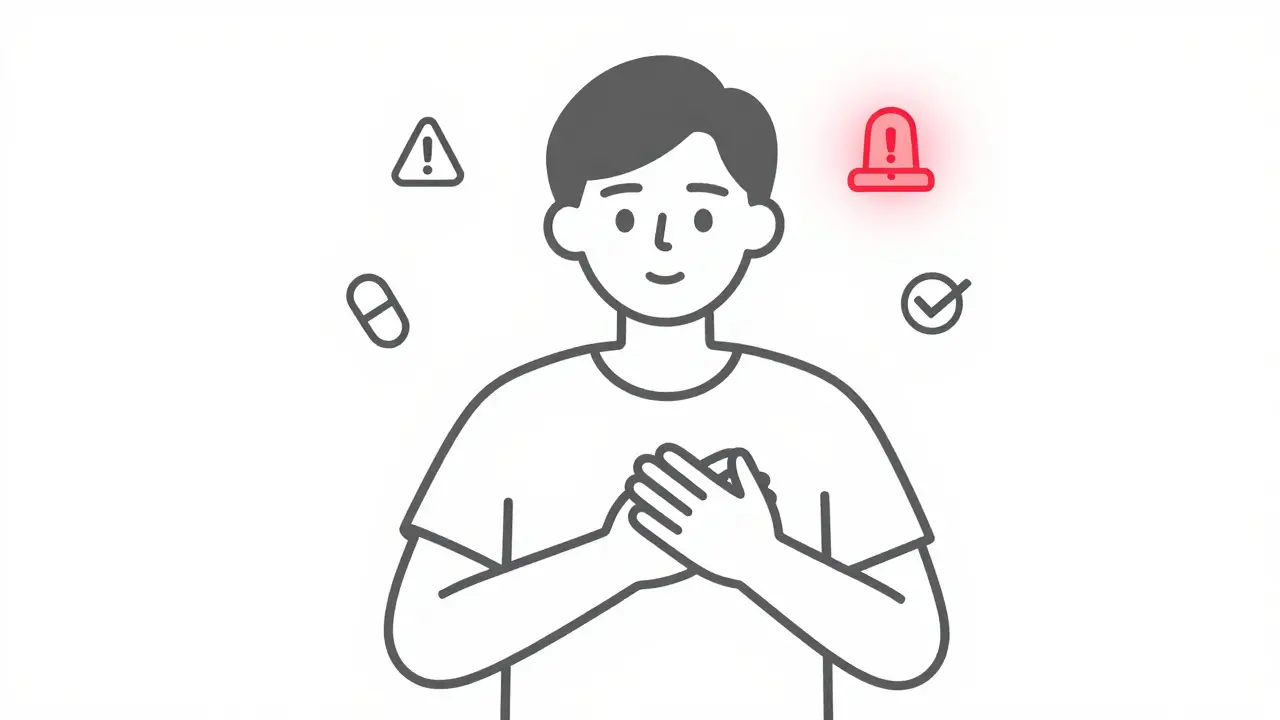
Taking medication should make you feel better, not worse. But sometimes, what starts as a simple side effect can turn into something serious-fast. If you’re on prescription drugs or even over-the-counter pills, knowing when to call your doctor isn’t just helpful; it can save your life.
What Counts as a Red Flag?
Not every weird feeling means something’s wrong. Nausea after antibiotics? Common. Dry mouth from antihistamines? Normal. But some symptoms aren’t just uncomfortable-they’re warning signs. The FDA defines a serious reaction as one that causes death, hospitalization, disability, permanent damage, or a birth defect. That’s the line you need to know.Here’s what you should never ignore:
- Difficulty breathing-even if it’s just a little tightness in your chest or throat. This is the #1 sign of anaphylaxis, a life-threatening allergic reaction that can hit within minutes.
- Hives or swelling-especially on your face, lips, tongue, or throat. If you notice red, raised bumps or your lips suddenly look puffy, don’t wait.
- Blisters or peeling skin-this could be Stevens-Johnson Syndrome (SJS) or toxic epidermal necrolysis (TEN). These rare but deadly reactions often start with flu-like symptoms, then turn into painful blisters that spread. About 100-200 cases are reported in the U.S. each year, and they need hospital care immediately.
- Fainting or feeling like you’re about to-dizziness is one thing; passing out is another. A sudden drop in blood pressure can signal a severe reaction to blood pressure meds, antibiotics, or even heart drugs.
- Severe nosebleeds or unexplained bruising-if you’re on blood thinners like warfarin or apixaban, minor bleeding is expected. But if you’re bleeding for more than 10 minutes or bruising without bumping into anything, call your doctor.
- Confusion, slurred speech, or weakness on one side-this could point to a stroke caused by a drug interaction or bleeding in the brain.
These aren’t "maybe" situations. If you have even one of these, call emergency services or go to the ER. Don’t text your doctor. Don’t wait until morning. Time matters.
When Is It Just a Side Effect?
Most side effects aren’t dangerous. In fact, they’re common. About 20-30% of people on antibiotics feel nauseous. Half of opioid users get constipated. One in three people on antihistamines feel drowsy. These aren’t reasons to quit your medicine.The National Institutes of Health says stopping medication without talking to your provider is one of the biggest reasons treatment fails. For chronic conditions like high blood pressure, diabetes, or depression, 40% of complications happen because people quit their meds too soon.
So how do you tell the difference?
- Minor side effects: Mild nausea, dry mouth, drowsiness, headache, mild rash, diarrhea. These usually fade after a few days as your body adjusts.
- When to worry: If it gets worse after 72 hours. If it stops you from sleeping, eating, or working. If it’s new and intense, especially if you just started a new drug.
Harvard Health Publishing says: If a side effect bothers you for more than 48 hours-or if it cuts into your daily life by more than 30%-it’s time to call. Not panic. Just call.
Keep a Side Effect Diary
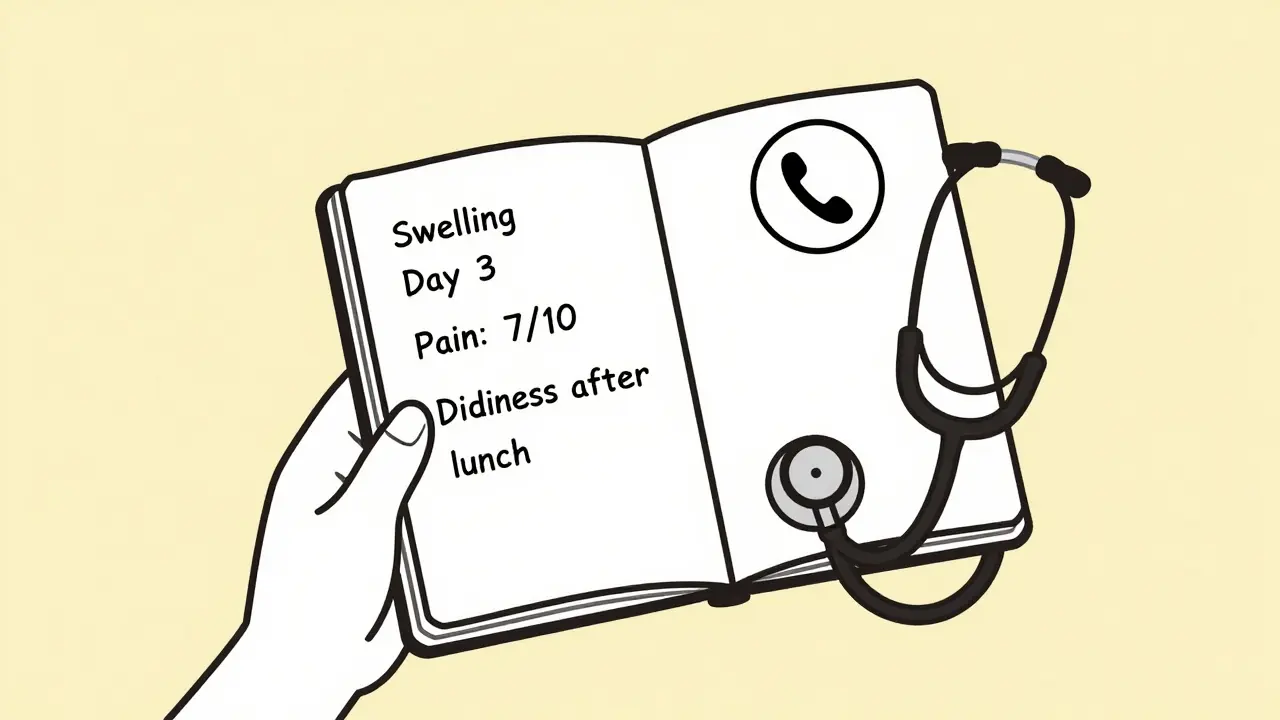
You’d be surprised how much detail helps your doctor. A 2022 Lancet study found that patients who kept a side effect diary improved diagnostic accuracy by 65%. That’s huge.Here’s how to do it:
- Write down the symptom: "Swelling in my ankles," not just "my legs hurt."
- When did it start? "Three days after I started the new blood pressure pill."
- How bad is it? Rate it 1-10. "Pain is a 7, constant."
- What time of day? "Dizziness hits right after lunch, every day."
- Did anything help? "Sat down, drank water, felt better in 15 minutes."
Bring this to your next appointment-or send a photo of it to your doctor’s portal. This isn’t extra work. It’s your best tool for getting the right answer fast.
Don’t Stop Your Meds (Unless It’s an Emergency)
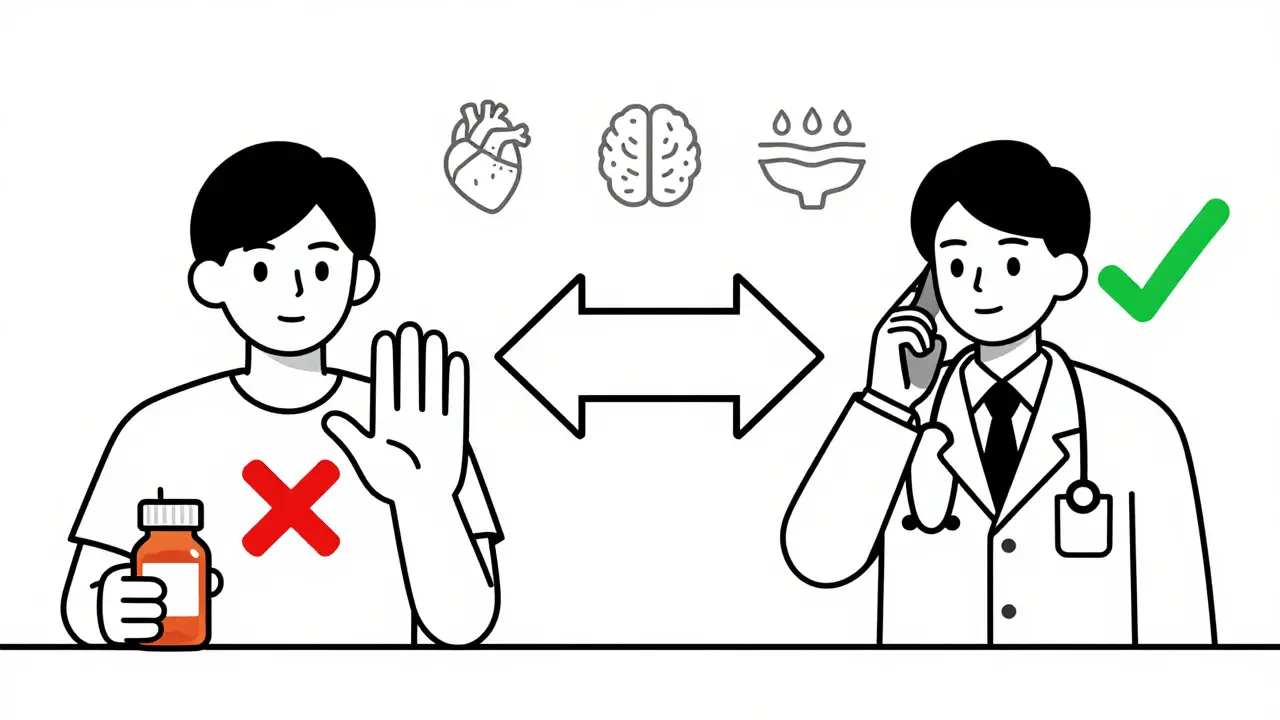
A lot of people panic when they feel off and quit their meds. That’s dangerous.For example, if you’re on a beta-blocker for heart issues and you feel dizzy, stopping it cold turkey can cause your heart rate to spike, triggering a heart attack. If you’re on antidepressants and quit suddenly, you can get withdrawal seizures. Even for antibiotics, stopping early can lead to resistant infections.
The rule? Only stop if you have signs of anaphylaxis or severe skin reactions. That means trouble breathing, swelling of the throat, or blisters covering more than 10% of your skin. Everything else? Call your doctor. They might adjust the dose, switch the drug, or add something to help with the side effect.
As Dr. Robert Wood from Johns Hopkins says: "Anaphylaxis can kill in minutes. Everything else? We can fix it."
How to Report a Bad Reaction
Your report matters. The FDA’s MedWatch program gets over 1.3 million adverse event reports every year. About 15-20% come from patients like you. These reports have led to 200-300 label changes and 15-20 drug recalls since 2020.Reporting is easy:
- Call 1-800-332-1088 (toll-free in the U.S.)
- Or go to fda.gov/medwatch (you can still report even if you’re outside the U.S.)
You don’t need a diagnosis. Just say: "I took this drug and had this reaction." Include the drug name, dose, when you took it, and what happened. The FDA uses this data to update warnings, change packaging, or pull dangerous drugs off the market.
It’s not just about you. It’s about the next person who might take that same pill.
What’s Changing in Medication Safety
The FDA just started a big push to make side effect info clearer. Starting January 1, 2025, all new medication guides must use plain language-not medical jargon. Instead of "gastrointestinal disturbance," you’ll see "stomach upset or diarrhea."The Sentinel Initiative, which tracks health data from 300 million patients, has already caught dangerous drug patterns faster than ever. In 2022, it spotted a heart failure risk with a diabetes drug within six months-something that used to take years. That’s saved lives.
And it’s not just tech. Pharmacies now hand out medication guides for 92% of high-risk drugs. The National Library of Medicine’s DailyMed database gives free, up-to-date side effect info for over 140,000 medications. Use it. Search your drug name. Read what’s listed.
Final Advice: Be Your Own Advocate
You know your body better than anyone. If something feels off, it probably is. Don’t second-guess yourself because "it might just be a side effect." And don’t wait for someone else to notice.Keep your meds list updated. Tell your doctor about every supplement, OTC pill, and herbal tea you take. Many dangerous interactions happen because no one knew you were taking ginger capsules with your blood thinner.
And remember: calling your doctor isn’t a burden. It’s part of staying healthy. Most doctors prefer you call with a question than show up in the ER because you waited too long.
What should I do if I think I’m having an allergic reaction to my medication?
If you have trouble breathing, swelling of your face or throat, hives, or feel like you’re going to pass out, call emergency services immediately. Do not wait. If you have an epinephrine auto-injector (like an EpiPen), use it right away. Even if symptoms seem to fade, you still need to go to the hospital-reactions can come back.
Can I stop taking my medication if side effects are annoying but not dangerous?
No-not without talking to your doctor first. Stopping meds like those for blood pressure, diabetes, seizures, or depression can cause serious health problems, including heart attacks, seizures, or relapses. Many side effects fade after a few days or can be managed with dose changes or added medications. Always ask before quitting.
How long should I wait before calling my doctor about a side effect?
If a side effect lasts more than 48 hours, gets worse, or interferes with your daily life (like making it hard to sleep, work, or eat), call your doctor. Don’t wait until it’s unbearable. Early action can prevent complications and help you stay on the right treatment.
Are over-the-counter drugs safe to take with prescription meds?
Not always. Common OTC drugs like ibuprofen, antacids, or cold medicines can interact with blood thinners, antidepressants, or heart medications. For example, mixing ibuprofen with warfarin increases bleeding risk. Always check with your pharmacist or doctor before adding any new pill-even if it’s "natural" or sold without a prescription.
What if I don’t have a doctor or can’t afford to see one?
In New Zealand, you can call Healthline (0800 611 116) for free, 24/7 advice from trained nurses. They can help you decide if your symptoms need urgent care or if you can wait. Many clinics also offer low-cost or sliding-scale visits. Your safety matters more than cost. Don’t delay help because you’re worried about the bill.
Alex Ogle
Man, I’ve been on blood pressure meds for years, and I swear, the first time I got that weird dizziness after lunch? I thought I was dying. Turned out it was just my body adjusting. But I kept a diary like they said-wrote down the time, what I ate, how I felt. Brought it to my doc, and we tweaked the dose. Now I’m golden. That little notebook? Best thing I ever did. Don’t sleep on it.
Also, side note: I started taking ginger tea for inflammation, didn’t think twice. Then I started bruising like a cartoon. Turns out ginger + warfarin = bad combo. Learned the hard way. Always tell your doctor about everything-even that ‘natural’ stuff. It’s not a burden. It’s insurance.
And yeah, I know some people think doctors are just trying to sell pills. But honestly? The ones who listen? They’re lifesavers. I’ve got one who remembers my dog’s name. That’s the kind of doc you keep.
Anyway. Just… keep track. It helps. More than you think.
Ryan Vargas
Let’s be brutally honest: the FDA doesn’t give a damn about you. They’re a corporate puppet show. The ‘MedWatch’ program? A PR stunt. The real data-the ones that matter-are buried under layers of red tape, corporate NDAs, and pharma-funded research. They only act when the death toll hits a statistically ‘newsworthy’ threshold.
And don’t get me started on the ‘plain language’ mandate starting in 2025. ‘Stomach upset’ instead of ‘gastrointestinal disturbance’? That’s not transparency-it’s infantilization. You think the average person can’t handle ‘dyspepsia’? Or are they just trying to dumb it down so you don’t ask questions?
The real red flag? The fact that we’re still being told to ‘call your doctor’ instead of being given real, accessible, real-time pharmacovigilance tools. We’re being managed, not protected. And if you think your diary is going to change the system? Sweetheart, it’s not about you. It’s about profit margins.
And yet… here we are. Still trusting the machine. Because what else can we do?
Sam Dickison
Bro, I’m on apixaban and I swear, if I see one more person say ‘minor bleeding is expected,’ I’m gonna scream.
Look-I’ve had nosebleeds for 48 hours straight. Not ‘a little’-like, I had to put a towel on my pillow. My wife thought I was having a stroke. I called my doc. He said, ‘Yeah, that’s not normal. Come in.’ We lowered the dose. Done.
Point is: don’t wait for a textbook. If it feels wrong, it probably is. And if your doc acts like it’s no big deal? Find a new one. I’ve had three different cardiologists. Only one listened. The rest were on autopilot.
Also-yes, the diary thing works. I do it on my phone. Voice memo. ‘3:15 p.m. Nosebleed. No trauma. Blood pressure 128/78.’ Simple. But it saved my ass. Just… don’t be lazy. Your life’s not a suggestion.
Karianne Jackson
I had hives after taking ibuprofen and I thought it was just stress… until my face swelled up like a balloon and I couldn’t breathe. I called 911. They thought I was joking. I wasn’t. I almost died. Now I carry an EpiPen like it’s my damn ID card.
Don’t be like me. Don’t wait. Don’t think ‘maybe it’ll go away.’ It won’t. It gets worse. I’m alive because I screamed. You should too.
Chelsea Cook
Oh my GOD, I’m so glad this exists. Like, I’ve been yelling into the void for years about how people just GIVE UP on their meds because they feel ‘weird’ for two days.
My aunt stopped her antidepressants because she got ‘a little dizzy.’ Two weeks later? She tried to jump off a bridge. She’s fine now. But I’m still mad.
And yes, ginger tea + blood thinners = bad idea. I told my cousin. She said ‘but it’s NATURAL.’ I said, ‘So is arsenic. That doesn’t mean you eat it.’
Also, the diary? I started one. Now I’m obsessed. I track my meds like it’s a dating app. ‘Swipe left on nausea. Swipe right on sleep.’
Stop being a hero. Call your doctor. They’re not judging you. They’re your backup.
Andy Cortez
LMAO at this ‘call your doctor’ nonsense. Who even has a doctor anymore? I got a 23-year-old PA who doesn’t know what warfarin is. And the ‘FDA’? That’s the same group that let OxyContin out. You really think they care?
Also-‘reporting’? Yeah, I reported a reaction once. Took six months. Got an auto-reply. My info vanished into the void. Meanwhile, the drug’s still on shelves.
And ‘plain language’? Please. ‘Stomach upset’? That’s not helping. That’s just them being scared to say ‘diarrhea.’
Real talk? If you’re on meds, you’re basically a lab rat. The system’s rigged. So yeah, keep your diary. But don’t expect it to change anything. Just survive.
P.S. I took 3 Advil with my blood thinner. I’m still here. So maybe the ‘rules’ are BS?
Jacob den Hollander
I just want to say-this post saved me.
I’ve been on a beta-blocker for 8 months. Felt dizzy, thought I was going crazy. I almost quit. Then I found this. I started the diary. Wrote everything. Turns out the dizziness only happened after I ate pizza. Turns out I was getting acid reflux, and it was messing with my blood pressure. Doc switched me to a different med. No more dizzy.
And yeah, I told my doc about the turmeric I was taking. He didn’t blink. Said, ‘Good call.’
I’m not a medical expert. I’m just a guy trying to stay alive. This stuff matters. Not because it’s perfect. But because it’s honest.
Thank you. Seriously. I needed this.
Kathryn Lenn
Oh, so now we’re supposed to trust the FDA? The same agency that let thalidomide through in the 50s? The same one that approved Vioxx and then buried the data? Don’t make me laugh.
And ‘call your doctor’? What if your doctor is on a pharma payroll? What if they’re incentivized to keep you on the drug? You think they care about your ‘side effects’? They care about their bonus.
And the ‘diary’? Cute. You think some spreadsheet is gonna stop a multi-billion-dollar industry? Please. This whole thing is a distraction. A feel-good ritual for people too scared to question the system.
Real solution? Get off the meds. Go primal. Eat real food. Sleep. Move. Don’t let Big Pharma own your body.
And if you die? At least you died free.
John Watts
Just wanted to say-you’re not alone. I was scared to call my doctor about my weird rash after starting a new statin. Thought I was overreacting. Took me three weeks. Then I finally did. They switched me in a day. No drama.
And yeah, I keep a diary. Not because I’m obsessive. Because I’m tired of guessing. I don’t want to be the ‘I thought it was just a side effect’ story.
You’re not being dramatic. You’re being smart. And if your doc makes you feel dumb for asking? That’s on them. Not you.
Also-side effect tracking is the new mindfulness. You’re not just surviving. You’re learning your body. That’s power.
Elan Ricarte
Look, I’m not here to sugarcoat this. You’re on a chemical cocktail. Your body is a battlefield. And the system? It’s not built to save you. It’s built to keep you paying.
That ‘15% of reports come from patients’? That’s because 85% of people are too scared, too broke, or too tired to care. And guess what? The drugs still get sold.
And ‘plain language’? Please. They’re not trying to help you. They’re trying to make you feel like you’re in control so you don’t sue them.
But here’s the truth: if you have swelling, trouble breathing, or skin peeling? GO TO THE ER. No questions. No waiting. That’s not paranoia. That’s biology.
Everything else? You’re playing Russian roulette with your liver. And yeah, I’ve been there. I’m still here. But I don’t trust any of it.
So keep your diary. But don’t trust the system. Trust your gut. And if your gut says ‘run’? Run.
Chelsea Deflyss
I took a new antibiotic and got diarrhea for 5 days. Called my doc. She said ‘oh, that’s normal.’ I said ‘but I’m losing 8 pounds and can’t walk.’ She said ‘maybe try yogurt.’
So I went to urgent care. Turned out I had C. diff. ICU. 3 weeks in the hospital.
Don’t let your doctor gaslight you. If you feel like you’re dying? You probably are. Trust yourself. Not the script. Not the pamphlet. Not the ‘it’s just a side effect’ nonsense.
Also-why is no one talking about how hard it is to get a doctor’s appointment anymore? I waited 11 days to see someone. That’s not healthcare. That’s a lottery.
Tricia O'Sullivan
Thank you for this comprehensive and meticulously structured overview. The clinical precision with which the distinctions between benign and life-threatening adverse reactions are delineated is commendable. I particularly appreciate the reference to the 2022 Lancet study, which reinforces the empirical validity of patient-reported symptom tracking.
Furthermore, the emphasis on pharmacovigilance as a collective civic responsibility-not merely an individual burden-is both ethically sound and epidemiologically vital.
One might posit, however, that the efficacy of MedWatch reporting is contingent upon systemic infrastructure, which in many regions remains under-resourced. In Ireland, for instance, adverse event reporting is facilitated through the HPRA, yet uptake remains low due to awareness gaps.
Perhaps the next iteration of this guidance could include international reporting portals? A small, yet significant, expansion.
Brett Pouser
Just wanted to say-I’m a guy who’s been on 7 different meds in 5 years. Some worked. Some didn’t. Some made me feel like a zombie.
But here’s what I learned: the people who survive are the ones who talk. Not the ones who Google. Not the ones who wait. The ones who say, ‘Hey, this isn’t right.’
My doc? She texts me back. Even at 10 p.m. I’ve sent her pics of my rash. She’s seen me cry. We’ve laughed about how weird my body is.
Medicine isn’t magic. It’s messy. But you don’t have to do it alone.
Call. Text. Send a voice note. Whatever. Just don’t sit there and suffer. You’re worth more than that.
Jessica Klaar
I had a stroke from a drug interaction. I didn’t know I was taking a supplement that messed with my blood thinner. I’m lucky I’m alive.
Now I keep a list. On my phone. In my wallet. On my fridge. I tell every new provider. Even the dentist.
And yes-I called my doctor about a headache. She said, ‘Good call.’
Don’t be embarrassed. Don’t be ‘that guy.’ Be the guy who’s still here.
And if you’re scared to talk? Start small. ‘Hey, I’ve been having this weird thing…’ That’s all it takes.
You’re not a burden. You’re a patient. And that’s okay.
glenn mendoza
It is with profound gratitude that I acknowledge the exceptional clarity and empathetic rigor demonstrated in this communication. The integration of empirical data, clinical guidelines, and patient-centered advocacy represents a paradigm shift in public health literacy.
Moreover, the emphasis on proactive self-advocacy-coupled with the documented efficacy of symptom documentation-affirms the centrality of patient agency in modern therapeutic outcomes.
I would respectfully propose that this content be disseminated through primary care clinics, pharmacy counters, and digital health platforms as a standardized educational module. The potential for harm reduction is not merely significant-it is transformative.
With sincere appreciation for your commitment to patient safety.
Alex Ogle
Replying to myself because I just remembered something-my neighbor’s 72-year-old husband died from a reaction to a new blood pressure med. He didn’t call. Thought it was ‘just aging.’
Don’t be him.