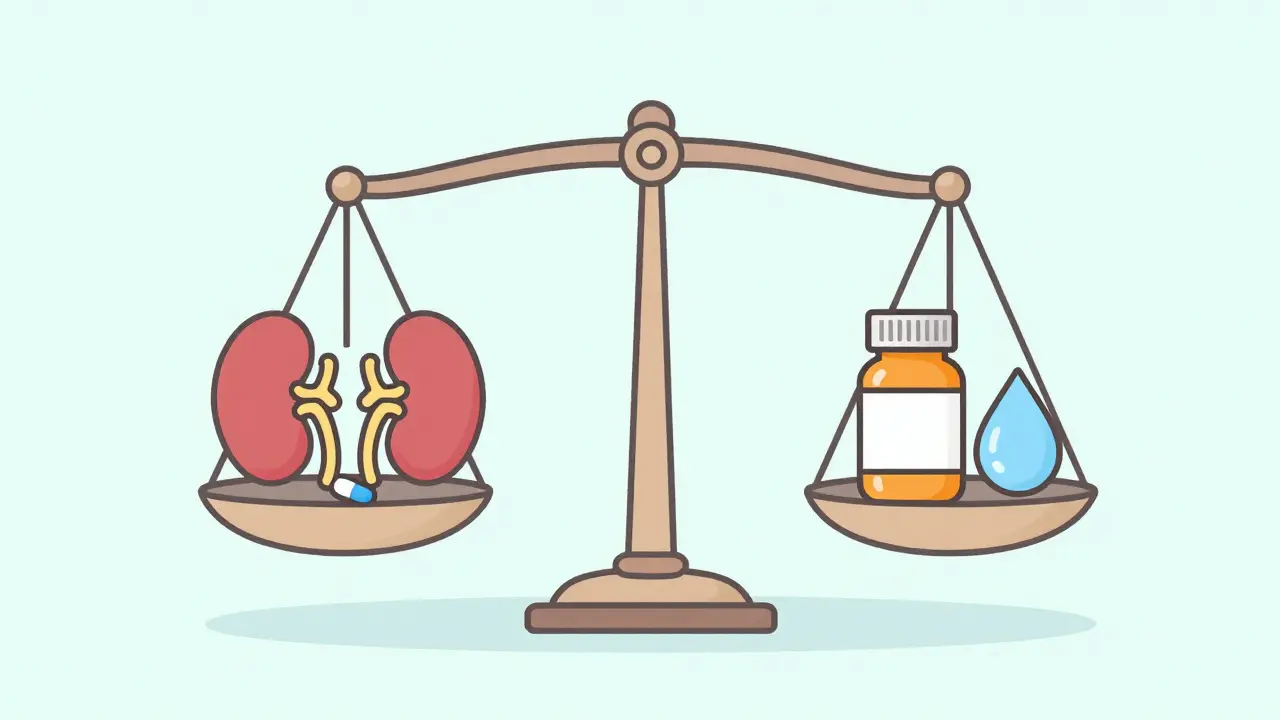
Mood Stabilizer Interaction Checker
When you're managing bipolar disorder, finding the right mood stabilizer isn't just about controlling highs and lows-it's about avoiding dangerous surprises. Lithium, valproate, and carbamazepine have been used for decades to stabilize moods, but their interactions with other medications can turn a safe treatment into a medical emergency. These aren't theoretical risks. Real people end up in the hospital because a simple painkiller, blood pressure med, or antibiotic changed how their mood stabilizer worked in their body.
Lithium: The Delicate Balance
Lithium doesn't get broken down by the liver. It leaves your body through your kidneys. That’s why anything that affects your kidneys or sodium levels can send lithium levels skyrocketing. A common NSAID like ibuprofen can raise lithium levels by 25-30% in just a few days. That’s enough to push someone from a safe 0.8 mmol/L to a toxic 1.3 mmol/L-enough to cause tremors, confusion, or even seizures.
Diuretics, especially thiazides, are another silent danger. They make your body hold onto sodium, which in turn makes your kidneys reabsorb more lithium. Patients on these combinations often need lithium dose reductions of 20-40%. ACE inhibitors like lisinopril do the same thing. Even mild dehydration from a stomach bug can trigger lithium toxicity. That’s why doctors tell you to drink water consistently-not to chug it, but to keep your sodium steady.
There’s no magic test for lithium sensitivity. But if your serum sodium drops below 135 mmol/L, your risk of toxicity goes up. And if you start feeling shaky, confused, or nauseous while on lithium, don’t wait. Get your blood checked immediately. The window between therapeutic and toxic is narrow: 0.6 to 1.2 mmol/L. That’s less than a teaspoon of salt in a bathtub of water.
Valproate: The Silent Thief
Valproate works differently. It’s mostly metabolized by the liver, but it doesn’t play nice with other drugs. It can make some medications build up in your system-especially lamotrigine. When you add valproate to lamotrigine, the lamotrigine level can double or even triple. That’s why someone on 400 mg of lamotrigine might suddenly need to drop to 200 mg once valproate is added. Miss that adjustment, and you risk a life-threatening rash called SJS.
But valproate isn’t just a thief-it’s also a target. Carbamazepine, a common seizure and mood stabilizer, speeds up how fast your body breaks down valproate. When taken together, valproate levels can fall by 30-50%. That means someone who was stable on 1,000 mg of valproate might suddenly start having manic episodes because their body is clearing it too fast. Doctors have to monitor levels closely when switching between these drugs or adding one to the other.
And there’s another layer: valproate binds tightly to proteins in your blood. When levels go above 100 mcg/mL, that binding gets unpredictable. Free (active) drug levels can spike even if total levels look normal. That’s why labs report both total and free valproate in complex cases. It’s not just about the number-it’s about what’s actually floating around in your bloodstream.
Carbamazepine: The Metabolism Mixer
Carbamazepine is a master manipulator. It doesn’t just affect other drugs-it changes how your own body handles it. In the first few weeks of treatment, your liver starts producing more enzymes to break it down. That’s called autoinduction. What started as a 40-hour half-life drops to 12-17 hours. That’s why people often feel worse at first-then better after a few weeks. But if you add valproate, everything flips.
Valproate doesn’t lower carbamazepine levels. It makes the toxic byproduct-carbamazepine-10,11-epoxide-build up. This metabolite is responsible for dizziness, balance problems, and confusion. Studies show it can rise 40-60% when valproate is added. So even if your carbamazepine level looks fine, you could still feel awful. That’s why some doctors check both the parent drug and the epoxide. The target for the epoxide? Below 3.5 mcg/mL. Anything higher, and you’re in danger zone.
Carbamazepine also speeds up the metabolism of many other drugs. Birth control pills? Their effectiveness can drop by 70%. That’s why women on carbamazepine need backup contraception. Antidepressants, antipsychotics like risperidone and haloperidol, even some cholesterol meds-all get cleared faster. You might think your meds are working fine, but your body is burning them off before they can do their job.
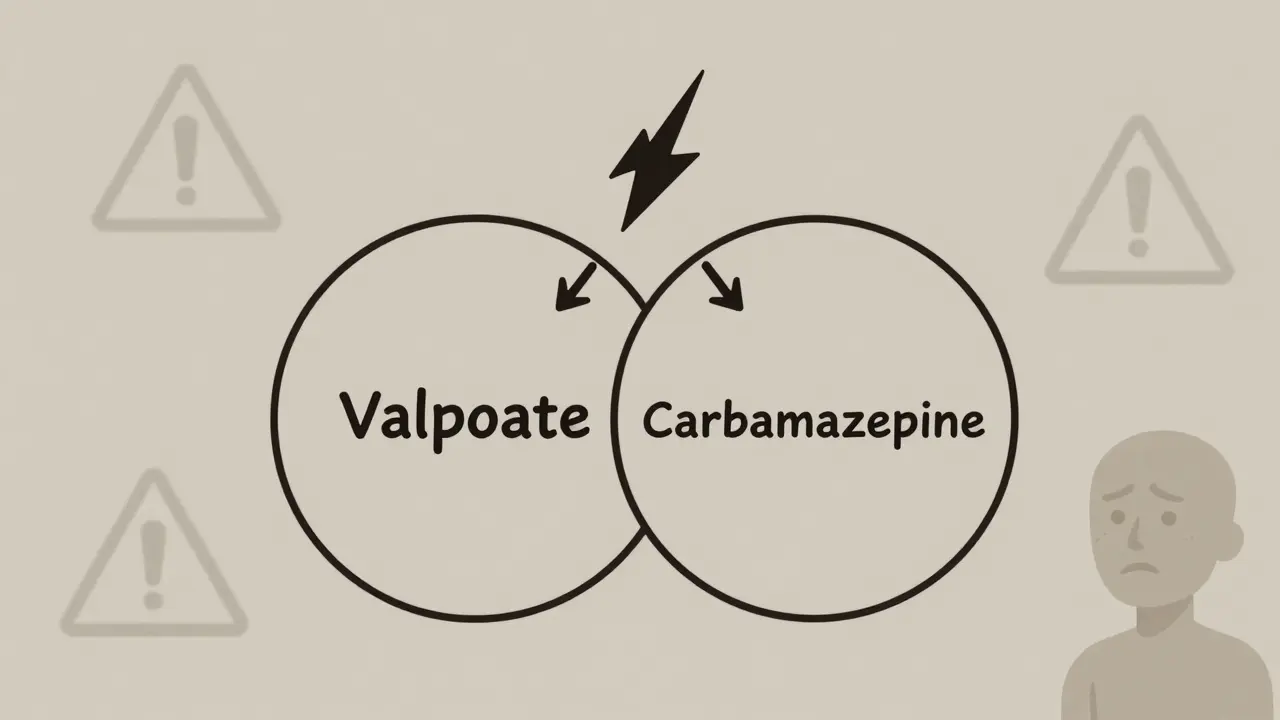
What Happens When You Mix Them?
Combining lithium and valproate is one of the few safe dual therapies for bipolar disorder. But even then, you need tight monitoring. Lithium levels can creep up slightly when valproate is added, though not as dramatically as with NSAIDs. Most patients tolerate this combo well if levels are checked weekly at first.
Valproate and carbamazepine? That’s the trickiest pair. The epoxide buildup can cause neurological side effects that mimic worsening bipolar symptoms. Patients often think they’re having a relapse, when really it’s a drug interaction. Dose reductions of carbamazepine by 25% are often needed when starting valproate. And even then, you need to check epoxide levels.
Lithium and carbamazepine? Less interaction than you’d think. Carbamazepine doesn’t affect kidney function, so lithium stays stable. But carbamazepine can still reduce the effectiveness of other meds you might be taking alongside lithium-like antidepressants or antipsychotics. That’s where things get messy. You might need higher doses of those other drugs, which increases side effect risks.
Real Stories, Real Risks
A woman in Wellington started taking ibuprofen for a headache while on lithium. Three days later, she couldn’t hold a cup without shaking. Her lithium level was 1.4 mmol/L. She spent a week in the hospital.
A man switched from carbamazepine to valproate for better mood control. His lamotrigine dose stayed the same. Two weeks later, he developed a rash that spread across his chest. He was diagnosed with Stevens-Johnson syndrome-a rare but deadly reaction.
A teenager on carbamazepine and birth control got pregnant. She didn’t realize the pill had stopped working. Her child was born with a neural tube defect.
These aren’t outliers. They’re textbook cases. The 2021 International Bipolar Foundation survey found 68% of lithium users needed dose changes when taking diuretics. 74% of psychiatrists say carbamazepine-valproate interactions are “moderately to severely problematic.”
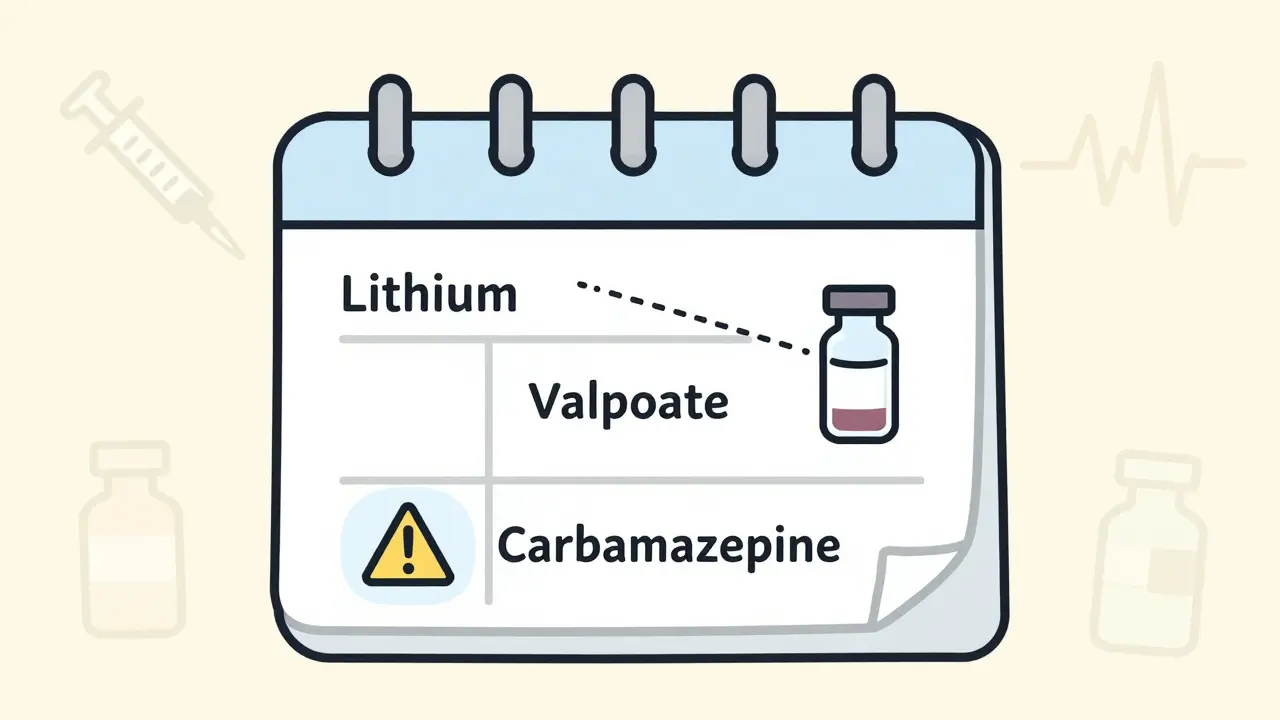
What You Can Do
Don’t stop your meds. But do this:
- Always tell every doctor-dentist, GP, specialist-that you’re on a mood stabilizer. Even if they don’t ask.
- Keep a list of every medication you take, including OTC painkillers, supplements, and herbal teas. St. John’s Wort can interfere with all three.
- Get blood tests before and after starting any new drug. Don’t wait for symptoms.
- If you’re on lithium, drink water daily. Avoid extreme salt loss (sweating, vomiting, diarrhea).
- If you’re on valproate and you’re a woman of childbearing age, talk to your doctor about alternatives. The risk of birth defects is real.
- If you’re on carbamazepine, use non-hormonal birth control. And never skip your level checks.
There’s no perfect mood stabilizer. But knowing how these three work-and how they fight with other drugs-can keep you safe. The goal isn’t just to feel better. It’s to stay alive while you do it.
What’s Changing in 2026
Doctors are starting to use genetic tests before prescribing carbamazepine. Some people have a gene variant that makes them break down the drug too fast-or too slow. That could explain why some people respond well and others don’t. By 2027, this may become standard.
New formulations are also helping. Extended-release lithium and microbead valproate give steadier blood levels, reducing spikes that cause interactions. But these aren’t magic bullets. Monitoring is still essential.
For now, the rule hasn’t changed: know your drugs. Know your body. And never assume a new pill is harmless just because it’s for something else.
Diana Stoyanova
Okay but can we talk about how wild it is that a simple ibuprofen can turn your mood stabilizer into a ticking time bomb? 🤯 I had no idea over-the-counter painkillers could do that. My cousin was on lithium and took Advil for a migraine-ended up in the ER with tremors and confusion. They didn’t even connect it until the bloodwork came back. Like… why isn’t this on every drug label? Why do we assume ‘OTC’ means ‘safe with everything’? It’s insane. We need better public awareness. Like, maybe a pop-up when you buy NSAIDs at the pharmacy: ‘HEY YOU’RE ON MOOD STABILIZERS? DON’T DO THIS.’
Elisha Muwanga
This article is dangerously irresponsible. It implies that psychiatric medications are inherently unstable and unpredictable, which only fuels stigma. The real issue is patients not following medical advice-not the drugs themselves. If people took their labs seriously and stopped self-medicating with ibuprofen and St. John’s Wort, none of this would be a problem. This kind of fearmongering makes people distrust their doctors. It’s not the science that’s flawed-it’s the narrative.
Maggie Noe
Y’all. I’m on valproate + lamotrigine. 😭 I had no clue my 300mg lamotrigine was basically a bomb waiting to go off until my doc switched me to valproate. I got the rash-thank god it was caught early. Now I carry a card in my wallet that says ‘ON VALPROATE + LAMOTRIGINE-DO NOT INCREASE LAMOTRIGINE.’ My pharmacist knows me by name. Also-St. John’s Wort is a TRAITOR. I tried it for ‘natural anxiety relief’ and nearly lost my mind. 🙈 Don’t be me.
Gregory Clayton
LMAO so let me get this straight-my psychiatrist wants me to avoid ibuprofen, but it’s totally fine to take 5 different psych meds that make me feel like a zombie? Also carbamazepine makes birth control useless?? My ex got pregnant on it and now she’s mad at ME because I didn’t ‘warn her’? Bro. This is why I hate doctors. They give you a list of 17 things you can’t do, then act like you’re the problem when you break one rule. I just wanna take a Tylenol and not die. Is that too much to ask?
Jacob Paterson
Let’s be real-90% of these ‘interactions’ happen because people are lazy. You don’t read the pamphlet. You don’t tell your dentist you’re on lithium. You pop a handful of herbal supplements because ‘it’s natural.’ Then you blame the medication. The system isn’t broken. People are. If you can’t be responsible enough to keep a list of your meds, maybe you shouldn’t be on them. I’ve been on carbamazepine for 12 years. Never had an issue. Because I read the damn label.
Jerian Lewis
It’s funny how people treat mood stabilizers like they’re magic bullets. They’re not. They’re tools. And like any tool, they require knowledge. I’ve been on lithium for 8 years. I know my sodium levels. I drink water. I get labs every 3 months. I don’t need a 10-page article to tell me not to take ibuprofen. I just need to remember to be careful. The real tragedy isn’t the interactions-it’s the people who think they’re too busy to care.
Patty Walters
just wanted to say i had the exact same thing happen with my cousin-ibuprofen + lithium = hospital. she didn’t even know she was taking it cause her mom gave her some for her period cramps. i made a printable list of meds to avoid with each stabilizer and gave it to my whole family. printed it on cardstock, laminated it. now i keep one in my purse and one in my car. if you’re on any of these, DM me and i’ll send you the template. it’s not rocket science, but it saves lives. 💙
Phil Kemling
There’s a deeper question here: why do we treat psychiatric meds like they’re separate from the rest of medicine? If you’re on blood thinners, you don’t take aspirin without asking. If you’re on insulin, you don’t binge sugar. But with mood stabilizers, we act like they’re ‘special’-like the rules don’t apply. Maybe it’s because we still don’t take mental illness seriously. We think it’s ‘just in your head,’ so the body’s chemistry doesn’t matter. But your brain is part of your body. And chemistry doesn’t care what you believe. The real revolution won’t be in new drugs-it’ll be in treating mental health like real health.