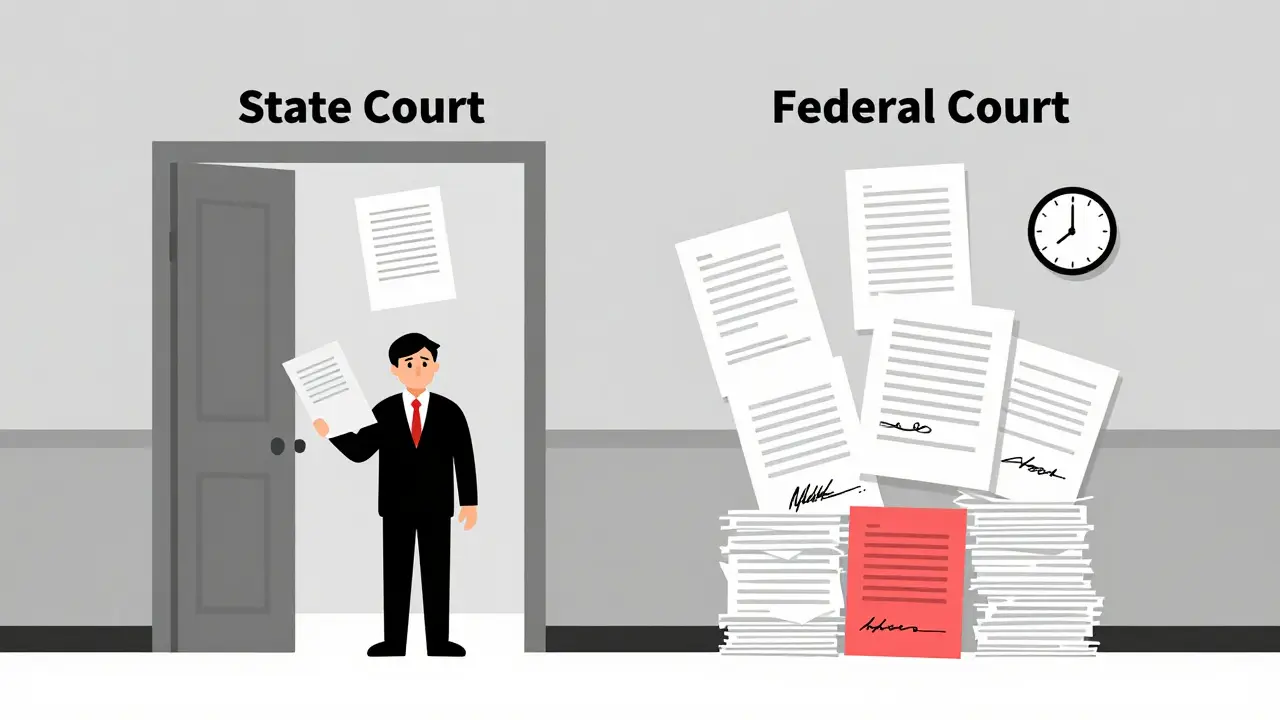
When you switch lawyers in the middle of a case, it might seem like a simple paperwork task. But if you're practicing in both state and federal courts, that simple change can blow up in your face. One court says you can swap attorneys with a signed form. The other demands a formal motion, signatures from three people, and a detailed explanation - all filed weeks in advance. And if you get it wrong? Your client’s case could be delayed, dismissed, or even lose its appeal rights. This isn’t hypothetical. In 2023, 17% of legal malpractice claims in the U.S. came from attorneys messing up substitution rules across jurisdictional lines.
Why This Isn’t Just a Paperwork Issue
The U.S. legal system is built on federalism. The Constitution gives states control over most civil procedures - including how lawyers can be replaced - while federal courts operate under their own rules. That means if you’re a lawyer handling a case in New York state court and then need to file a related motion in federal court, you’re not just dealing with two different courts. You’re dealing with two entirely different legal cultures. Federal courts prioritize control. They want to avoid last-minute changes that disrupt schedules, delay trials, or create confusion. State courts, on the other hand, often prioritize the client’s right to choose their own lawyer. This difference isn’t just theoretical. It’s written into the rules. And if you don’t know which set applies, you risk losing your client’s trust - and possibly your license.Federal Rules: Strict, Uniform, and Unforgiving
In federal court, substitution isn’t a formality. It’s a process. Federal Rule of Civil Procedure 83 requires a formal motion signed by three people: the outgoing attorney, the incoming attorney, and the client. Even if you’re switching to another lawyer in the same firm, you still need this motion. No exceptions. Some districts add their own layers. The Eastern District of New York, for example, requires all substitution requests to go through a magistrate judge via a letter motion. And while state courts might approve last-minute changes with a quick email, federal courts are strict. The Second Circuit rejected 31% of substitution motions filed within 30 days of trial in 2023. Why? Because they assume any last-minute change is a tactic to delay proceedings. There’s also the issue of qualifications. In federal tax court, Rule 83.12 demands proof that your new lawyer is authorized to practice before the IRS. In federal bankruptcy court, you might need to show they’ve completed specific continuing education. These aren’t just formalities - they’re gatekeepers.State Rules: A Patchwork of Freedom
Now contrast that with state courts. Here, the rules vary wildly - even within the same state. In Florida, the Supreme Court Rule 4-1.16(c) says the client has an absolute right to change lawyers. All you need is a signed form between the old and new attorneys. No court filing. No judge review. Just hand it in and move on. In Virginia, you don’t even need to file anything. The state’s Practice Guide 2024 explicitly says substitutions don’t require court approval - as long as both attorneys agree. Even in big states like California, Texas, and New York, 32 states allow substitutions without court approval at all. That’s zero federal circuits that do the same. In New Jersey, state courts require only 7 days’ notice. In Pennsylvania’s federal court? You need 14. And in Texas, Harris County requires electronic filings, while Brewster County still accepts paper forms. If you’re practicing in multiple counties, you’re playing a guessing game.
The Real Cost of Getting It Wrong
It’s not just about delays. It’s about money. Attorney Mark Reynolds from Chicago filed a substitution form using Illinois state rules - thinking it would work in federal court. The motion was stricken. His client’s case was put on hold. He lost $8,500 in wasted fees and had to refile everything. The LegalMalpractice.com database shows a 23% year-over-year increase in substitution-related claims between 2022 and 2024. And 68% of those cases involved lawyers applying state rules in federal court. That’s not ignorance. That’s systemic confusion. Even worse, the Federal Judicial Center found that 18% of all non-merits dismissals in pro hac vice admissions (when out-of-state lawyers appear in federal court) were due to substitution errors. That means attorneys were getting kicked out of cases not because they were unqualified - but because they didn’t know the rules.What Happens When State and Federal Rules Clash?
Here’s the legal hammer: the Supremacy Clause. Established in McCulloch v. Maryland (1819), it means federal law overrides state law when there’s a conflict. So even if your state lets you swap lawyers with a quick email, if you’re in federal court, you must follow federal rules. The U.S. Supreme Court confirmed this in United States v. Gonzalez (2023), ruling that federal courts have the inherent power to enforce stricter substitution rules than states. That means your state’s flexibility doesn’t protect you in federal court. The American Bar Association’s Formal Opinion 502 (March 2024) is even clearer: failing to follow federal substitution rules - even if state rules are looser - is professional misconduct under Model Rule 3.4. You could be disciplined. Your firm could be sued. Your reputation could take a hit.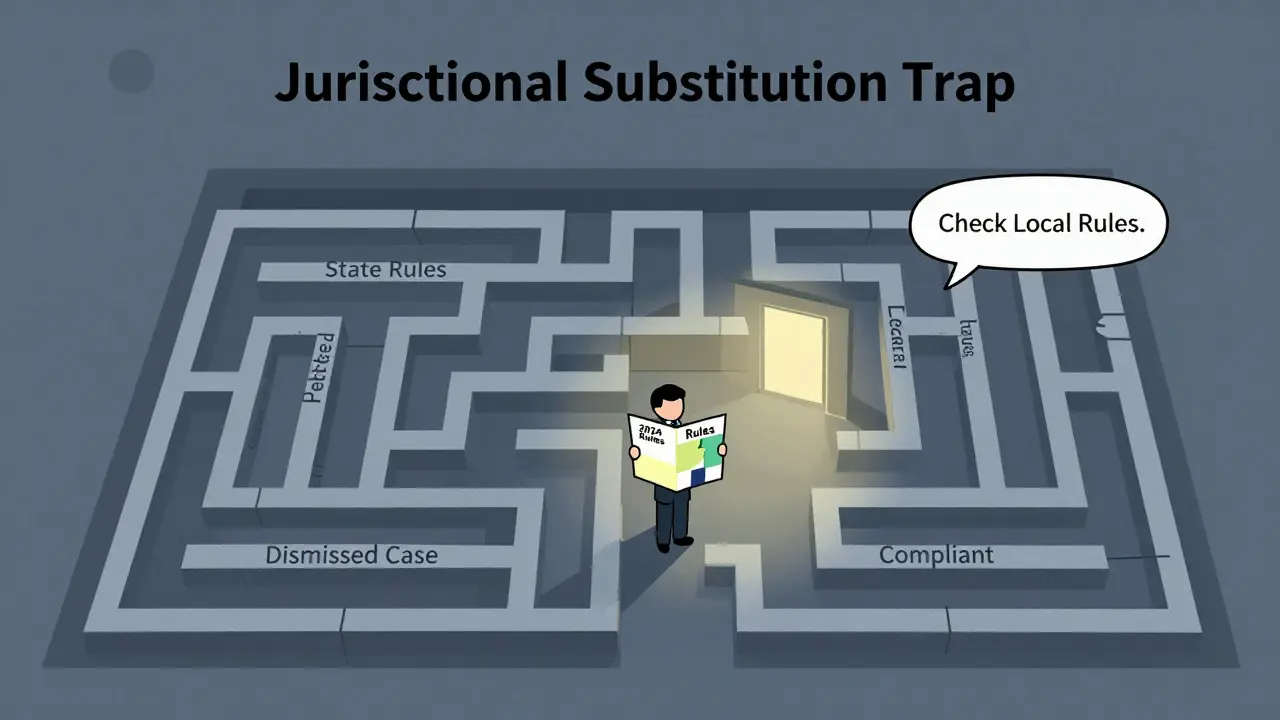
How to Avoid the Trap
The solution isn’t memorizing every state’s rules. It’s building systems. First, always check two places before filing a substitution:- Federal Rules of Civil Procedure, Rule 83 - the baseline
- Local rules of the specific federal district - these often add requirements
- Your state’s civil procedure code - not for what you can do, but to understand what you’re NOT allowed to assume
The Future: Will This Get Better?
The pressure to fix this is growing. The Bureau of Labor Statistics reports that 28% of attorneys now practice in both state and federal courts - up from 22% in 2020. That’s more than one in four lawyers navigating this minefield. The Uniform Law Commission is drafting the Interjurisdictional Legal Practice Act, set for final release in December 2025. It proposes common substitution standards across state and federal systems. If adopted, it could end the patchwork. Meanwhile, the Federal Rules Advisory Committee is considering amendments for 2026 - including standardized electronic filing and clearer emergency substitution rules. Some federal districts are already piloting faster processes. The Administrative Office of U.S. Courts launched a pilot in 12 districts in January 2025, cutting processing time by 15%. But until then, the risk remains. The RAND Institute for Civil Justice predicts substitution-related errors will cost the legal system $417 million annually by 2030 if nothing changes.Bottom Line: Know Your Court
Switching lawyers isn’t just about trust or chemistry. It’s about procedure. And procedure is jurisdictional. If you’re in federal court, federal rules apply - no matter what your state allows. If you’re in state court, follow your state’s rules - but never assume they’ll work in federal court. The difference between a smooth substitution and a disaster isn’t experience. It’s awareness. One form. One signature. One missed deadline. That’s all it takes.Don’t guess. Don’t assume. Don’t rely on what worked last time. Check the rules. Every time.
Josiah Demara
Let me get this straight - you’re telling me lawyers are getting sanctioned because they didn’t read the fine print in federal rules? This isn’t incompetence, it’s negligence wrapped in a law degree. The fact that 17% of malpractice claims stem from this is a national disgrace. No one is teaching this in law school? No one is running mandatory CLEs on jurisdictional substitution? The system is rotting from the inside, and we’re still pretending it’s just a paperwork issue. It’s a failure of institutional training, and it’s costing clients their livelihoods. Fix this or shut it down.
Kaye Alcaraz
Thank you for this incredibly clear breakdown. As someone who works with cross-jurisdictional clients, I’ve seen firsthand how easily a simple substitution can unravel a case. The key is not just knowing the rules - it’s building systems to enforce them. I’ve implemented dual templates in my firm, and our error rate dropped by over 50%. Consistency beats memorization every time. If you’re reading this and not already using a checklist, start today. Your future self will thank you.
Charlotte Dacre
Oh wow. So the federal courts are the strict, rigid, bureaucratic overlords while the states are just chill, ‘do what feels right’ hippies? That’s not federalism - that’s chaos with a robe. I bet the judges in the Eastern District of New York have a whole shrine to Rule 83. Maybe they light candles before filing motions. At least in the UK, we just send a polite email and move on. No drama. No three signatures. Just… professionalism.
Esha Pathak
Law is not just rules - it is the mirror of society’s soul. In federal courts, we see control as virtue; in state courts, we see autonomy as sacred. This is not a technical glitch - it is a metaphysical divide. Who are we to say one soul is more valid than another? The Supremacy Clause is not a weapon - it is a wound in the body of American justice. We must heal the fracture, not enforce it. The client’s right to choose - is that not the highest law? Or is it just a footnote in a PDF?
Kapil Verma
India has 28 high courts and 700+ district courts - and we still manage to have a unified procedure. You Americans can’t even agree on how to change a lawyer? Pathetic. You have a Constitution, a Supreme Court, a federal system - and you’re still lost in paperwork. This isn’t complexity - it’s incompetence. You call this democracy? This is chaos with a judge’s gavel. Fix your system before you lecture the world.
Betty Kirby
Let’s be real - if you’re a lawyer who can’t handle substitution rules, you shouldn’t be practicing. This isn’t rocket science. It’s a form. Three signatures. A deadline. If you’re too lazy to check the local rules, then your clients deserve to lose. 68% of claims are from people who assumed state rules apply in federal court? That’s not ignorance - it’s arrogance. And now you want a federal law to fix your laziness? No. Make lawyers do their damn homework.
Erica Banatao Darilag
i just wanted to say thank you for writing this. i’m a paralegal and i’ve seen so many cases derailed because someone thought ‘it worked last time’ so it’d work again. i’ve had to fix submissions where the motion was filed 3 days before trial and the judge just threw it out. it’s heartbreaking for the clients. i’ve started making a printed checklist for every new case now - state vs federal, district, clerk contact info. it’s small, but it helps. thank you for the reminder.
Chiruvella Pardha Krishna
The real tragedy is not the rules - it is the silence. Lawyers who do not know the difference between state and federal substitution are not outliers. They are the norm. And no one speaks of it. The profession protects its own. We celebrate the courtroom orators, the high-profile litigators - but we bury the quiet failures. The ones who lost cases because they didn’t check a local rule. No one writes a book about them. No one gives them a TED talk. They just vanish. And the system keeps turning.
Joe Grushkin
Oh look, another article that treats federal courts like some sacred temple of procedure. Newsflash - federal judges are just bureaucrats with better robes. They don’t care about your client. They care about their calendar. And you’re telling me we need a new federal law to fix this? How about we just abolish the entire patchwork and go with one rule? The Constitution didn’t create 94 different rulebooks. We’re the ones who did. And now we’re crying about it. Pathetic.
Virginia Kimball
Y’all are overcomplicating this. I’ve been doing this for 12 years. Every time I switch lawyers, I just call the court clerk. Always. No guesswork. No stress. They’re usually super nice and tell you exactly what you need. And if you’re using Clio or any decent case management tool? It flags the rule mismatch before you even hit send. This isn’t a crisis - it’s a habit problem. Stop assuming. Start asking. It’s that simple. And yes - I’m still a lawyer who believes in kindness. You can be competent AND human.
Michael Page
The system is a mirror. Federal courts demand control because they fear unpredictability. State courts embrace flexibility because they recognize human imperfection. We are not meant to be perfect. We are meant to adapt. The real question is not whether the rules are right - but whether we are willing to change how we think about them. Law is not a machine. It is a conversation. And right now, we are shouting past each other.
Mandeep Singh
Let me break this down for you, because clearly you didn’t read the fine print - and I’m not surprised. The Federal Rules of Civil Procedure Rule 83 is not a suggestion. It’s a mandate. The 31% rejection rate in the Second Circuit? That’s not arbitrary - that’s a warning shot fired across the bow of every half-assed attorney who thinks state rules are interchangeable. And you want to know what’s worse? The 23% YoY increase in claims? That’s not a spike - that’s a tsunami. You think Clio fixes this? No. It just tells you you’re wrong. It doesn’t teach you. It doesn’t train you. It doesn’t replace the missing education. You’re not just losing cases - you’re losing credibility. And the legal profession? It’s watching. And it’s judging. And you? You’re still scrolling through your phone thinking ‘it’ll be fine.’ It won’t be. It never is.