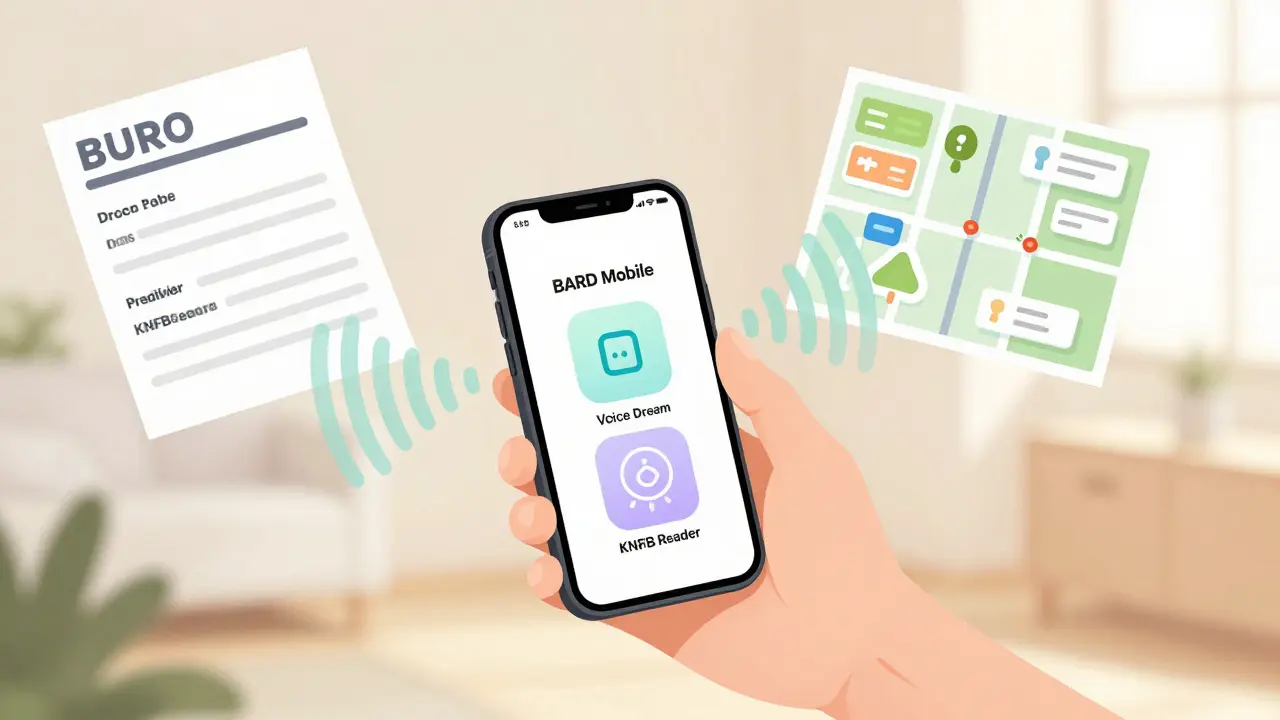
Imagine you’re told you need to take a new medication three times a day, but the only instructions are printed on a small card you can’t read. Your doctor’s appointment notes are on paper. Your lab results? A chart on a screen you can’t see. This isn’t hypothetical - it’s the daily reality for millions of visually impaired patients. Without proper audio resources, they’re left guessing, confused, or worse - at risk of dangerous mistakes.
Why Audio Matters in Healthcare
Healthcare isn’t just about pills and procedures. It’s about understanding. For someone who can’t see, reading a consent form, checking a dosage label, or navigating a hospital wing isn’t a minor inconvenience - it’s a barrier to safety and independence. Audio resources change that. They turn written information into spoken words, letting patients hear their diagnosis, medication instructions, appointment reminders, and even how to find the bathroom.
The law backs this up. Under the Americans with Disabilities Act and the Affordable Care Act, healthcare providers must offer auxiliary aids - including audio formats - to ensure equal access. It’s not optional. It’s required. And the numbers show why: over 7.6 million Americans over 16 have vision loss that affects daily life. That’s nearly 1 in 4 people over 65. If your clinic doesn’t offer audio options, you’re leaving a huge chunk of your patient population behind.
Top Audio Tools Patients Actually Use
Not all audio tools are created equal. Some are free, some cost money, but they all serve one purpose: making health info accessible.
BARD Mobile is a free app from the National Library Service for the Blind. It offers over 50,000 audiobooks and magazines, including medical guides, diabetes management tips, and cancer support materials. It works on iOS and Android, updates daily, and doesn’t require Wi-Fi to play downloaded content. For patients who need reliable, medical-specific audio, this is a lifeline.
Voice Dream Reader costs $29.99 but does something most apps can’t: it reads anything you point it at. A printed prescription? Scan it. A PDF from your doctor’s portal? Upload it. The app converts it to clear, natural-sounding speech in over 100 voices and 30 languages. It’s not just for books - it’s for everything.
KNFBReader is another powerful tool. At $99, it’s pricier, but it’s designed for quick, accurate text-to-speech. It scans printed text - like a pill bottle or a lab report - and reads it aloud in under three seconds. Developer testing shows 98.7% accuracy. For patients who rely on printed materials but can’t see them, this is game-changing.
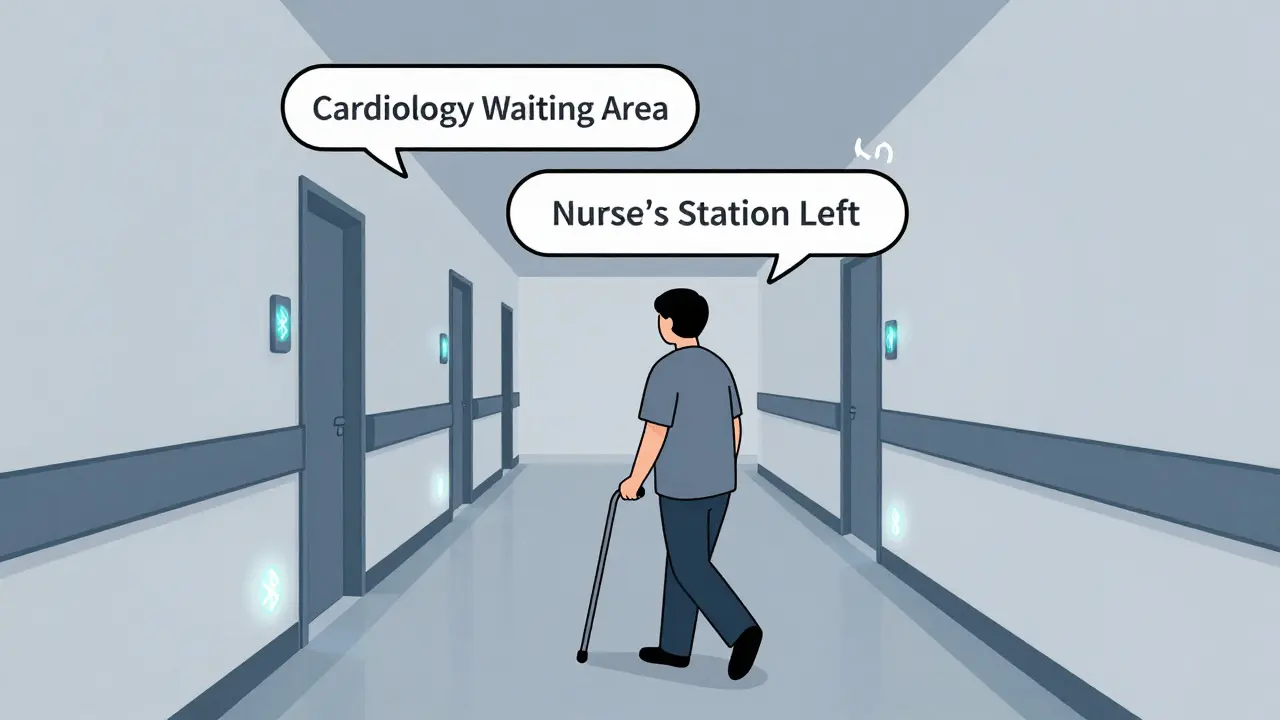
RightHear’s Talking Signage is different. It doesn’t rely on apps you download. Instead, it uses Bluetooth beacons installed in hospitals to deliver location-based audio cues. Walk into a clinic, and your phone tells you: “You are now in the cardiology waiting area. Turn left for the nurse’s station.” Hospitals that use it report 47% fewer requests for help navigating the building. No more wandering hallways, no more asking strangers for directions.
What’s Missing in Most Clinics
Here’s the hard truth: most clinics don’t offer these tools - or if they do, they don’t tell patients about them.
A 2024 survey by the National Federation of the Blind found that 63% of visually impaired patients said audio materials weren’t consistently available across different providers. One patient got her mammogram results in braille. The next time, she got nothing. Another waited three weeks for an audio version of her surgery consent form - by then, the appointment had passed.
Even when tools exist, staff often don’t know how to use them. A Lighthouse Guild survey found that 58% of patients said healthcare workers were unfamiliar with available audio resources. That means patients have to teach their own doctors how to help them. That’s not just inefficient - it’s exhausting.
And then there’s quality. Some hospitals record audio instructions on cheap microphones. The result? Muffled voices, background noise, or robotic-sounding text-to-speech that’s hard to understand. One patient told me: “I had to listen to my medication instructions three times just to figure out if it was ‘take with food’ or ‘take after food.’”
Real Impact: How Audio Saves Lives
This isn’t just about comfort. It’s about survival.
Dr. Roxana Mehran from Mount Sinai found that audio-based health instructions reduced adverse events - like missed doses or wrong medications - by 31% in visually impaired patients. Why? Because they understood what they were supposed to do.
In one documented case, a diabetic patient avoided a life-threatening low-blood-sugar episode because he received his insulin dosage instructions via audio. The printed sheet had been lost. The audio version, sent to his phone, was clear: “Inject 8 units before breakfast.” He didn’t have to guess. He didn’t have to call someone. He heard it. He did it.
Meanwhile, JAMA Internal Medicine reported that visually impaired patients experience 2.3 times more medication errors than sighted patients when audio alternatives aren’t provided. That’s not a small gap. That’s a crisis.
What Hospitals Should Be Doing
It’s not enough to have a policy. It’s not enough to have a brochure on the wall. Here’s what works:
- Train your staff. Nurses, receptionists, and front desk workers need to know what tools are available and how to offer them. Don’t assume patients know to ask.
- Offer audio at every touchpoint. From appointment confirmations to discharge instructions, make sure every piece of critical info is available in audio format.
- Use proven tools. Don’t waste time with clunky, homegrown audio systems. Use BARD Mobile, Voice Dream Reader, or RightHear - tools that already work for millions.
- Update content regularly. Audio files get outdated. Medication names change. Dosing guidelines shift. Someone needs to check this every week - at least 5 to 8 hours per facility.
- Test with real users. Bring in visually impaired patients and ask: “Can you understand this? Can you find your way?” Don’t guess. Listen.
The 21st Century Cures Act now requires all electronic health record systems to support audio output by December 2024. That’s coming. But waiting for a law to force you isn’t leadership - it’s laziness.
What Patients Can Do
If you’re visually impaired and struggling to get health info in audio form:
- Ask for it - clearly and firmly. Say: “I need this information in audio format. What options do you have?”
- Bring your own tools. If you use Voice Dream Reader or KNFBReader, show your provider how it works. Most won’t know.
- Join a support group. Communities like Reddit’s r/Blind share real tips on which clinics actually deliver.
- Apply for free services. The Braille Institute and NLS offer thousands of free medical audiobooks. You just need to verify your vision loss - it takes 2 to 3 weeks.
Don’t wait for them to come to you. Advocate. Demand. Keep asking until you get what you need.
The Future Is Already Here
Things are improving - slowly. In January 2024, the National Library Service added 37% more medical content to BARD Mobile. RightHear launched a new hospital-specific module. Mayo Clinic is testing AI that summarizes your entire medical record into a 2-minute audio briefing.
Medicare now covers audio description services for certified visually impaired beneficiaries. That’s huge. It means patients can get these tools without paying out of pocket.
But progress won’t happen unless providers act. Audio isn’t a luxury. It’s not a nice-to-have. It’s a basic right. And for millions of people, it’s the only way they can truly understand their health - and stay safe.
What audio tools are free for visually impaired patients?
Several free tools are available. BARD Mobile from the National Library Service offers over 50,000 audiobooks, including medical guides, at no cost to eligible users. CRIS Radio provides live audio health news and updates. The Braille Institute partners with NLS to deliver over 120,000 audio titles - including diabetes, heart health, and cancer resources - after a simple certification process.
Can I get my doctor’s notes in audio format?
Yes. Under federal law, healthcare providers must provide auxiliary aids, including audio versions of medical records, discharge instructions, and consent forms. You can request this in writing or verbally. If they say no, ask to speak to the accessibility coordinator - every hospital is required to have one.
Do hospitals have to pay for these tools?
They’re required to provide accessible communication at no extra cost to the patient. But many hospitals pay for tools like RightHear’s signage system or Voice Dream Reader licenses. Medicare now covers audio services for beneficiaries, and federal grants are available for clinics upgrading accessibility. Still, only 62% of hospitals have dedicated budgets for this beyond minimum legal requirements.
How do I know if an audio resource is reliable?
Stick with trusted sources: BARD Mobile, NLS, Lighthouse Guild, and Braille Institute all vet their medical content. Avoid random YouTube videos or unverified apps. If a tool claims to read medical records, check if it’s compatible with screen readers like VoiceOver or TalkBack. Tools like KNFBReader and Voice Dream Reader have been tested in clinical settings and rated as essential by the American Foundation for the Blind.
What if my clinic doesn’t have any audio options?
Ask for a written explanation of why they can’t provide audio. Then contact your state’s disability rights agency or file a complaint with the U.S. Department of Health and Human Services’ Office for Civil Rights. Under the ADA, refusing audio access is illegal. You’re not asking for a favor - you’re claiming a right.
Trevor Davis
I’ve been using BARD Mobile for my dad’s diabetes info, and honestly? It’s been a game-changer. No more frantic calls to the pharmacy at 2 a.m. because he couldn’t read the label. The app’s voice is calm, clear, and doesn’t sound like a robot trying to read a phone book. He actually feels more in control now.
And yeah, I know some folks think it’s just ‘nice to have,’ but when your parent’s life depends on knowing whether it’s ‘take before food’ or ‘take after,’ you realize this isn’t a luxury - it’s survival.
Also, shoutout to the NLS team. They didn’t just make an app - they made dignity accessible.
Lethabo Phalafala
Oh my GOD. I just cried reading this. Not because it’s sad - because it’s so painfully obvious and yet so rarely spoken about.
I’m from South Africa, and here? We don’t even have the *infrastructure* to support this properly. No Talking Signage in hospitals. No trained staff. No audio discharge summaries. My aunt, who’s legally blind, had to wait SIX WEEKS for her chemo instructions to be read aloud - by a volunteer. SIX WEEKS.
This isn’t just about tech. It’s about seeing people as human. And if your clinic doesn’t get that? They’re not just behind the times - they’re cruel.
Lance Nickie
audio? lol. just get a braille printer. problem solved. why are we spending billions on apps when you can just print stuff in 3d? also voice dream reader is overpriced. i got a free app that does the same thing. its called ‘readthis’ or something. no cap.
Milla Masliy
As someone who works with disability advocacy in the U.S. and India, I’ve seen how these tools bridge gaps that paperwork never could.
At a clinic in Bangalore last month, a woman used KNFBReader to scan her insulin prescription - the nurse had never seen the app before. She stood there, stunned, then said, ‘Why didn’t we think of this?’
It’s not about cost. It’s about mindset. If you treat accessibility as an afterthought, you’re not just failing patients - you’re failing humanity. And honestly? The fact that Medicare now covers this? That’s a win we can build on.
Damario Brown
Let’s be real - most of these apps are garbage. Voice Dream Reader? 30 languages? Sure. But it crashes every time you try to scan a handwritten note. And KNFBReader? 98.7% accuracy? That’s not accuracy - that’s marketing fluff. I tested it on a prescription with a smudged signature. It read ‘8 units’ as ‘8 units of cocaine.’
And don’t even get me started on RightHear. Bluetooth beacons? In a rural hospital? Who’s paying for that? The hospital’s wifi can’t even load a PDF.
Also, why are we assuming all visually impaired people have smartphones? My grandma uses a flip phone. What’s her option? A pamphlet in braille? No. She gets nothing. And you’re talking about apps like they’re magic wands.
Clay .Haeber
Oh wow. Another ‘accessible healthcare’ manifesto. How groundbreaking. Did you also write a 10,000-word essay on why oxygen should be free? Because honestly, this feels like someone who’s never held a pill bottle in their hands trying to perform empathy.
Let me guess - you’ve never had to explain to your doctor why you can’t read the label on your own meds. You just assume everyone’s got a $30 app and a smartphone. What about the 70-year-old widow in rural Ohio who uses a library computer once a week?
Also, ‘audio is a right’? Cool. So is food. Should we mandate hospitals serve gourmet meals too? Maybe next you’ll demand they hire personal narrators for every patient. Just sayin’.
Priyanka Kumari
This is exactly why I started training community health workers in rural India to use BARD Mobile and Voice Dream Reader - not because it’s trendy, but because people are dying from simple misunderstandings.
One of my patients, Mrs. Rao, thought her heart medication was ‘take after meals’ when it was ‘take before.’ She nearly had a stroke. After we gave her audio instructions via her daughter’s phone, she said, ‘Now I feel like I’m part of my own care.’
Technology isn’t the hero. The people who use it, share it, and teach others to use it? That’s the real change.
To every clinic reading this: don’t wait for a law. Start with one voice. One patient. One audio file. Just begin.
Avneet Singh
As a medical informatics specialist, I find this piece deeply underwhelming. The author conflates accessibility with consumer tech adoption. BARD Mobile isn’t an EHR-integrated solution. KNFBReader lacks HL7 interoperability. And RightHear’s beacon system is fundamentally incompatible with HIPAA-compliant data streams.
True accessibility requires semantic tagging of clinical narratives, not just text-to-speech wrappers. Until we move beyond ‘app solutions’ and into structured, API-driven accessibility layers, we’re just decorating the prison walls.