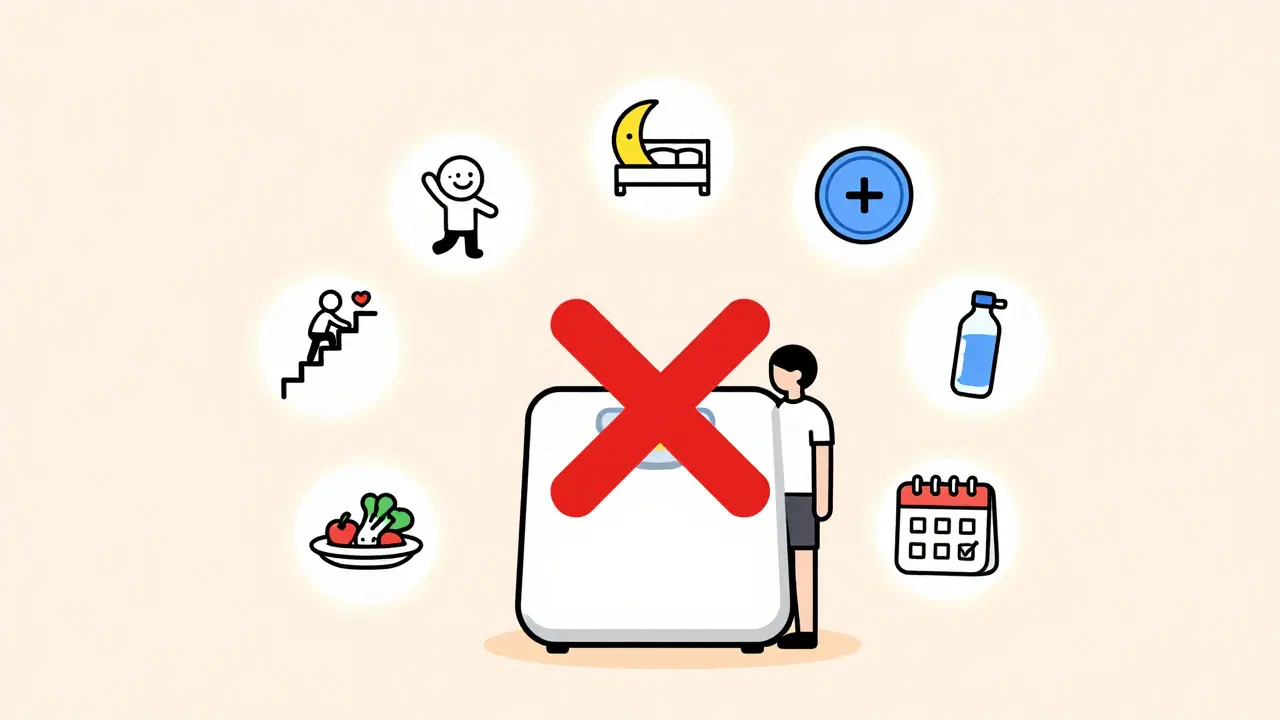
What if the number on the scale doesn’t tell you the whole story? You’ve been eating better, moving more, sleeping deeper-and yet, the scale hasn’t budged. Maybe it went up. Maybe it stayed the same. And suddenly, you feel like you’re failing. But here’s the truth: non-scale victories are often the real signs you’re healing your body, not just losing pounds.
Why the Scale Lies to You
The scale measures total weight-not muscle, not fat, not water, not inflammation. It doesn’t know if you’ve lowered your blood sugar, slept through the night, or stopped reaching for snacks when you’re stressed. It just gives you a number, and that number can swing up or down by 2 to 5 pounds in a single day because of what you ate, how much water you drank, or even your menstrual cycle. A 2023 study from Mather Hospital found that daily weight fluctuations are mostly caused by sodium intake, hydration levels, and hormonal shifts-not fat loss. That means if you’re only watching the scale, you’re ignoring 90% of what’s actually changing in your body. And here’s the kicker: people who fixate on the scale are more likely to quit. A National Institutes of Health review showed that patients in weight management programs who focused only on weight loss reported higher stress, lower motivation, and worse long-term outcomes than those who tracked other improvements.What Counts as a Non-Scale Victory?
Non-scale victories are real, measurable changes that have nothing to do with pounds. They’re the quiet wins that build lasting health. Here’s what they look like in real life:- Physical function: You can climb a flight of stairs without stopping. You no longer need a seatbelt extender on planes. You can tie your shoes without bending over awkwardly.
- Energy and sleep: You wake up without hitting snooze. You don’t need caffeine after 2 p.m. You fall asleep faster and stay asleep longer.
- Digestion and comfort: Bloating is gone. You’re regular without relying on supplements. Your stomach doesn’t feel tight after meals.
- Clothing fit: Your jeans feel looser. Your favorite shirt buttons easily. You can buy clothes without checking the size tag.
- Lab results: Your blood pressure dropped. Your HbA1c improved. Your cholesterol numbers are in a healthier range.
- Emotional well-being: You feel less anxious about food. You eat when you’re hungry, stop when you’re full. You no longer punish yourself for eating a cookie.
- Behavioral changes: You cook dinner at home four nights a week. You drink water instead of soda. You walk after meals instead of scrolling on your phone.
How to Start Tracking Non-Scale Victories
If you’ve only ever tracked weight, this might feel strange. But tracking non-scale victories is simple. Start with one area that matters most to you. Step 1: Pick one domain. Choose from:- Physical function (movement, strength, endurance)
- Energy and sleep
- Emotional relationship with food
- Lab markers (if you’re working with a doctor)
- Specific: “I want to walk more” → “I will walk 20 minutes after dinner, 5 days a week.”
- Measurable: Use a calendar, app, or journal to check it off.
- Achievable: Don’t start with a 5K if you haven’t walked 10 minutes in a year.
- Relevant: Does this matter to your health goals?
- Time-bound: “This week,” “next month,” “in 90 days.”
- What you did
- How you felt
- When you noticed the change
Why This Works Better Than Weight Loss
Weight loss is a result, not a behavior. You can’t control weight directly-you control what you eat, how you move, how you sleep, and how you manage stress. Non-scale victories focus on the behaviors that lead to lasting change. When you celebrate cooking at home instead of obsessing over a 1-pound loss, you’re more likely to keep doing it. When you feel proud of sleeping 7 hours straight, you’ll protect that habit-even if the scale doesn’t move. A 2023 report from Dietitians On Demand found that patients who tracked non-scale victories were 3 times more likely to stick with their nutrition plan after 6 months than those who focused only on weight. Why? Because they saw progress every day-not just once a week on the scale.What About Body Composition?
You might hear that “muscle weighs more than fat,” so the scale can’t be trusted. That’s true-but it’s not the full picture. Muscle gain is great. But you don’t need a DEXA scan to know you’re building strength. If you can carry groceries without groaning, lift your kid more easily, or hold a plank for 30 seconds instead of 10-you’re getting stronger. That’s progress. Same with fat loss. You might not lose weight, but if your waistband feels looser, your belly doesn’t ache after meals, or you no longer feel dizzy after standing up-you’re losing visceral fat. That’s the kind that harms your heart and liver. And that’s far more important than a number on a scale.When the Scale Still Matters
Non-scale victories don’t mean you should ignore the scale forever. For some people-especially those with diabetes, thyroid issues, or severe obesity-the scale is a useful tool when used correctly. The key is balance. Don’t weigh yourself daily. Weigh once a week, same day, same time, same clothes. Then ask: “What else changed this week?” If your weight dropped and your energy improved? Great. If your weight stayed the same but you started walking every day and sleeping better? That’s still a win.
Real Stories, Real Change
One patient, a 58-year-old woman with prediabetes, didn’t lose weight for 5 months. But she started cooking meals at home, stopped drinking soda, and walked 15 minutes after dinner. Her HbA1c dropped from 6.2 to 5.6. She no longer needed her blood sugar monitor. She could play with her grandkids without getting winded. She didn’t care about the scale. She cared about being there for her family. Another man, 42, struggled with anxiety and late-night snacking. He started journaling his meals and noticed he ate when he was bored, not hungry. He began reading before bed instead. His sleep improved. His mood lifted. His weight didn’t change much-but his life did. These aren’t outliers. They’re the norm when people stop measuring success in pounds.What to Do When You Feel Stuck
If you’re not seeing any non-scale victories yet, ask yourself:- Have I changed one habit for at least 2 weeks?
- Am I drinking more water than I used to?
- Have I slept more than 6 hours on average this week?
- Did I eat a meal without guilt?
Final Thought: Your Body Isn’t a Machine
Your body isn’t a calculator. It doesn’t respond to inputs with predictable outputs. It’s alive. It adapts. It heals. It responds to sleep, stress, movement, connection, and joy-not just calories in and calories out. Non-scale victories remind you that health isn’t about fitting into a size. It’s about feeling strong, calm, energized, and free. So stop waiting for the scale to give you permission to celebrate. You’ve already won.What are the most common non-scale victories people experience?
The most common non-scale victories include clothes fitting better, having more energy throughout the day, sleeping more deeply, no longer needing medication for blood pressure or blood sugar, being able to climb stairs without getting winded, and feeling less anxious about food. Many people also report improved digestion, reduced bloating, and increased strength during physical activity-even if their weight hasn’t changed.
Can you lose fat without losing weight?
Yes. When you build muscle and lose fat at the same time, your weight may stay the same or even go up slightly. But your body composition improves-your waist shrinks, your strength increases, and your metabolic health gets better. This is why measuring waist circumference, energy levels, and lab results like cholesterol and blood sugar is more meaningful than weight alone.
How often should I track non-scale victories?
Track them weekly. Pick one or two victories to focus on each week and write them down. Don’t overcomplicate it. The goal isn’t perfection-it’s awareness. Over time, you’ll start noticing patterns: what habits lead to better sleep, more energy, or less cravings. That’s where real change happens.
Why do some people say non-scale victories are just excuses?
People who say this often haven’t experienced the emotional toll of weight-focused diets. They may believe that if you’re not losing weight, you’re not trying hard enough. But research shows that focusing on behavior-like eating more vegetables, moving daily, or managing stress-leads to better long-term health than chasing a number on the scale. Non-scale victories aren’t excuses; they’re evidence of real progress.
Do doctors recognize non-scale victories?
Yes. Registered dietitians, endocrinologists, and primary care providers increasingly use non-scale victories to assess patient progress. For example, improved HbA1c levels, reduced blood pressure, or better cholesterol numbers are standard clinical markers that reflect health improvements-even without weight loss. The NIH and major health organizations now support this approach as part of patient-centered care.
Jennifer Phelps
I used to weigh myself every morning like it was my job and now I don't even own a scale
My jeans fit better my energy is up and I actually sleep through the night
Who needs a number when you feel this alive
beth cordell
YES YES YES 🙌
My HbA1c dropped last month and I cried happy tears
I didn't lose a pound but I can now chase my toddler without gasping
Non scale victories are the real magic 💪❤️
Rinky Tandon
Look I get it but let's be real here
You're just sugarcoating failure
If you're not losing weight you're not doing it right
And no your 'energy boost' doesn't count if your waistline didn't shrink
Stop lying to yourself this is why obesity is an epidemic
Cassie Widders
I started tracking my walks after dinner last month
Used to sit on the couch scrolling till midnight
Now I'm out there breathing air and watching the sunset
Didn't care about the scale
But I noticed I stopped needing antacids after dinner
That was the win
Prachi Chauhan
The scale is a relic of industrial capitalism disguised as health
It reduces the sacred mystery of the human body to a single digit
We've been conditioned to believe that value equals quantity
But your worth isn't measured in pounds or kilos
It's in the way you breathe after climbing stairs
The way you laugh without guilt after eating dessert
The quiet dignity of choosing rest over punishment
Health is not a metric
It's a relationship
With your body
With your time
With your soul
And that relationship can't be quantified
Only felt
Only honored
Only lived
Craig Wright
As a British man who has seen decades of health fads I can say this
People in America have turned wellness into a religion
Non-scale victories sound nice but they're just excuses for laziness
Weight loss is the only true indicator of discipline
And if you're not losing weight you're not trying hard enough
Get real
Lauren Warner
Prachi you sound like you're trying to justify your own failure
And Craig you're still stuck in the 90s
Lauren here
Let me break this down for you
1. The NIH study you're quoting has a sample size of 300 and was funded by a wellness startup
2. Muscle gain doesn't automatically mean you're healthier if your visceral fat is still rising
3. If your HbA1c improved but your BMI is 35 you're still at risk
4. Celebrating non-scale victories is dangerous if it lets people ignore real metabolic damage
5. You're not healing your body if you're still eating processed sugar daily
Stop romanticizing mediocrity
Progress is measurable
And it starts with weight loss
Ben Kono
My wife stopped weighing herself last year
She started cooking and walking and now she can carry groceries one handed
She didn't lose weight
But she stopped taking blood pressure meds
And she hugs me longer now
So yeah I think we're doing something right
And if the scale says different I don't care