Orange Book TE Code Checker
Check Therapeutic Equivalence Code
Enter a TE code from the Orange Book to see what it means for drug substitution. This tool explains FDA-approved therapeutic equivalence codes and substitution safety.
Common TE codes:
AB, AN, AO, AX, BC, BD
The Orange Book isn’t a book you read for fun - it’s the single most important reference pharmacists, prescribers, and patients rely on to know if a generic drug can safely replace a brand-name one. Every day, millions of prescriptions in the U.S. are filled with generic versions. But how do we know they work just as well? That’s where the Orange Book comes in. Published by the U.S. Food and Drug Administration (FDA), it’s not just a list. It’s a system - a coded, scientific evaluation of whether one drug can be swapped for another without risking patient safety or treatment effectiveness.
What the Orange Book Actually Does
The official title is Approved Drug Products with Therapeutic Equivalence Evaluations, but everyone calls it the Orange Book because of its orange cover. First published in 1980, it was created to support the Hatch-Waxman Act of 1984 - a law designed to balance two goals: encouraging drug companies to invent new medicines, and letting cheaper generics enter the market once patents expire.
It doesn’t list every drug ever approved. It only includes drugs that have been reviewed for both safety and effectiveness, and then evaluated for therapeutic equivalence. That’s the key phrase. If two drugs are therapeutically equivalent, they’re considered interchangeable in clinical practice. You can switch between them without expecting a change in how well they work or how safe they are.
But here’s what the Orange Book doesn’t do: it doesn’t compare different drugs that treat the same condition. For example, it won’t tell you if ibuprofen is equivalent to naproxen. Both are pain relievers, but they’re chemically different. The Orange Book only compares exact matches - same active ingredient, same dosage form, same strength.
What Makes a Drug Therapeutically Equivalent?
For a generic drug to earn a therapeutic equivalence rating, it must meet three strict criteria:
- Pharmaceutical equivalence: The generic must contain the exact same active ingredient in the same amount, in the same form - tablet, capsule, injection - as the brand-name drug. It must also meet the same standards for purity, strength, and quality.
- Bioequivalence: The generic must be absorbed into the bloodstream at the same rate and to the same extent as the brand-name version. This is tested in clinical studies with healthy volunteers. If the body doesn’t process the drug the same way, it won’t work the same way.
- FDA approval: The generic must be manufactured under the same strict quality rules as the brand - Current Good Manufacturing Practices (CGMP). The FDA inspects these facilities regularly.
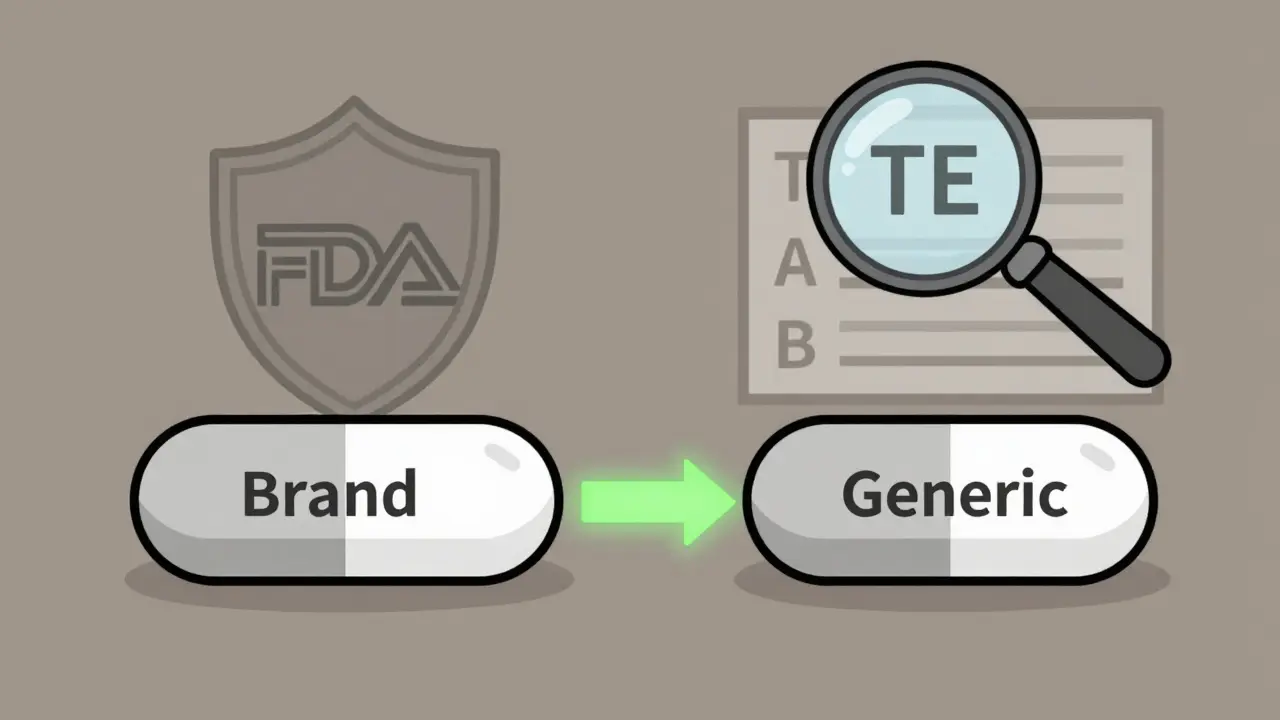
If all three are met, the FDA assigns a Therapeutic Equivalence (TE) code. These codes are short, but packed with meaning. All therapeutically equivalent drugs start with the letter A. Non-equivalent drugs start with B.
Here’s what the letters mean:
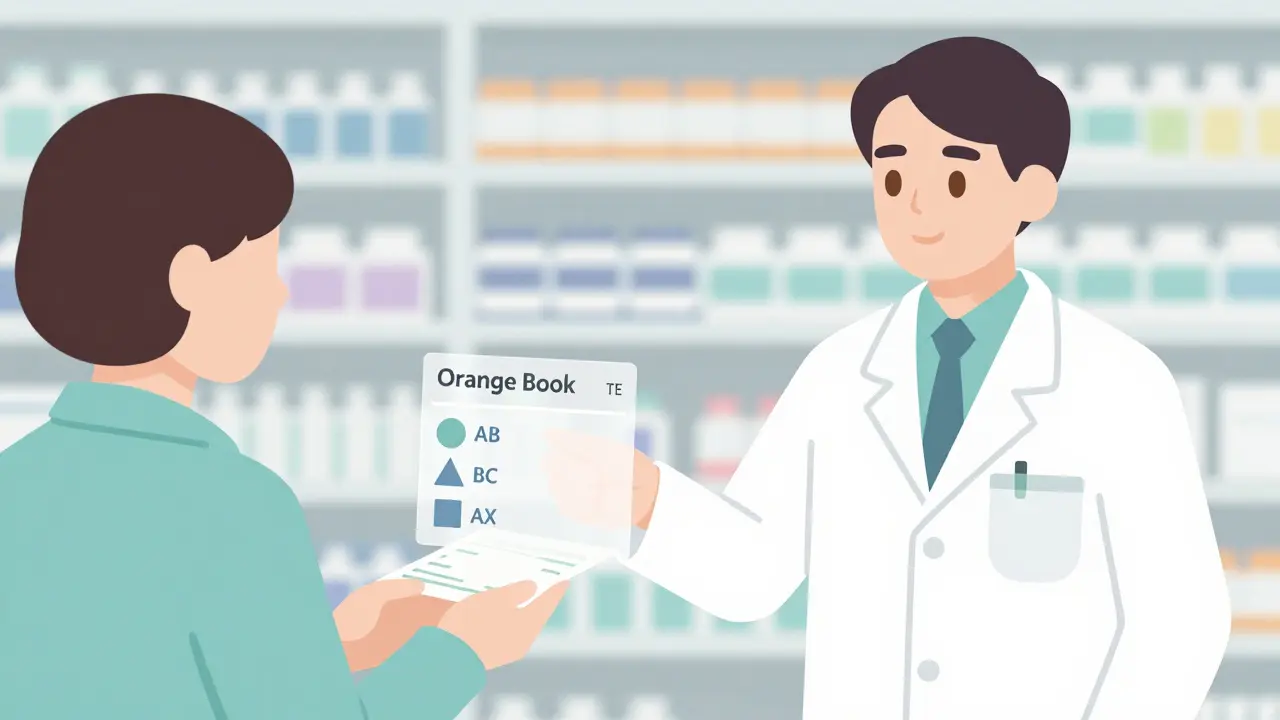
- AB: The drug is therapeutically equivalent with no known bioequivalence issues. This is the gold standard. You can substitute with confidence.
- AN: An oral solution or suspension that’s equivalent, but may have different inactive ingredients.
- AO: An inhalation product that’s equivalent, even if the delivery device differs slightly.
- AX: The drug is not therapeutically equivalent. Usually because there’s not enough data to prove bioequivalence.
- BC or BD: These are red flags. The drug may be pharmaceutically equivalent, but bioequivalence hasn’t been proven - or there are known problems.
These codes aren’t just for pharmacists. Insurance companies, pharmacy benefit managers, and state laws use them to decide which drugs get covered and which can be automatically substituted at the pharmacy counter.
How the Orange Book Is Organized
The Orange Book isn’t one big list. It’s broken into four parts:
- Part I: Prescription drugs with therapeutic equivalence ratings. This is the most used section.
- Part II: Over-the-counter (OTC) drugs that don’t follow standard FDA monographs.
- Part III: Biologics - drugs made from living sources, like vaccines or blood products. These are reviewed by a different FDA center and have separate rules.
- Part IV: Drugs that were approved but never sold, discontinued, or approved only for export or military use.
It doesn’t include drugs approved before 1938, like phenobarbital, or those still under the old DESI review system, like Donnatal or Librax. These are grandfathered in based on safety alone - not therapeutic equivalence.
Why TE Codes Matter in Real Life
On paper, the system looks simple. In practice, it’s messy.
In 2022, Walgreens reported that $1.2 million in claims were rejected because pharmacists misread TE codes - especially with BC and BD drugs. These are the tricky ones. They look like generics, but the FDA says: “We don’t have enough proof this works the same.” If a pharmacist substitutes one anyway, the insurance company denies payment. The patient gets stuck with a higher bill. Or worse - they get the wrong drug.
CVS Health fixed this by building an automated system that checks TE codes in real time at the point of sale. In just one year, they cut substitution errors by 63% and saved $47 million. That’s not just money - it’s fewer mistakes, fewer patient complaints, and less stress for pharmacists.
But not everyone has that kind of tech. A 2023 survey of 142 pharmacy technicians found that 78% had been asked to substitute a drug they weren’t sure about. And 67% of pharmacists said the TE code system was “moderately to extremely difficult” to interpret without training.
The FDA estimates pharmacists spend an average of 12.7 minutes per complex prescription just checking the Orange Book. That’s time that could be spent counseling patients. That’s why the National Community Pharmacists Association offers a 4-hour certification course on TE codes - and over 8,000 pharmacists took it in 2022.
The Bigger Picture: Generics Save Billions
The Orange Book isn’t just a technical tool. It’s an economic engine.
Thanks to the Hatch-Waxman Act and the Orange Book’s clear rules, 90% of all prescriptions filled in the U.S. are now generics. Yet they make up only about 23% of total drug spending. Between 2010 and 2019, generic drugs saved the U.S. healthcare system $1.67 trillion.
That’s why the FDA approved 758 new generic drugs in 2022 - a 14% jump from the year before. Each one of those approvals depends on a clear therapeutic equivalence evaluation.
But the system is evolving. Complex drugs - like inhalers, topical creams, and injectables - are harder to copy. The device, the formulation, the way it’s delivered can all affect how the drug works. The FDA released new guidance in 2022 to help manufacturers and reviewers handle these cases. The message was clear: the drug must still produce the same clinical effect and safety profile. The device doesn’t have to be identical - but the outcome must be.
What’s Coming Next
The FDA is upgrading the Orange Book. The old printed version is gone. The current online version is searchable, but clunky. A new, modernized digital platform is set to launch in Q2 2024. It will show TE codes, application numbers, manufacturer names, and drug strengths all in one place. No more flipping through pages or hunting through PDFs.
It’s also starting to include biosimilars - cheaper versions of complex biologic drugs like Humira or Enbrel. These aren’t technically generics, but they follow similar rules. By 2028, biosimilars could make up 12.5% of the biologics market - a $52 billion opportunity.
Still, challenges remain. For drugs with a narrow therapeutic index - like warfarin, lithium, or digoxin - tiny differences in how the body absorbs the drug can cause serious side effects. The Orange Book doesn’t have a special code for these yet. Some states require extra monitoring. Others don’t. That inconsistency creates confusion.
And yet, every state board of pharmacy requires TE code verification before allowing substitution. That’s not a suggestion. It’s the law.
What Patients Should Know
If your doctor prescribes a brand-name drug, and your pharmacist gives you a generic - that’s normal. It’s not a downgrade. It’s science.
But if you’ve ever been told, “We can’t substitute this,” it’s probably because the drug has a B code. Don’t assume it’s unsafe. It just means the FDA hasn’t confirmed it works the same way yet.
Always ask your pharmacist: “Is this generic approved as equivalent in the Orange Book?” If they’re unsure, ask to see the TE code. You have the right to know.
And if you’re on a narrow therapeutic index drug - like blood thinners or seizure meds - don’t switch between different generic brands without talking to your doctor. Even if both are AB-coded, slight differences in fillers or manufacturing can matter.
Final Thoughts
The Orange Book is quiet. It doesn’t make headlines. But every time you fill a prescription for a $5 generic instead of a $300 brand, you’re benefiting from it. It’s the invisible backbone of affordable medicine in America.
It’s not perfect. The codes are confusing. The updates are frequent. The system struggles with complex drugs. But it works - and it saves lives and money every day.
For pharmacists, it’s a tool. For patients, it’s a promise: that a cheaper pill can still be just as effective. And that’s worth understanding.
What does 'AB' mean in the Orange Book?
'AB' means the generic drug is therapeutically equivalent to the brand-name drug. It has the same active ingredient, same dosage form, and has been proven to be bioequivalent - meaning your body absorbs it the same way. These are the safest and most reliable substitutions.
Can any generic drug be substituted for a brand-name drug?
Only if it has an 'A' code in the Orange Book. Drugs with 'B' codes - like 'BC' or 'BX' - are not considered interchangeable. Pharmacists are not allowed to substitute them unless the prescriber writes "Dispense as Written" or "Do Not Substitute."
Why are some generic drugs not listed in the Orange Book?
Some drugs are approved by the FDA but never evaluated for therapeutic equivalence. This includes older drugs approved before 1938, drugs still under the DESI review process, and some complex products where bioequivalence studies haven’t been completed or approved. They may be legal to sell, but they’re not officially interchangeable.
How often is the Orange Book updated?
The Orange Book is updated every month. New generic approvals, changes in TE codes, and withdrawn products are added or removed monthly. The FDA publishes the latest version on its website, and the new digital version launching in 2024 will make these updates even faster and easier to access.
Are biosimilars included in the Orange Book?
Currently, biosimilars are not listed in the Orange Book. They follow a different approval pathway under the Biologics Price Competition and Innovation Act (BPCIA). The FDA is working on integrating them into a future version of the Orange Book, but as of now, they have their own separate reference list.
Next Steps for Patients and Providers
If you’re a patient: Always ask your pharmacist if your generic drug has an 'AB' code. If you’re switched to a different generic and feel different - tell your doctor. It’s not just in your head. Even AB-coded generics can vary slightly.
If you’re a prescriber: When writing a prescription, check the Orange Book if you’re unsure about substitution. Write "Dispense as Written" if you don’t want a generic - especially for narrow therapeutic index drugs.
If you’re a pharmacist: Use the FDA’s free online training modules. Bookmark the monthly updates. Don’t guess TE codes - verify them. Your patients depend on it.
The Orange Book isn’t just a government document. It’s a bridge between innovation and affordability. And in a world where drug prices keep rising, it’s one of the few things still working exactly as intended.
Harbans Singh
Been using generics for years and never thought about the Orange Book until now. Turns out there's a whole coded system behind why my $5 pill works just like the $300 one. Kinda cool that the FDA keeps this running in the background so we don't have to worry.
Zabihullah Saleh
It's wild how something so mundane - a colored book with letters and codes - holds up the entire infrastructure of affordable medicine. We take it for granted like electricity or clean water. But without it, the system collapses. The real miracle isn't the drug. It's the bureaucracy that made it accessible.
sagar patel
AB codes are not a suggestion they are law
Linda B.
Let me guess the FDA is just another branch of Big Pharma’s lobbying arm. They 'approve' generics but only after the brand-name companies have milked every last dime. And now they want us to trust a letter code? The same people who approved Vioxx and OxyContin? Please.
Christopher King
They’re hiding something. Why does the Orange Book even exist? Why not just say 'these are safe'? Why the cryptic AB BC BD codes? It’s a control mechanism. The government wants you to think you’re saving money when really you’re being funneled into a system designed to keep you dependent on the same corporations. They don’t want you to question. They want you to scan and swallow.
Carlos Narvaez
TE codes are a linguistic minefield. The fact that pharmacists need certification just to interpret them speaks volumes about the incompetence of the system.
Oluwatosin Ayodele
You Americans think this is advanced? In Nigeria we just use what works. If the pill looks the same and the price is low we take it. No codes. No forms. No FDA. You overcomplicate everything. Your system is beautiful but fragile. Ours is messy but alive.
Jason Jasper
My uncle’s on warfarin. His pharmacist switched him to a different generic last year. He got dizzy. Turned out both were AB-coded but different fillers. Took three weeks to stabilize. The Orange Book doesn’t account for individual biology. It’s a population tool. Not a personal one.
Mussin Machhour
Just read this whole thing. Now I’m gonna go tell my pharmacist I want to see the TE code before they swap my meds. This is the kind of knowledge that saves money AND lives. Thanks for the deep dive - seriously. This isn’t just info. It’s power.
Michael Dillon
Actually the Orange Book is a scam. The FDA approves generics based on bioequivalence studies done by the same companies that make the brand drugs. The studies are short, small, and often done in healthy young men. What about elderly patients? Women? People with liver disease? The system is built on a lie. And you’re all just repeating it like a prayer.