Rare Adverse Event Detection Calculator
Calculate the minimum number of patients needed to detect rare adverse events with statistical confidence. This tool helps understand when registries versus claims data can detect specific side effects.
Results
Minimum Patients Needed
This is the absolute minimum number of patients needed to detect your specified adverse event with statistical confidence.
Real-World Data Sources
Compare with data source capabilities:
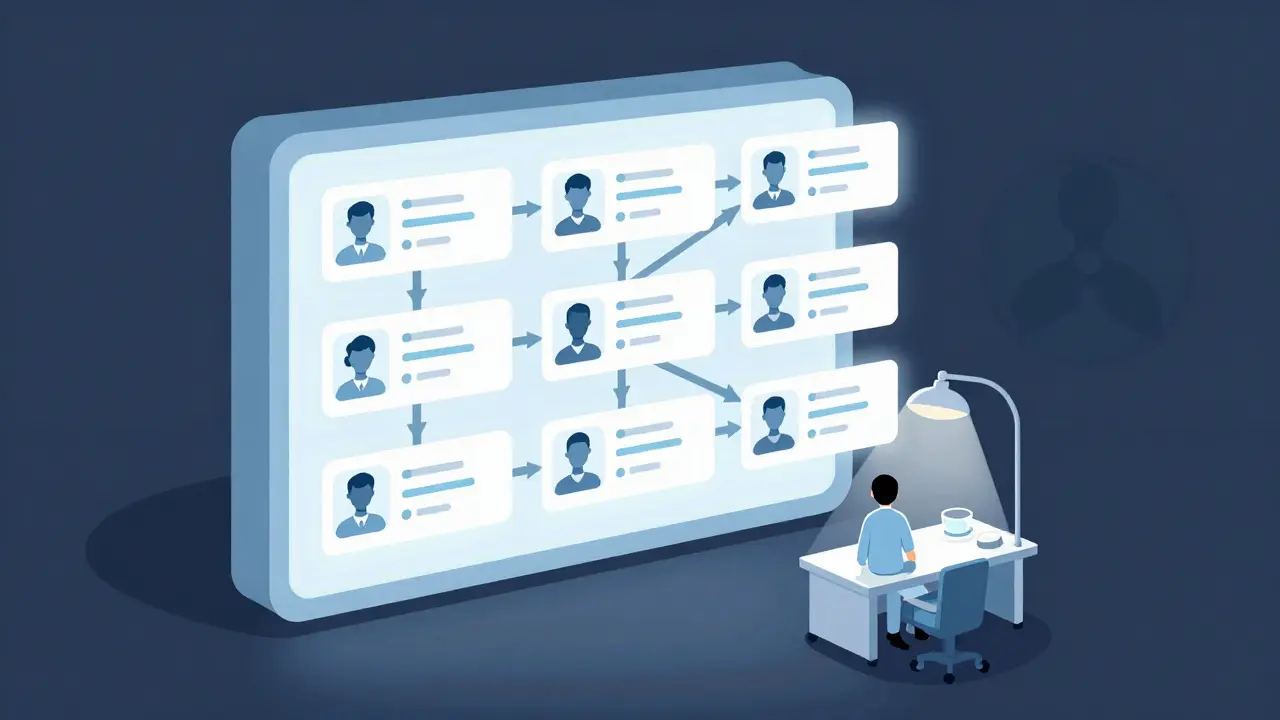
When a new drug hits the market, the real test of its safety doesn’t happen in a clinical trial. It happens in the messy, complex world of everyday healthcare-where millions of people take the medicine, with different diets, other drugs, and underlying conditions. That’s where real-world evidence comes in. Two of the most powerful tools for tracking drug safety outside of trials are registries and claims data. They’re not flashy, but they’re the backbone of how regulators and drug makers spot hidden risks long after approval.
What Real-World Evidence Actually Means
Real-world evidence (RWE) isn’t just data-it’s meaning pulled from real life. The U.S. Food and Drug Administration (FDA) defines it as clinical evidence drawn from real-world data (RWD), which includes everything from hospital billing records to patient surveys. Unlike clinical trials, which control variables and pick healthy volunteers, RWE captures how drugs behave in the wild. Think of it like watching how a car performs on actual roads, not just a test track.Since the 21st Century Cures Act in 2016, regulators have leaned harder on RWE. Between 2017 and 2021, the FDA approved 12 new drug uses based partly on real-world sources. Five of those relied directly on claims data or registries. The European Medicines Agency (EMA) followed suit, launching Darwin EU in 2021 to connect health databases across 15 countries and cover over 100 million people.
Registries: The Deep Dive
Registries are structured databases that track specific groups of patients. There are two main types: disease registries (like a cancer registry tracking everyone diagnosed with melanoma) and product registries (tracking everyone prescribed a certain drug, like a transplant patient registry monitoring tacrolimus use).These aren’t random collections. They collect detailed, standardized information: lab results, imaging reports, patient-reported symptoms, treatment changes, and long-term outcomes. A 2021 study found registries offer 37.2% more detail on long-term outcomes than claims data alone. That’s huge when you’re looking for slow-developing side effects-like liver damage that only shows up after five years.
Take the Cystic Fibrosis Foundation Patient Registry. It helped identify a safety signal for ivacaftor, a drug for rare CFTR mutations. Clinical trials didn’t catch it because those mutations were too rare. But the registry, with its deep patient profiles, spotted the pattern. The registry included over 30,000 patients, each with years of clinical notes, genetic data, and quality-of-life logs.
But registries have limits. They’re expensive. Setting one up takes 18 to 24 months and $1.2 million to $2.5 million. Annual upkeep? $300,000 to $600,000. And participation isn’t mandatory. Voluntary registries often only capture 60% to 80% of eligible patients. That creates selection bias-if only the healthiest or most motivated join, you miss the real-world picture.
Claims Data: The Broad View
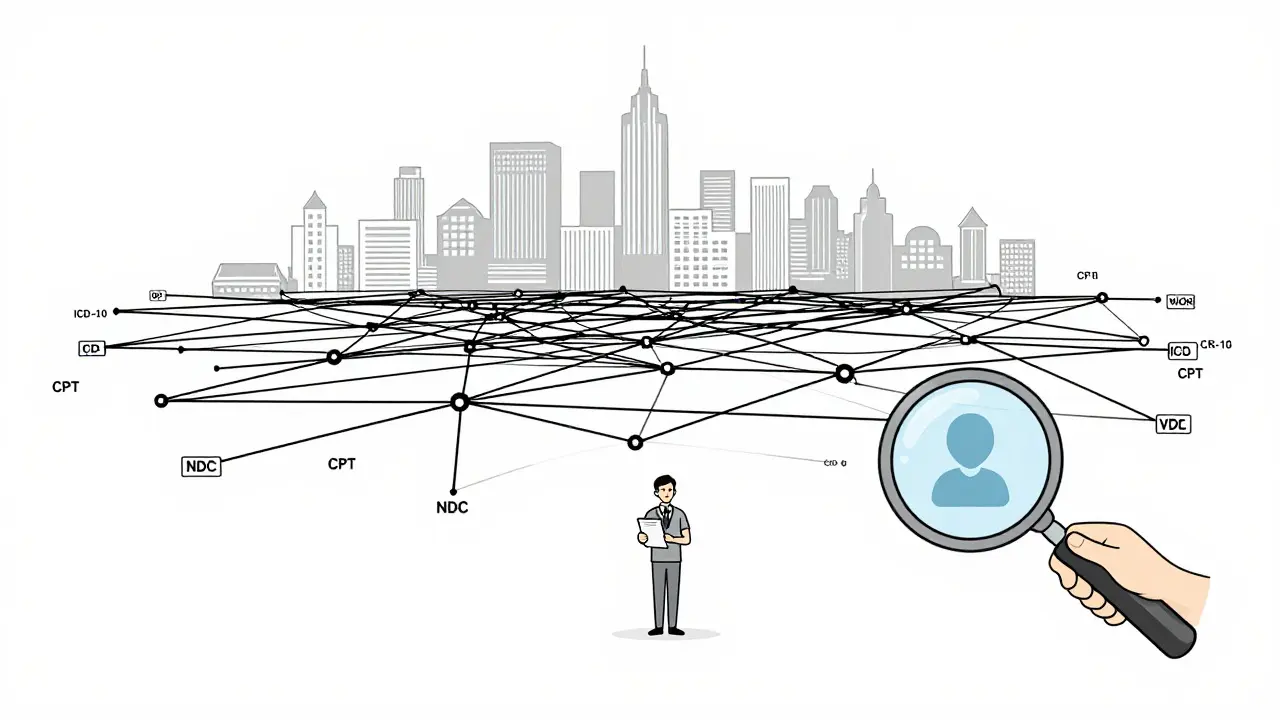
Claims data is what gets generated every time someone visits a doctor, gets a prescription filled, or is admitted to the hospital. It’s built into the billing system. Think ICD-10 codes for diagnoses, CPT codes for procedures, and NDC codes for medications. It’s not clinical-it’s administrative.But it’s massive. IBM MarketScan covers 200 million lives. Optum has 100 million. Truven’s database includes 150 million. Medicare claims alone span 15+ years for each beneficiary. That’s more longitudinal data than any clinical trial could ever collect.
The FDA used Medicare claims data to study olmesartan (Benicar) in 850,000 diabetic patients between 2007 and 2011. They found no increased cardiovascular risk-something that couldn’t have been proven in a trial of a few thousand people over two years. In 2019, claims data helped support Palbociclib’s expanded use in older patients with breast cancer.
Claims data catches things registries can’t: rare events. If a side effect happens in 1 in 10,000 people, you need a million records to be confident it’s real. Registries rarely hit that scale. But claims databases? They’re built for it.
Still, claims data has blind spots. It doesn’t record lab values reliably-only 45% to 60% of results are captured. Patient-reported symptoms? Almost never. And coding errors? A 2020 AHRQ report found diagnosis codes are wrong 15% to 20% of the time. A patient with heart failure might be coded as “chest pain” because that’s what brought them in. That’s enough to muddy the signal.
Registries vs. Claims Data: The Trade-Offs
| Feature | Registries | Claims Data |
|---|---|---|
| Population Size | 1,000-50,000 patients | 100 million+ lives |
| Clinical Detail | 87% completeness for lab values | 52% completeness for lab values |
| Longitudinal Coverage | Typically 5-10 years | Up to 15+ years (Medicare) |
| Cost to Maintain | $300K-$600K/year | $50K-$200K/year (for access) |
| Best For | Complex outcomes, rare mutations, long-term effects | Rare adverse events, large population trends |
| Key Limitation | Selection bias, low participation | Missing clinical context, coding errors |
For example, in oncology, 38% of RWE submissions use registries-because cancer treatments are complex, and outcomes depend on genetics, comorbidities, and response patterns. In cardiovascular drugs, 45% of submissions rely on claims data-because heart attacks and strokes are common, and billing codes capture them reliably.
How Regulators Are Using Both Together
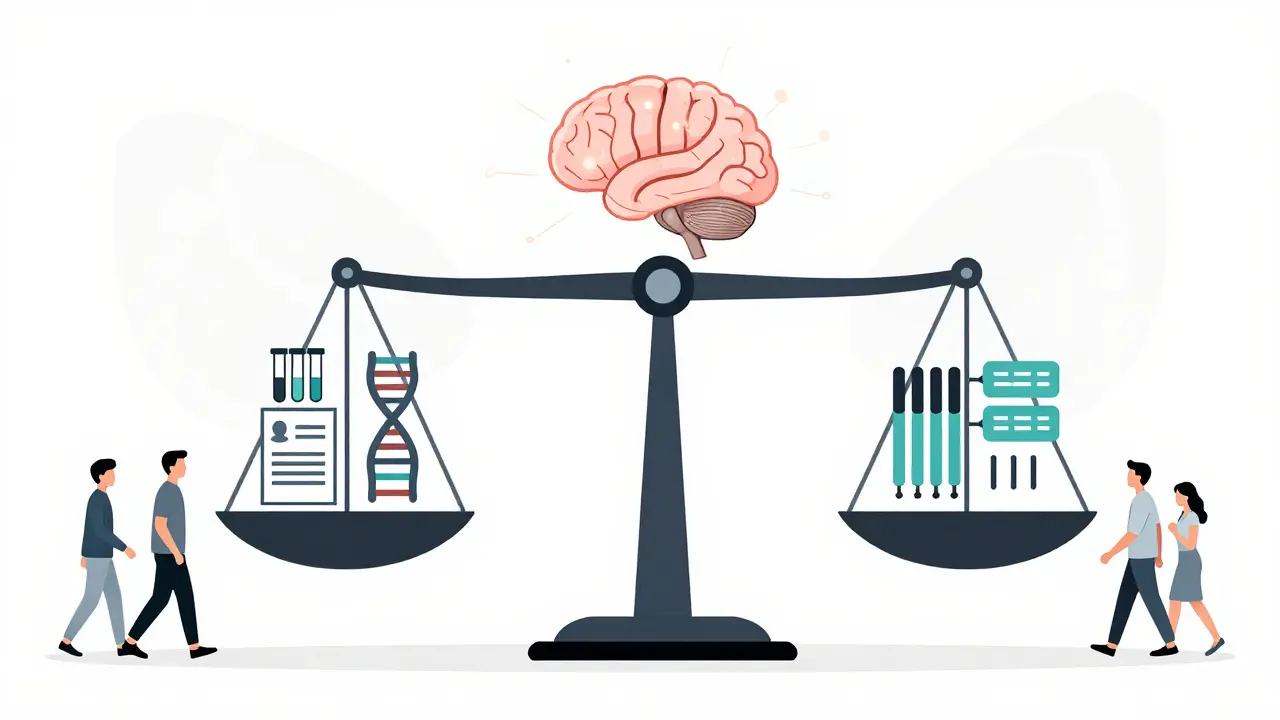
The smartest approaches don’t pick one-they combine them. The International Council for Harmonisation (ICH) E2 proposal in June 2023 said combining registry and claims data cuts false positive safety signals by 40%. Why? Registries give context; claims data gives scale.The FDA’s Sentinel Initiative is the gold standard. It links 11 health systems and 3 claims processors to monitor 300 million patient records. It’s how they caught a spike in pancreatitis linked to a diabetes drug in 2016-claims data flagged it, and registry data confirmed the patients had no other risk factors.
And now, AI is helping. A 2024 JAMA Network Open study showed AI algorithms trained on combined data reduced false alarms by 28%. Novartis is piloting wearable data (like heart rate monitors) with claims records to monitor Entresto patients for early signs of low blood pressure. That’s the future: layered data.
Challenges and What’s Coming
It’s not easy. Data standardization eats up 40% to 60% of project time. Privacy laws like HIPAA and GDPR add layers of complexity. And if you don’t fix “immortal time bias”-a statistical trap where patients are counted as safe before they even started the drug-you’ll get wrong answers. The FDA says proper methods cut that bias by 35% to 50%.The FDA’s 2023-2027 RWE plan is pushing hard. By 2025, they’ll have 5-7 new analysis standards for claims data. The REAL program, launched in 2023, is standardizing registry collection for 20 priority diseases-especially rare ones-by 2026. EMA’s Darwin EU just added eight more national databases in late 2023, covering 120 million people.
Pharma companies are shifting budgets too. In 2017, only 3% to 5% of pharmacovigilance spending went to RWE. Now it’s 8% to 12%. Why? Because regulators are asking for it. And because the cost of missing a safety signal-lawsuits, recalls, reputational damage-is far higher than building the systems.
Why This Matters to Everyone
You might think this is all about regulators and drug companies. But it’s not. It’s about you. Every time you fill a prescription, you’re part of this system. Registries and claims data help catch side effects that only appear after years of use. They help determine if a drug is safe for older adults, pregnant women, or people with kidney disease-groups often left out of trials.Without these data sources, we’d be flying blind. We’d rely on tiny, short-term trials and hope for the best. Instead, we have a system that watches millions of people, in real time, across decades. It’s not perfect. But it’s the best tool we have to make sure the medicines we take don’t do more harm than good.
Are registries and claims data legally accepted by regulators?
Yes. Both the U.S. FDA and the European Medicines Agency (EMA) formally accept registry and claims data as valid sources for drug safety decisions. The FDA has used them in over 100 regulatory submissions since 2018. In 2017, the FDA approved a supplemental indication for pembrolizumab based on registry data. In 2021, the EMA approved tacrolimus using data from the Scientific Registry of Transplant Patients. Regulatory guidelines now require these data sources to be documented with clear methodology, but they are not just accepted-they’re expected.
Can claims data detect rare side effects?
Yes, but only if the dataset is large enough. For a side effect occurring in 1 in 10,000 people, you need at least 1 million patient records to detect it with statistical confidence. Claims databases like Medicare or IBM MarketScan easily meet this threshold. Registries, which usually cover fewer than 50,000 patients, are less reliable for rare events unless they’re national or multi-center. That’s why claims data is often the first line of detection for unexpected adverse reactions.
Why do registries have better clinical detail than claims data?
Because registries are designed to collect detailed clinical information. Trained staff input lab values, imaging results, patient-reported symptoms, and treatment changes directly into structured forms. Claims data, by contrast, is generated for billing-not clinical insight. It captures diagnosis codes and procedure codes, but not why a test was ordered or what the result meant. A registry might record a patient’s hemoglobin level of 8.2 g/dL and note they were fatigued; claims data just says “ICD-10: D63.8-other anemia.” The context is missing.
Is claims data accurate enough to make safety decisions?
It’s accurate enough for broad trends, but not for individual diagnosis. Diagnosis coding errors occur in 15% to 20% of claims, according to the Agency for Healthcare Research and Quality (AHRQ). But when you’re looking at trends across hundreds of thousands of patients, those errors tend to cancel out. A 2015 FDA study on entacapone used 1.2 million Medicare records and found no cardiovascular risk-despite coding inaccuracies. The key is using statistical methods that account for noise, not expecting perfect data. Combining claims with registry data reduces false signals by 40%, as shown by ICH guidelines.
How do companies pay for using claims data?
Companies don’t pay to collect claims data-they pay for access. Firms like IBM MarketScan, Optum, and Truven sell data licenses to pharmaceutical companies, researchers, and insurers. Annual fees range from $50,000 to $200,000 depending on data scope and duration. Some companies build internal teams to analyze the data, while others contract with analytics firms. The cost is far lower than running a registry, which can cost over $1 million to launch. For many drug safety teams, claims data access is a routine budget line item, not a major investment.
David Robinson
Registries are a joke. You spend millions, wait two years, and still only get 60% participation? Meanwhile, claims data is sitting there with 300M+ records, doing the heavy lifting. Why are we still funding these boutique databases like they're art installations? It's 2024. We have AI, we have cloud infrastructure. Stop romanticizing manual data collection.
Srividhya Srinivasan
I knew it!!! I KNEW IT!!! The government is using our medical records to track us!!! They're building a database of who's taking what drug, and next thing you know, they'll deny you insurance because you took 'too many' statins! Or worse-they'll start charging you extra for being 'high-risk' based on your prescription history!!! This isn't science-it's surveillance capitalism with a lab coat!!!
Prathamesh Ghodke
Honestly? This post nails it. Registries give us the ‘why’-like why ivacaftor messed with some CF patients’ liver enzymes. Claims data gives us the ‘how many’-like how many people in Ohio had a stroke after starting olmesartan. Neither alone is enough. You need both. It’s like trying to understand a movie by only watching the soundtrack or only reading the script. You need both. And yeah, the coding errors? Yeah, they’re wild. I once saw a patient coded as ‘chickenpox’ because the nurse typed ‘chicken’ and hit enter. It was actually a rash from a new antibiotic. Classic.
Stephen Habegger
This is actually one of the most hopeful things I’ve read in a while. We’re finally moving past ‘small trials = truth’ and embracing the messy, real world. That’s progress. The fact that we can now catch liver damage after 5 years? That’s saving lives. I’m not saying it’s perfect-but we’re getting better. And that’s worth celebrating.
Justin Archuletta
I just want to say-thank you for explaining this so clearly. I work in pharmacy and honestly? I had no idea how much of this stuff was already being used. Claims data saved my aunt’s life-turned out her ‘chest pain’ was actually a drug interaction. Without that data, she’d have been sent home with more pills. So yeah. This matters.
Sanjana Rajan
Let’s be real. Registries are just corporate vanity projects. Pharma companies love them because they look ‘rigorous’ to regulators. But guess what? The same companies that fund registries also own the claims data companies. It’s all one big loop. You think the FDA’s ‘Sentinel Initiative’ is independent? Ha. It’s funded by the same vendors that sell data to Big Pharma. Wake up. This isn’t science. It’s PR with a spreadsheet.
Kyle Young
I find it fascinating how we’ve institutionalized the idea that ‘real-world’ data is somehow less valid than controlled trials. But isn’t that the entire point? Real life isn’t controlled. The trial is the artificial environment. The registry and claims data? Those are the ecosystems where drugs actually live. We’re not studying drugs-we’re studying humans in context. And maybe that’s the deeper truth we’ve been avoiding: we don’t understand biology. We understand systems. And systems are messy.
Aileen Nasywa Shabira
Oh, so now we’re supposed to trust claims data? The same data that miscodes ‘heart attack’ as ‘indigestion’ 20% of the time? And you call this science? This is just statistical noise dressed up in Excel. I’ve seen studies where the ‘signal’ was just a coding glitch in a rural hospital’s billing system. They called it a ‘safety signal.’ I called it a glitch. They got a press release. I got laughed at.
Kendrick Heyward
I’m so tired of this. Every time someone says ‘claims data is reliable,’ I want to scream. My brother died because his drug interaction was buried in a 15% error rate. They said ‘statistical noise.’ He was a person. Now they’re talking about AI ‘reducing false alarms.’ What about the real alarms? The ones that get drowned out? This system is built on ignoring the people. I’m not mad. I’m just… done.
lawanna major
There’s a quiet revolution happening here, and most people don’t even notice it. We’re not just tracking side effects-we’re building a collective, longitudinal portrait of human health. Every claim, every registry entry, every lab result that gets digitized adds a pixel to a mural that spans decades. It’s not perfect. But it’s the first time in history we’ve had the scale and persistence to see how drugs truly behave across populations, ages, and comorbidities. That’s not just data. That’s wisdom. And it’s being built, one coded line at a time.