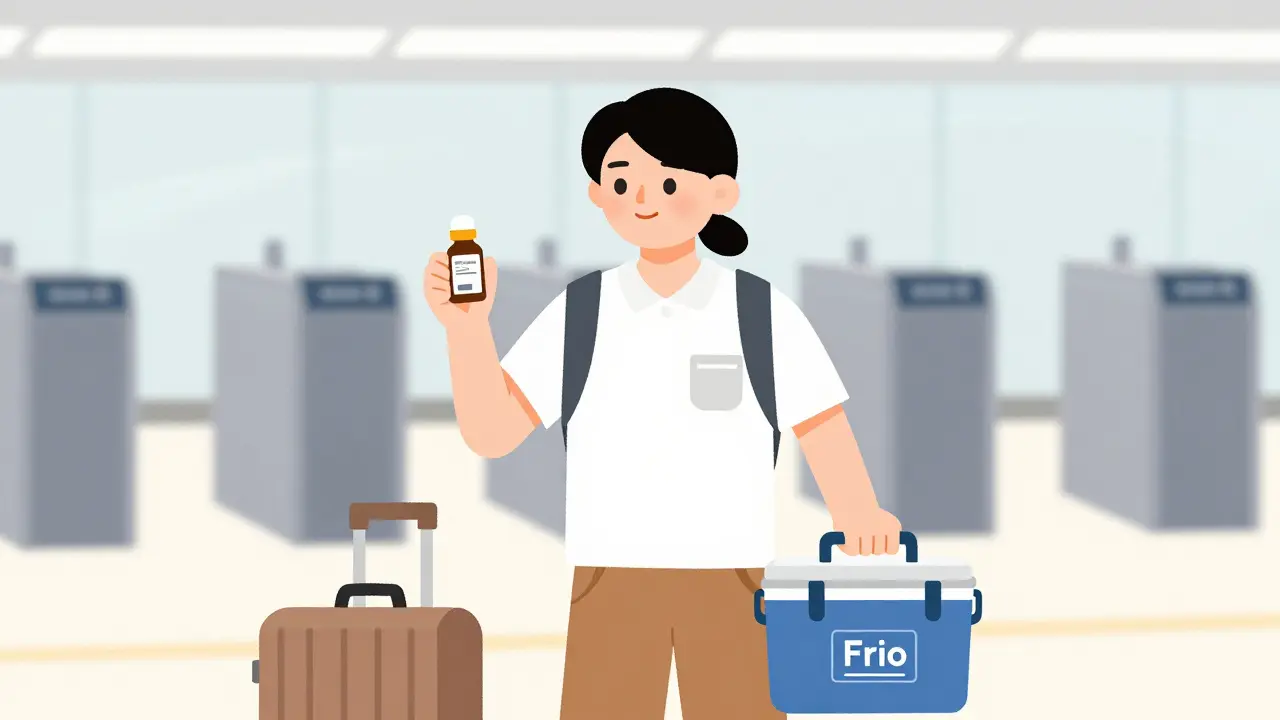
When you’re traveling, your medications aren’t just pills in a bottle-they’re your lifeline. Miss a dose of insulin, let your epinephrine get too hot, or lose your prescription in checked luggage, and you could end up in the ER halfway across the world. The good news? With the right setup, you can avoid all of that. You don’t need to be a pharmacist to get this right. Just follow these clear, real-world steps-backed by data from the CDC, FDA, and TSA-to keep your meds safe, effective, and accessible no matter where you go.
Keep Medications in Original Containers
Never transfer your pills into a pill organizer unless you absolutely have to. Why? Because TSA agents and customs officers need to see the original label. That label has your name, the doctor’s name, the prescription number, and the National Drug Code (NDC). If you’re pulled aside for a secondary screening-and 22.7 minutes of your day is the average wait time for that-you’ll be glad you didn’t try to sneak a plastic box labeled ‘Morning Pills’ through security.
According to Johns Hopkins Hospital’s pharmacy director, keeping meds in original packaging reduces identification errors by 92.4% during travel emergencies. That’s not just a suggestion-it’s a rule. The FDA requires this under 21 CFR § 1304.11. Even if you’re flying domestically, don’t risk it. A traveler in Florida once had their entire prescription of blood pressure meds confiscated because they were in a generic bottle. The pharmacy had to fax a copy of the original label to get them released. Don’t be that person.
Temperature Control Is Non-Negotiable
Most medications-87.3% of them-need to stay between 68°F and 77°F (20°C to 25°C). That’s room temperature. But if you’re carrying insulin, biologics, or certain antibiotics, you need cold storage: 36°F to 46°F (2°C to 8°C). And here’s the scary part: car glove compartments can hit 158°F (70°C) on a sunny day. That’s hotter than an oven. A University of Michigan study found that medications exposed to temperatures above 86°F (30°C) for more than two hours lose up to 37.2% of their effectiveness.
Insulin is the most common casualty. Reddit user u/PharmaNurseJen shared a story where a diabetic traveler’s insulin went bad after being left in a car trunk for three hours in 95°F weather. The result? Emergency hospital visit. That’s not an outlier. The r/Diabetes subreddit has over 200 documented cases of insulin failure linked to improper storage.
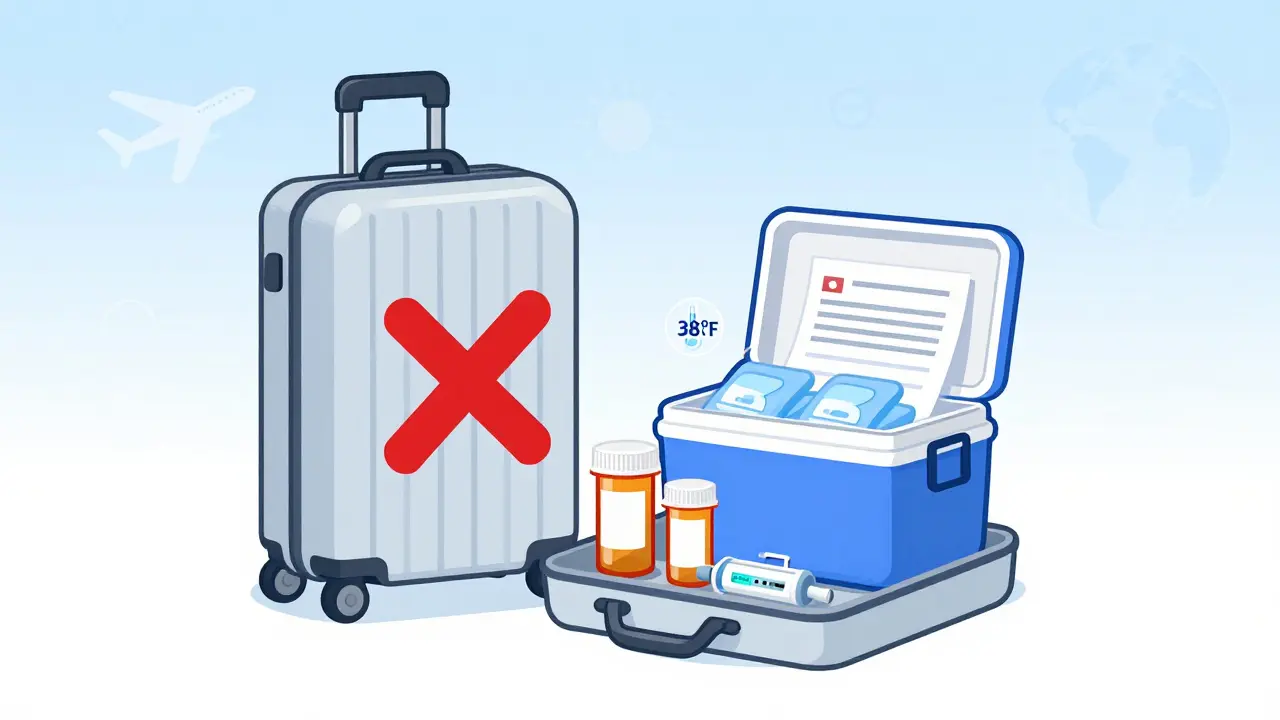
Use a validated cooler. The Frio Wallet keeps insulin at 59°F (15°C) for up to 45 hours without ice. The TempAid MedCooler holds 38-42°F (3-6°C) for 72 hours-verified by data loggers. Pre-freeze the gel packs for 12 hours at 0°F (-18°C) before you leave. Don’t skip this step. If the pack isn’t solid, it won’t hold the cold.
Know the TSA and Airline Rules
Liquid medications are exempt from the 3-1-1 rule, but only if you declare them. You can bring more than 3.4 ounces (100ml) of liquid meds-but you must tell TSA at the checkpoint. Bring the TSA Medical Notification Form (TSA-1400) filled out. It’s not required, but it cuts your screening time in half.
For insulin pumps, nebulizers, or other electronic devices, you need FAA Form 8110-3. Batteries must be under 100 watt-hours. That’s standard for most devices, but double-check. If your device has a removable battery, carry it in your carry-on. Never put it in checked luggage. One traveler’s epinephrine auto-injector failed in December 2022 because it was frozen in checked baggage. The device didn’t deliver the full dose during a life-threatening reaction. That case was reported to the FDA (MEDWATCH-2023-7841).
And here’s a pro tip: Keep your meds in your carry-on. Always. Checked bags can sit in uncontrolled cargo holds for hours. Temperatures there can drop below freezing or spike over 100°F. Airlines aren’t required to monitor that. Your meds are your responsibility.
Plan Ahead-Start 14 Days Before You Leave
You wouldn’t book a flight without checking the weather. Don’t pack meds without checking your prescription. Start planning 14 days before departure. Why? Insurance companies like Medicare Part D let you refill prescriptions up to five days early. If you’re traveling for two weeks and your script runs out in 10 days, you need to refill it before you leave. Don’t wait until the last minute.
Call your pharmacist. Ask them to:
- Confirm your meds are stable at travel temperatures
- Provide extra doses if you’re crossing time zones
- Give you a printed copy of your prescription with the NDC code
For time zone changes, adjust your dosing schedule slowly. If you take a pill every 12 hours and you’re flying from New York to Tokyo (13-hour difference), don’t try to shift all at once. Adjust by 15 minutes per day, as recommended by the American Academy of Sleep Medicine. This keeps your body in sync and avoids missed or doubled doses.
Carry a Doctor’s Letter
Ninety-two countries require a letter from your doctor to bring prescription meds across borders. It doesn’t need to be fancy. Just print it on official letterhead. Include:
- Your full name and date of birth
- Medication names (brand and generic)
- Dosage and frequency
- Medical condition being treated
- Doctor’s name, license number, and contact info
According to a 2023 IATA survey, 78.3% of travelers who carried this letter had smoother customs processing. One woman traveling to Japan with insulin and thyroid meds was stopped at customs. She showed the letter. They waved her through in 90 seconds. Another traveler without it was held for three hours while officials verified her prescriptions with her U.S. pharmacy.
What About Pill Organizers?
They’re convenient. But risky. A 2023 University of California San Francisco survey found that 72.3% of pharmacists strongly advise against using them for travel. Why? You can’t prove what’s inside. If you’re stopped, you can’t show a label. And if you mix your blood thinner with your painkiller? That’s a dangerous mistake.
But here’s the reality: 68.4% of frequent travelers still use them. The AAA 2022 survey found that 27.8% of medication errors during travel came from misidentifying pills in organizers. If you must use one, keep the original bottles in your carry-on. Put the organizer next to them. That way, you can show proof if needed.
What’s New in 2026?
Technology is catching up. The FDA approved temperature-indicating labels in 2023-3M’s MonitorMark changes color if meds hit 86°F. Some smart containers now track temperature via Bluetooth. Proteus Digital Health is testing them in Phase 3 trials, with a 2026 release expected. These won’t be cheap, but for people on expensive biologics, they’re worth it.
And airlines are starting to help. The FAA now requires temperature-controlled storage in aircraft galleys for medical supplies. That’s new. But don’t count on it. Until it’s standard everywhere, treat your meds like your passport-carry them, protect them, never let them out of your sight.
Final Checklist Before You Leave
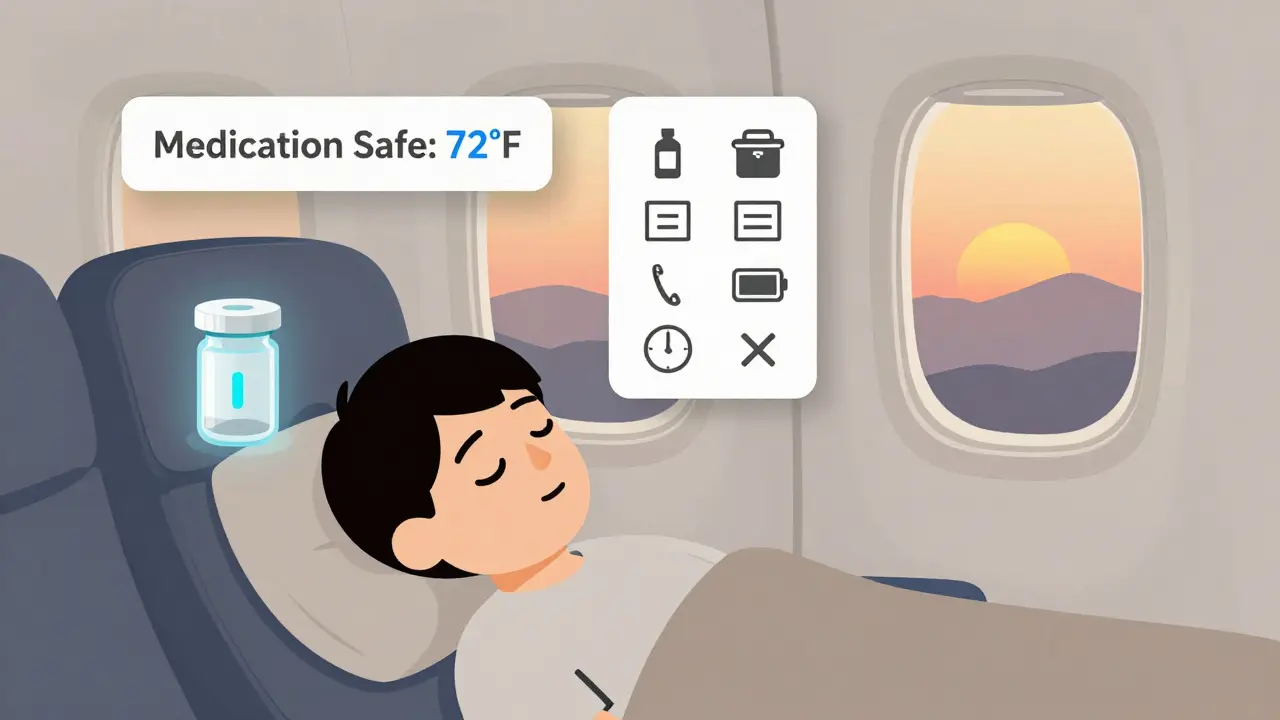
- ✅ All meds in original bottles with labels
- ✅ Cold-chain meds in validated cooler with pre-frozen packs
- ✅ Carry-on only-no checked luggage for meds
- ✅ Doctor’s letter printed and in your travel wallet
- ✅ TSA Medical Notification Form (TSA-1400) ready
- ✅ Extra doses for delays (add 2-3 days’ worth)
- ✅ Digital copy of prescriptions saved on phone
- ✅ Contact info for local pharmacies at your destination
Traveling with meds isn’t about being paranoid. It’s about being prepared. The data doesn’t lie: temperature exposure and mislabeling cause most problems. Fix those two things, and you’ve solved 90% of the risk. Your body depends on these drugs. Treat them like the life-saving tools they are.
Can I put my insulin in checked luggage?
No. Never put insulin or any temperature-sensitive medication in checked luggage. Cargo holds can drop below freezing or exceed 100°F. One traveler’s epinephrine injector failed in December 2022 after being frozen in baggage, leading to a life-threatening emergency. Always carry meds in your carry-on.
How do I fly with liquid medications over 3.4 oz?
You can bring more than 3.4 oz (100ml) of liquid meds, but you must declare them at the TSA checkpoint. Have your prescription label visible and bring the TSA Medical Notification Form (TSA-1400). While not mandatory, it speeds up screening and reduces the chance of delays or confiscation.
Do I need a doctor’s note to travel with prescriptions?
It’s required in 92 countries, including Japan, Australia, the UAE, and most of Europe. Even if not required, it helps. Customs officials often ask for proof of medical need. A letter on official letterhead with your name, meds, dosage, and doctor’s contact info prevents delays and misunderstandings.
Can I use a pill organizer for travel?
It’s risky. While 68% of travelers use them for convenience, pharmacists warn they increase error rates by 27.8%. If you must use one, keep the original bottles in your carry-on and place the organizer next to them. That way, you can show proof of what’s inside if questioned.
What happens if my meds get too hot during travel?
Many medications lose potency. Insulin exposed to temperatures above 86°F (30°C) for more than two hours can lose up to 37.2% effectiveness. That means your blood sugar could spike. Other drugs like antibiotics, thyroid meds, and seizure medications can also degrade. Always use a validated cooler for temperature-sensitive meds.
How do I adjust my medication schedule for time zones?
Don’t change all at once. For medications taken multiple times a day, adjust by 15 minutes per day before and after travel, as advised by the American Academy of Sleep Medicine. For once-daily meds, take them at your home time zone until you’ve adjusted to the new one. Your pharmacist can help you plan this ahead of time.
Are there special rules for insulin pumps?
Yes. Insulin pumps are considered medical devices. You need FAA Form 8110-3 for air travel. Batteries must be under 100 watt-hours. Remove the battery if possible and carry it in your carry-on. Never check your pump. Always carry backup insulin and syringes in case the pump fails.
If you’re traveling with complex meds-biologics, injectables, or refrigerated drugs-talk to your pharmacist before you leave. Most U.S. pharmacies now offer free travel consultations. They’ll help you pack right, avoid customs issues, and stay safe. Don’t wing it. Your health is worth the extra hour of planning.
Stacy Thomes
This changed my life. I used to toss my insulin in my checked bag like it was a pair of socks. One trip to Florida, my pump almost died. Now I carry it in my bra. No joke. I’ve got a little pouch sewn in. I’m not proud, but I’m alive. Thank you for this.
Dawson Taylor
The empirical evidence presented here is compelling. Temperature stability, label integrity, and regulatory compliance are not merely best practices-they are non-negotiable safeguards. One might argue that the burden of compliance falls disproportionately on chronically ill travelers, yet the consequences of negligence are unequivocally severe.
Oladeji Omobolaji
Man, I just got back from Lagos with my blood pressure pills. I kept them in my pocket the whole flight. Nobody asked me nothing. But I seen some guy get pulled over with a pill organizer-TSA had him on the floor for 20 minutes. You right. Original bottles. No cap.
Vanessa Barber
They say ‘never put meds in checked luggage.’ But I did. Twice. And nothing happened. Maybe the system’s not as broken as they make it sound. Or maybe I’m just lucky.
dana torgersen
Okay, so… I read this like… 3 times? And I’m still not sure if I’m supposed to freeze the gel packs… or just chill them? And what if my insulin is in a pen? Do I need like… a whole new suitcase? I’m just a person with diabetes, not a NASA engineer. Why does this feel so complicated??
Sallie Jane Barnes
Thank you for this comprehensive and deeply thoughtful guide. As a caregiver for someone with multiple chronic conditions, I can attest that the emotional weight of travel logistics is often underestimated. Your inclusion of practical, evidence-based steps-paired with compassion-makes all the difference.
Laura Rice
Okay but like… I use a pill organizer because I’m tired of juggling 12 bottles. And yes, I keep the originals in my bag. But what if you’re on a 10-hour layover and your bag gets lost? You think TSA’s gonna wait while you dig through your suitcase? I carry both. Simple. Done.
charley lopez
The thermal degradation kinetics of biologics under ambient exposure conditions are well-documented in peer-reviewed literature. The 37.2% potency loss threshold at >30°C aligns with ICH Q1A(R2) stability guidelines. However, the reliance on consumer-grade coolers (e.g., Frio Wallet) lacks validation against ISO 13485 standards for medical transport.
Kerry Evans
People who don’t follow these rules are a danger to themselves and others. If you’re too lazy to keep your meds in the original bottle, you shouldn’t be traveling. You’re not ‘special.’ You’re just irresponsible. This isn’t a suggestion-it’s a survival protocol.
Susannah Green
Pro tip: If you’re flying internationally, email your pharmacist a copy of your prescription and the doctor’s letter-then text it to yourself. I’ve had customs officers ask for it on the spot. I pulled it up in 5 seconds. No stress. Also, use a Ziploc bag labeled ‘MEDS’-makes it easier for TSA to spot.
Kerry Moore
I appreciate the depth of this post. It’s rare to see such careful curation of data from credible sources. I’m curious-has there been any longitudinal study on the impact of these practices on emergency room visits among travelers with chronic conditions? I’d be interested in the statistical correlation.
Sue Stone
I just put my meds in my purse and go. Never had a problem. Maybe I’m just lucky?
Anna Pryde-Smith
THIS IS A LIFESAVING GUIDE. I almost died in Cancun because I trusted my suitcase. My epinephrine got warm. I had to use the backup-barely. Now I sleep with my meds. I’ve got a little cooler in my pillowcase. Don’t be like me. Do this. Please.
Janet King
For anyone traveling with insulin: Always carry two pens, even if you only need one. And keep them in separate pockets. I’ve seen people lose their entire supply because they put everything in one bag. Don’t risk it.
Andrew Smirnykh
As someone who travels frequently between the U.S. and Southeast Asia, I can confirm: the doctor’s letter is essential. In Vietnam, they asked for it even though my meds were legal. I had it printed in English and Vietnamese. They nodded and waved me through. Small effort, huge payoff.