When you take a medication like warfarin or levothyroxine, even a tiny change in how your body absorbs it can mean the difference between being safe and facing a life-threatening reaction. These are narrow therapeutic index drugs - medicines where the gap between an effective dose and a harmful one is razor-thin. That’s why regulators don’t treat them like ordinary generics. The rules for proving they’re safe to swap for the brand-name version are much stricter. And those rules are changing - fast.
What Makes a Drug a Narrow Therapeutic Index (NTI) Drug?
An NTI drug isn’t just any powerful medicine. It’s one where a small shift in blood levels can cause serious harm. The FDA defines it using a therapeutic index - the ratio between the dose that causes toxicity and the dose that works. If that ratio is 3 or less, it’s considered narrow. That means if your blood level goes just 33% higher than it should, you could overdose. If it drops 33% lower, the drug might not work at all.
Think of it like driving a car with no speedometer. You know you need to stay around 60 mph. But if you go 70, you get a ticket. Go 50, you’re late. Go 80? You crash. NTI drugs are like that. Even a 10% variation in absorption can trigger seizures, organ rejection, or dangerous bleeding.
Common examples include:
- Warfarin (blood thinner)
- Levothyroxine (thyroid hormone)
- Digoxin (heart medication)
- Phenytoin (anti-seizure)
- Tacrolimus (transplant rejection prevention)
- Lithium (bipolar disorder)
These aren’t obscure drugs. They’re prescribed to millions. In the U.S. alone, NTI drugs make up about $45 billion in annual sales. That’s a huge market - but also a huge risk if generics aren’t held to the highest standard.
Why Standard Bioequivalence Rules Don’t Work for NTI Drugs
For most generic drugs, regulators accept bioequivalence if the generic’s absorption falls within 80% to 125% of the brand-name version. That’s called the 80-125% rule. It works fine for drugs where a 20% drop or 25% spike won’t hurt you.
But for NTI drugs? That range is too wide. A 25% increase in warfarin could send a patient into internal bleeding. A 20% drop in levothyroxine could cause fatigue, weight gain, or heart problems in someone with hypothyroidism.
Back in the 1990s, some patients switched from brand to generic digoxin and ended up in the hospital. Those cases weren’t common - but they were enough to shake confidence. That’s when regulators realized: one-size-fits-all bioequivalence rules don’t cut it here.
How Different Regulators Are Raising the Bar
Now, agencies around the world have tightened the rules - but not the same way.
The FDA’s approach is the most complex. For NTI drugs, generics must pass three tests:
- Reference-scaled average bioequivalence (RSABE): The acceptable range isn’t fixed. It shrinks or expands based on how much the brand-name drug varies from person to person. If the brand varies a lot, the generic can vary a bit more too - but only if it’s not more variable than the brand.
- Variability comparison: The generic can’t be more inconsistent than the brand. If the brand’s absorption jumps around a lot, the generic must match that stability. This is measured with a statistical test, and the upper limit of the confidence interval for the ratio of variability must be ≤ 2.5.
- Unscaled average bioequivalence: Even if it passes the first two, the generic must still fall within the traditional 80-125% range. This acts as a safety net.
This system was designed to be scientifically smart. It doesn’t treat all NTI drugs the same. For example, warfarin has high variability - so the FDA allows slightly wider limits. But for a drug like lithium, which is very consistent, the limits are tighter.
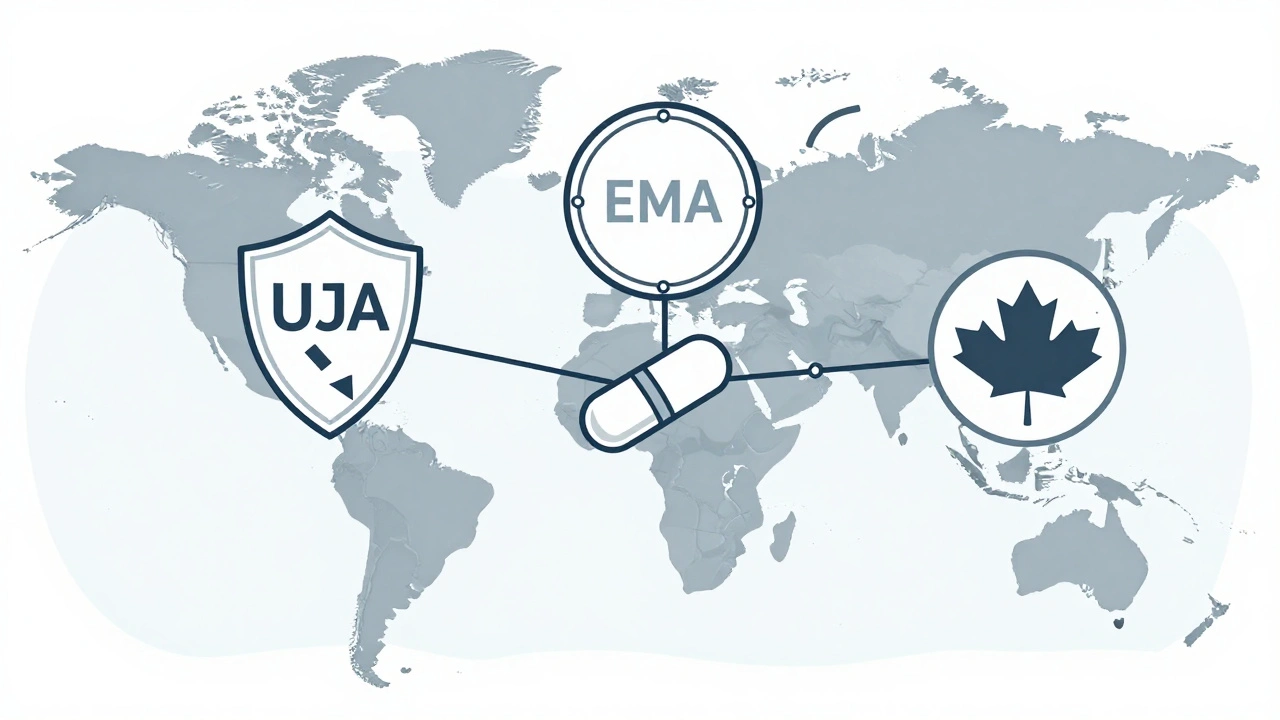
The EMA (Europe) takes a simpler route. They use a fixed range: 90-111% for both AUC and Cmax. No scaling. No variability tests. Just a narrower box.
Health Canada uses 90.0-112.0% for AUC, which is similar to the EMA but slightly looser.
Here’s how they compare:
| Agency | AUC/Cmax Range | Variability Test? | Scaling? |
|---|---|---|---|
| FDA (USA) | 80-125% (unscaled) + RSABE | Yes (ratio ≤ 2.5) | Yes (based on reference variability) |
| EMA (Europe) | 90-111% | No | No |
| Health Canada | 90.0-112.0% (AUC only) | No | No |
The FDA’s method is more precise - but also more expensive. Studies now need 36 to 54 participants instead of the usual 24 to 36. That pushes costs from $300,000-$700,000 to $500,000-$1 million per drug. That’s why fewer generic companies bother with NTI drugs.

Real-World Evidence Shows It Works
Some doctors still hesitate to prescribe generic NTI drugs. They worry about switching patients. But real-world data is starting to ease those fears.
A 2017 study in the American Journal of Transplantation followed over 1,000 kidney transplant patients who switched from brand to generic tacrolimus. Using the FDA’s stricter criteria, researchers found no increase in rejection rates or side effects.
In 2019, a study in Circulation: Cardiovascular Quality and Outcomes looked at over 10,000 patients on warfarin. They found no difference in bleeding or clotting events between brand and generic versions - even after switching.
These aren’t lab studies. These are real people, in real clinics, taking the drugs daily. The results show that when the bioequivalence rules are strict enough, generics are just as safe.
Why This Matters for Patients and Prescribers
Generic drugs save money - a lot of it. But for NTI drugs, cost savings can’t come at the cost of safety. That’s why regulators didn’t just tighten the rules. They redesigned them.
Patients who rely on these drugs need consistency. If you’ve been on the same brand of levothyroxine for years and your doctor switches you to a generic, you shouldn’t need to get your blood tested every week. You shouldn’t feel anxious about whether the pill you just swallowed will work.
Prescribers need confidence. The FDA’s approach gives them that. It’s not about being overly cautious - it’s about being scientifically precise. If a generic passes the FDA’s three-part test, it’s not just “similar.” It’s proven to behave like the brand in real people.
That’s why the FDA doesn’t just list NTI drugs. They issue product-specific guidance for each one. As of 2023, they’ve done this for 15 drugs - including warfarin, phenytoin, and digoxin. And they’re planning to expand the list using a new quantitative method based on therapeutic index calculations, instead of relying on expert opinion.
Challenges and the Road Ahead
There’s still friction.
First, the lack of a public, official list of NTI drugs makes it hard for generic manufacturers to know which drugs they can target. They’re playing guesswork - and that slows down development.
Second, the cost of studies is high. Smaller companies can’t afford the $1 million price tag. That means fewer competitors - which could keep prices higher than they should be.
Third, there’s debate. Some experts, like Dr. Lawrence Lesko, argue that for some NTI drugs, the extra rules don’t add real safety - just cost. They worry the system might block good generics.
But the FDA is listening. They’re reviewing post-marketing data from approved generics. They’re working with EMA and Health Canada to align standards. Industry analysts predict that by 2026, global harmonization could reduce study costs by 15-20%.
For now, the message is clear: if you’re taking an NTI drug, switching to a generic isn’t a gamble - if it’s been approved under the new rules.
What’s Next for NTI Drug Regulation?
The FDA plans to finalize its guidance on reference-scaled bioequivalence by mid-2024. That will turn current draft rules into binding law.
They’re also building a new classification system. Instead of saying “phenytoin is NTI,” they’ll calculate its therapeutic index using clinical data - making the list more objective and science-based.
And while the EMA and Health Canada haven’t adopted the FDA’s scaling model, they’re watching closely. If more real-world data keeps showing safety, we may see more agencies move toward similar methods.
For patients, this means more access to affordable generics - without the fear. For manufacturers, it means a clearer, though tougher, path to market. For doctors, it means less hesitation when prescribing.
The goal isn’t to stop generics. It’s to make sure the ones that reach patients are truly safe. And that’s worth the extra effort.
Benjamin Sedler
Let’s be real - the FDA’s whole RSABE thing is just corporate theater. They want you to think they’re being ‘scientific’ but it’s just a way to keep generics off the market so Big Pharma can keep pricing gouging. I’ve seen patients pay $300 for a brand-name warfarin pill while the generic costs $5. If the blood levels are ‘similar enough’ for 99% of drugs, why the hell is this one sacred? It’s not science - it’s profit.
Jessica Baydowicz
Y’all need to chill. I’m a pharmacist and I’ve been switching folks to generic NTI drugs for years under the new rules - zero issues. The data’s solid. The FDA didn’t make this up to annoy you, they did it because real people got hurt. Now? People save hundreds a month and don’t end up in the ER. That’s a win.
Shofner Lehto
There’s a dangerous myth that all generics are equal. This post clarifies why that’s not just wrong - it’s life-threatening. The FDA’s three-tiered approach isn’t bureaucracy, it’s precision medicine. One size doesn’t fit all, especially when one size could kill you. We need more of this rigor, not less.
val kendra
My grandma’s on levothyroxine. Switched her to generic last year. No changes. No weird symptoms. No panic. She saves $120 a month. The FDA’s rules aren’t overkill - they’re the bare minimum to protect people like her. Stop treating patients like lab rats. If the generic passes the test, trust it.
Isabelle Bujold
As someone who works in regulatory affairs in Canada, I’ve watched this whole debate from the sidelines. The EMA’s fixed 90-111% range is clean and simple, but it’s also rigid. The FDA’s method accounts for real-world pharmacokinetic noise - which matters when you’re dealing with drugs like tacrolimus where a 5% dip can trigger rejection. We’re not far behind here, but we’re still playing catch-up. The science is clear: variability matters, and one-size-fits-all is outdated.
Ben Choy
Just wanted to say thanks for this. I’ve been nervous about switching my dad’s digoxin to generic. This broke it down in a way that actually made me feel better. I’ll tell my GP to check if it’s FDA-approved. Small wins matter.
Ashley Elliott
...I just read this whole thing. Twice. And I’m still not sure if I should be relieved or terrified. But I’m glad someone’s paying attention. This isn’t just about pills - it’s about trust. And if the system’s rigged to protect profits over patients, then we’re all in trouble.
Ollie Newland
RSABE is essentially a statistical sleight of hand. The variability test (ratio ≤ 2.5) is arbitrary - it’s not grounded in clinical outcomes, it’s a regulatory artifact. We’re optimizing for statistical compliance, not patient safety. The EMA’s approach may be blunt, but it’s transparent. And transparency builds trust.
Rebecca Braatz
Let’s stop pretending this is about science. It’s about money. The FDA’s process costs $1M per drug. Only big pharma can afford that. So guess what? The market stays monopolized. That’s not regulation - that’s cartel protection disguised as safety. We need public funding for NTI bioequivalence studies. Not corporate gatekeeping.
Michael Feldstein
My brother’s a transplant patient on tacrolimus. He switched to generic last year after the FDA approved it. No rejection. No side effects. His bloodwork’s perfect. He’s saving $200 a month. If the data says it’s safe, why are we still arguing? We’re letting fear override evidence. That’s not helping anyone.
jagdish kumar
Is this not just another example of how medicine has become a mathematical religion? We worship p-values and confidence intervals like they’re divine. But a human heart doesn’t care about 90-111% - it cares about whether the pill works today. Maybe the real NTI drug isn’t warfarin… it’s trust.