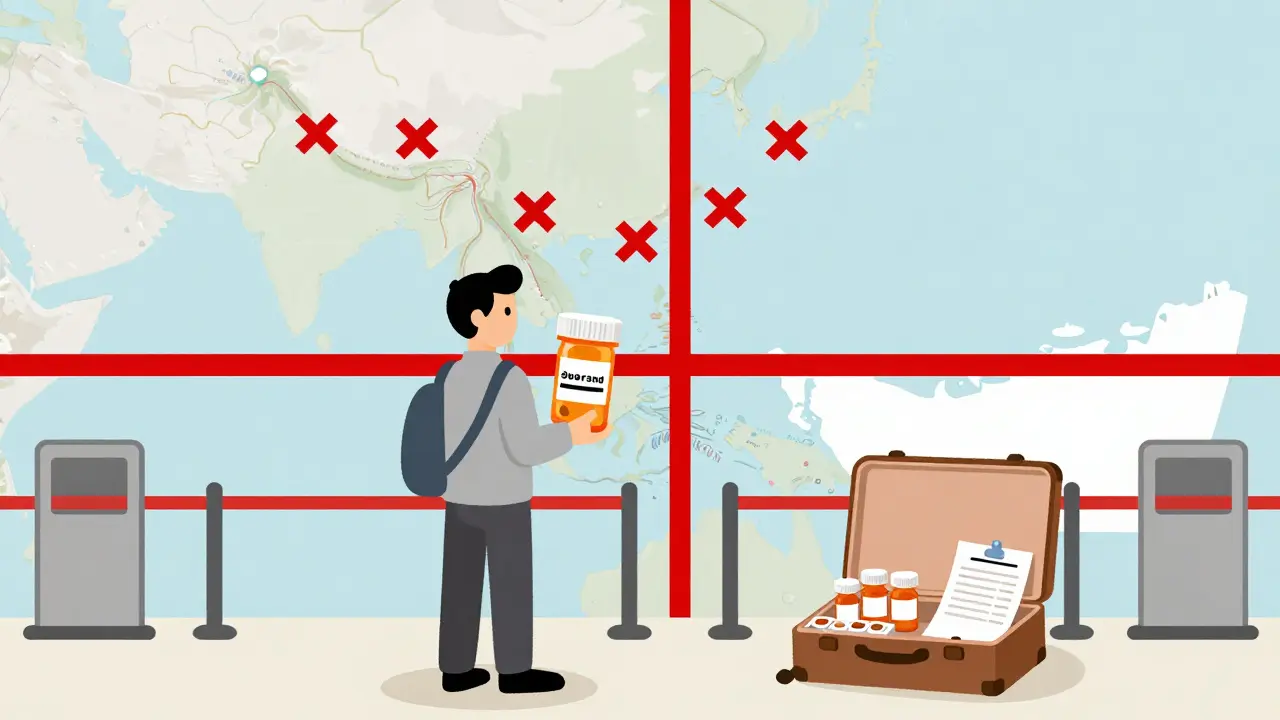
Traveling with medication isn’t just about packing your pills. If you don’t know the rules, you could lose your medicine at the border, face fines, or even get arrested-no matter how legal it is at home. In 2026, the rules have gotten tighter, more confusing, and more inconsistent than ever. What’s allowed in New Zealand might be banned in Thailand. A drug you can buy over the counter in Canada could require a special permit in Japan. And if you’re carrying anything even remotely controlled-like Adderall, Xanax, or painkillers-you’re walking into a minefield.
What’s Allowed? It Depends on Where You’re Going
There’s no global standard for bringing medication across borders. The U.S. lets you bring a 90-day supply of most prescription drugs for personal use. Canada allows up to 180 days. The European Union generally sticks to 90 days, but Germany, France, and Italy each have their own tweaks. Some countries, like Singapore and the UAE, ban even common medications like pseudoephedrine or codeine. Others, like Australia, require you to declare every single pill-even your daily multivitamin-if it contains a regulated substance.The biggest shift in 2025 was the U.S. suspension of the $800 de minimis threshold for medication shipments. That meant packages under $800 used to slip through customs without fees or delays. Now, every box of pills, no matter how small or cheap, gets flagged. Processing times jumped from 2 days to over 5 days on average. If you’re mailing your meds ahead of a trip, plan for delays. Don’t assume your prescription will arrive before you do.
Controlled Substances Are the Biggest Risk
Not all medications are treated equally. The real danger lies in controlled substances-drugs with potential for abuse. That includes:- Stimulants: Adderall, Ritalin, Vyvanse
- Benzodiazepines: Xanax, Valium, Klonopin
- Opioids: Oxycodone, Hydrocodone, Codeine
- Sleep aids: Ambien, Lunesta
According to the International Narcotics Control Board (INCB), 87% of countries restrict at least one of these. In Southeast Asia, even a single Xanax pill can get you jailed. In the Middle East, sleeping pills are treated like heroin. In Japan, Adderall is illegal unless you have a special government permit-obtained before you leave.
Here’s what actually happens at the border: If you’re carrying these drugs without the right paperwork, customs agents don’t ask questions. They confiscate them. Then they decide whether to let you go-or start an investigation. In 2024, the DEA processed over 12,000 requests for personal importation of controlled substances. Only 78% were approved. That means nearly one in four people trying to bring these meds into the U.S. were denied. Imagine what happens when you’re trying to bring them out of the U.S. into a stricter country.
Documentation: Your Lifeline
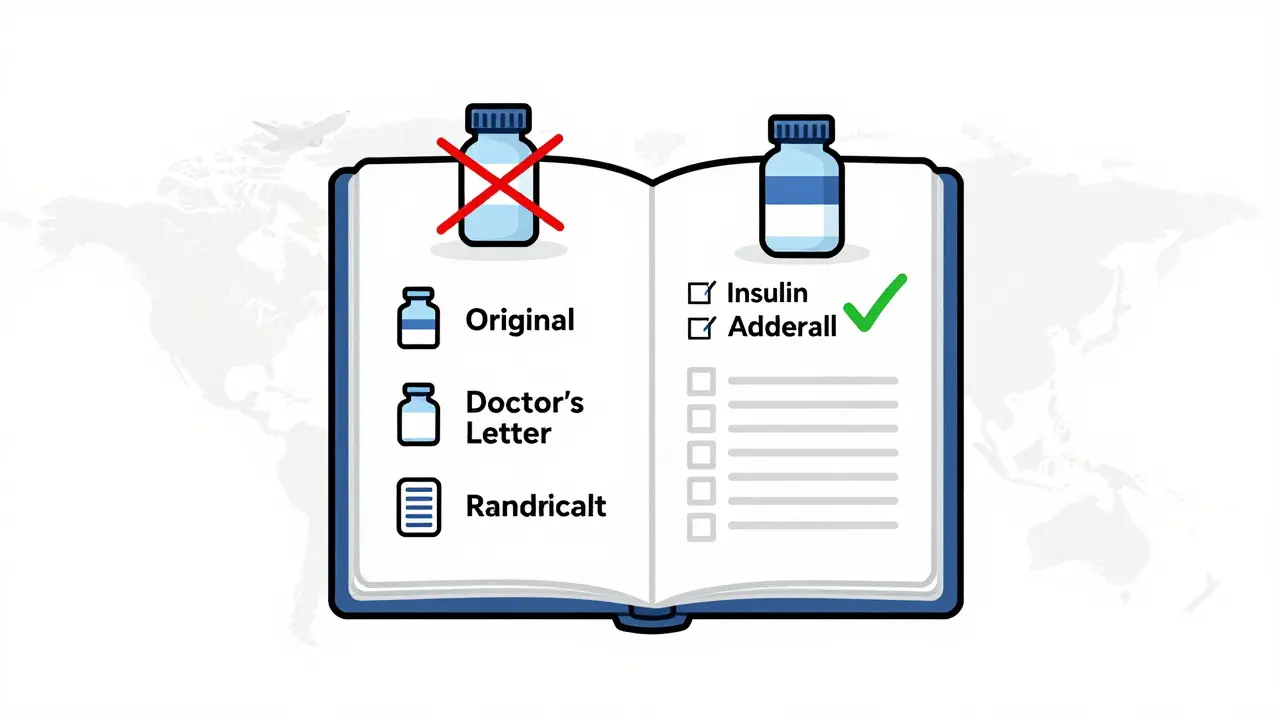
The number one thing that saves travelers isn’t luck-it’s paper. You need three things:- Original prescription bottles with the pharmacy label showing your name, the drug name, dosage, and your doctor’s info. This isn’t optional. If you transfer pills to a pill organizer, you’re breaking the rules. Keep them in the original containers.
- A doctor’s letter on official letterhead. It should list your name, the medication’s generic name (not brand name), dosage, frequency, and why you need it. For example: “Patient requires 20mg Adderall daily for diagnosed ADHD.” Include your doctor’s phone number and license number.
- A translated copy if you’re going to a non-English-speaking country. In 78 countries, you must have your prescription translated into the local language. Some embassies offer free translation services. Others charge $50-$100. Don’t rely on Google Translate. Customs officers won’t accept it.
Travelers who carry all three documents report a 62% lower chance of issues, according to PlanetDrugsDirect’s 2025 survey. Those who skip the letter? Over half get questioned. One in three have meds seized.
Medical Devices and Special Cases
If you use an insulin pump, continuous glucose monitor (CGM), or nebulizer, you’re not just carrying pills-you’re carrying medical equipment. The TSA allows these devices on planes, but you must notify them in advance. Call the TSA Cares hotline at 1-855-787-2227 at least 72 hours before your flight. Bring a doctor’s note explaining the device. Don’t wait until you’re at security to explain.For travelers with diabetes, insulin is generally allowed worldwide-but not always. In Saudi Arabia, insulin pens must be declared. In China, you need a letter from your doctor in both English and Chinese. In Australia, you can bring up to a 12-month supply, but you must apply for approval ahead of time.
And what about marijuana? Even if it’s legal in your state, federal law still bans it. You can’t bring CBD oil into Canada unless it’s from a licensed producer. In Japan, CBD is treated like THC-strictly illegal. In the EU, CBD laws vary by country. If you’re unsure, leave it at home.
Real Stories, Real Consequences
A Reddit user from California flew to Thailand with her Xanax prescription. She had the bottle, the letter, everything. But Thailand doesn’t recognize U.S. prescriptions for benzodiazepines. Her meds were taken. She spent three days in a detention center before being released. She never got her pills back. Another traveler brought Adderall to Dubai. He didn’t declare it. Customs found it in his bag. He was fined $10,000 and banned from entering the country for five years. On the flip side, a nurse from New Zealand flew to Japan with her insulin and a letter translated by the Japanese embassy. She carried her bottles in her carry-on, showed them at security, and walked through without a single question. She had done her homework.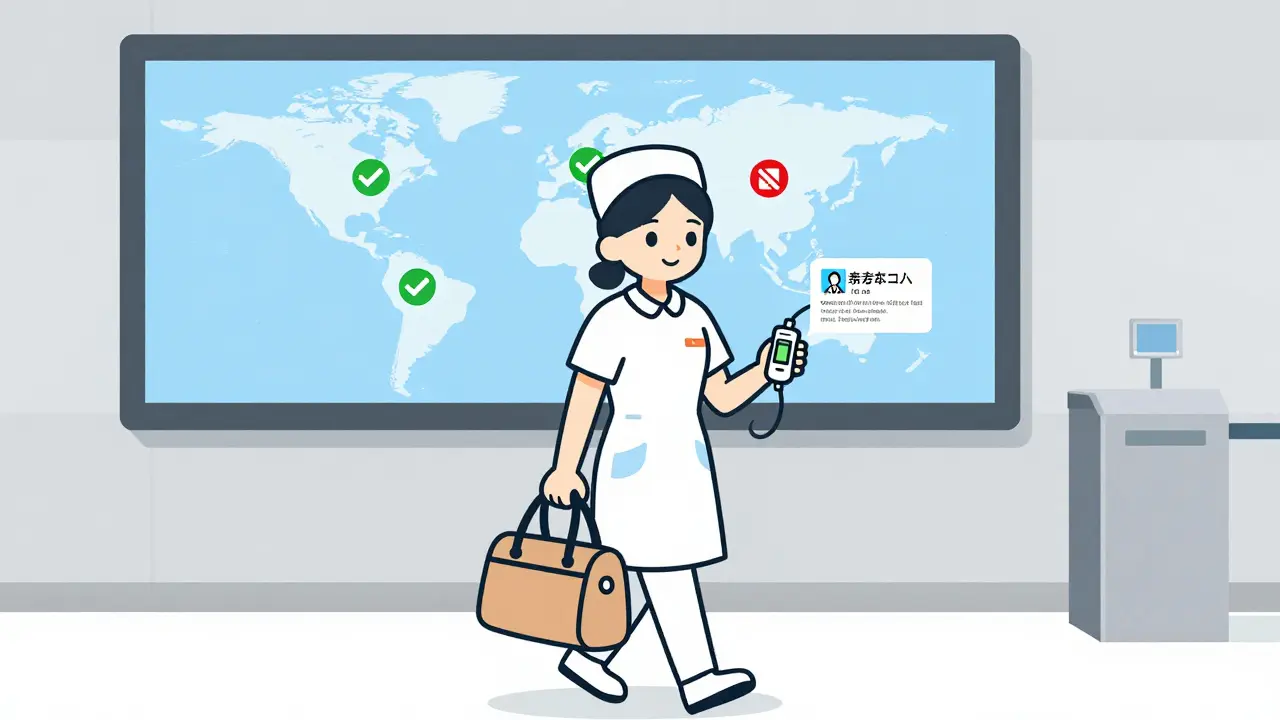
How to Prepare (Step by Step)
Don’t wait until the night before your flight. Start 6-8 weeks out:- Check your destination’s rules. Use the INCB’s online database (updated October 2025) to search for your medication by generic name. It lists whether it’s banned, restricted, or allowed.
- Contact the embassy. Call or email the embassy of your destination country. Ask: “Is [generic drug name] allowed for personal use? What documentation is required?” Get their answer in writing.
- Get your doctor’s letter. Don’t use a template. Make sure it’s on letterhead, signed, dated, and includes contact info.
- Translate if needed. Use a certified translator. Many embassies have lists of approved translators. Don’t risk a bad translation.
- Carry meds in original bottles. No pill organizers. No Ziploc bags. No unlabeled containers.
- Keep meds in your carry-on. Checked luggage can be lost. If your insulin or heart medication vanishes, you’re in danger.
- Bring extra. Pack a 10-15% buffer in case of delays. Don’t rely on buying more abroad.
What to Do If Your Meds Are Confiscated
If customs takes your medication:- Stay calm. Arguing won’t help.
- Ask for a written receipt. It may help if you need to file a complaint later.
- Contact your country’s embassy immediately. They can’t get your meds back, but they can help you find local alternatives or arrange medical care.
- Don’t lie. If you hid meds, you’re now in deeper trouble.
Some countries offer emergency prescriptions. Others don’t. If you’re diabetic or have a chronic condition, you need a backup plan. Know where the nearest pharmacy or hospital is. Save the contact info for your doctor in case you need a new prescription.
The Future Is Getting Harder
The trend is clear: more restrictions, more paperwork, more enforcement. By 2027, 45% of countries plan to tighten rules further-especially around synthetic opioids and mental health meds. The EU is moving toward a 60-day limit for personal imports. The U.S. will require electronic tracking for all imported drugs by January 2026. That means even pharmacies will need to label your meds with digital codes.For travelers, that means more delays, more costs, and more confusion. The days of slipping through with a bottle in your suitcase are over. The only way to travel safely with medication now is to plan like a diplomat-not a tourist.
Can I bring my prescription meds in a pill organizer?
No. Most countries require medications to be in their original, labeled containers with the pharmacy’s information visible. Pill organizers are acceptable only if you also carry the original bottles with you. Some customs officers will confiscate pills from unlabeled containers, even if you have a prescription.
Are over-the-counter drugs like ibuprofen or allergy pills restricted?
Most common OTC drugs like ibuprofen, acetaminophen, or loratadine are allowed worldwide. But some countries ban pseudoephedrine (found in cold meds) because it can be used to make illegal drugs. Always check the specific rules for your destination-even if it seems harmless.
Do I need to declare my meds at customs?
It depends. In the U.S., Canada, and the EU, you’re not required to declare personal-use meds unless asked. But in countries like Australia, Japan, or the UAE, you must declare all medications on arrival forms. When in doubt, declare them. It’s safer than hiding them.
What if my medication is banned in my destination country?
You cannot legally bring it. Contact your doctor before your trip to find an alternative that’s allowed. Some countries permit similar medications with different names. For example, if Adderall is banned, your doctor might prescribe a different stimulant that’s legal in Japan. Never try to smuggle it.
Can I mail my medication ahead of time to avoid carrying it?
You can, but it’s risky. Since August 2025, all international medication shipments are subject to customs inspection, duties, and delays. Processing now takes 5-7 business days on average. If your meds arrive late, you’re stuck without them. Only mail if you have a backup supply and can wait.
Patrick Merrell
People still think they can just wing it with meds like it's 2012? This isn't a backpacking trip to Bali anymore. Every country has its own rules, and if you don't respect them, you're not a traveler-you're a liability. I've seen customs agents roll their eyes at Americans who show up with a Ziploc bag of Adderall and a smile. Don't be that guy.
TONY ADAMS
bro i just put my xanax in my pocket and flew to mexico last month and no one said a word lmao
George Rahn
The erosion of sovereign pharmaceutical autonomy is not merely bureaucratic-it is a metaphysical surrender to global technocratic hegemony. We have traded the dignity of individual medical sovereignty for the illusion of procedural compliance. The original prescription bottle, once a symbol of personal autonomy, is now a bureaucratic talisman demanded by faceless bureaucracies who view the human body as a data point in a global surveillance matrix. The doctor's letter? A feudal oath. The translation? A linguistic colonization. And yet-we comply. Why? Because we have forgotten how to resist.
Ashley Karanja
There's a deep psychological and systemic tension here between autonomy and regulation-especially when we consider how mental health medications are pathologized differently across cultures. In the U.S., ADHD is normalized to the point of overprescription, but in Japan, it's treated as a social deviance requiring state-level authorization. This isn't just about logistics-it's about epistemic injustice. The burden of translation, documentation, and preemptive compliance falls disproportionately on neurodivergent and chronically ill travelers, who are already navigating medical systems that don't center their lived experience. We need structural change, not just better packing lists. The current framework treats patients as suspects, not citizens.
Karen Droege
Listen. I’m a nurse who’s flown to 17 countries with insulin, and I’ve had zero issues because I treated this like a mission, not a chore. I called the Japanese embassy. I got my letter translated by a certified pro. I packed my pens in my carry-on with a printed copy of the WHO guidelines. I showed them at security like I was handing over my boarding pass-not like I was smuggling contraband. And guess what? They nodded, thanked me, and let me through. This isn’t about fear-it’s about preparation. You want to travel? Then act like you belong in the world, not like you’re begging for permission to exist in it. Stop cutting corners. Your life depends on it.
Napoleon Huere
It’s fascinating how we’ve turned something as basic as taking medicine into a geopolitical negotiation. We’re not just carrying pills-we’re carrying cultural assumptions. The U.S. sees meds as a right. Japan sees them as a privilege. The EU sees them as a regulated commodity. And somewhere in between, the individual gets lost. Maybe the real question isn’t how to comply with the rules-but why we’ve allowed rules to become so fragmented in the first place. Is this really safety? Or is it control dressed up as caution?
Shweta Deshpande
So many of us stress about visas and flights but forget the little things that can ruin everything. I took my antidepressants to India last year and didn’t even know they needed a doctor’s note-I just had the bottle. Lucky for me, the officer was nice and just asked me to write down the generic name. I did, and he waved me through. But I cried after because I realized how lucky I was. Don’t wait for luck. Do the work. It’s not that hard. Just a few emails, a printout, and a little patience. You’re worth the effort.
Neil Thorogood
Oh wow, so now I need a notarized affidavit, a certified translator, and a background check just to bring my Adderall to Canada? 🤡 Next they’ll ask for my astrological sign to determine if I’m 'medically compatible' with the country. Look, I get it-some places are crazy strict. But this isn’t prevention. This is performance. They’re not protecting you. They’re protecting themselves from liability. And you? You’re the one paying with your time, your stress, and your dignity. So yeah. Bring your meds. Bring your letter. Bring your patience. And bring your rage. You’ve earned it.
Jessica Knuteson
Documented cases show 62% reduction in issues with proper paperwork. That means 38% still get hit. So the system isn’t working. It’s just making people feel safer while still failing them. The real problem isn’t travelers. It’s the lack of international standardization. And the fact that no one in power actually cares enough to fix it.
Robin Van Emous
I’ve traveled to over 20 countries with chronic illness meds, and I’ve learned this: every country has a story. Some are strict because of past drug scandals. Others are paranoid because of foreign policy. But most officers just want to do their job without getting in trouble. If you show up calm, prepared, and respectful-with your bottles, your letter, your translation-you’re not a threat. You’re a person. And people respond to people. Don’t treat this like a battle. Treat it like a conversation. You’ll get further. And honestly? You’ll sleep better at night.