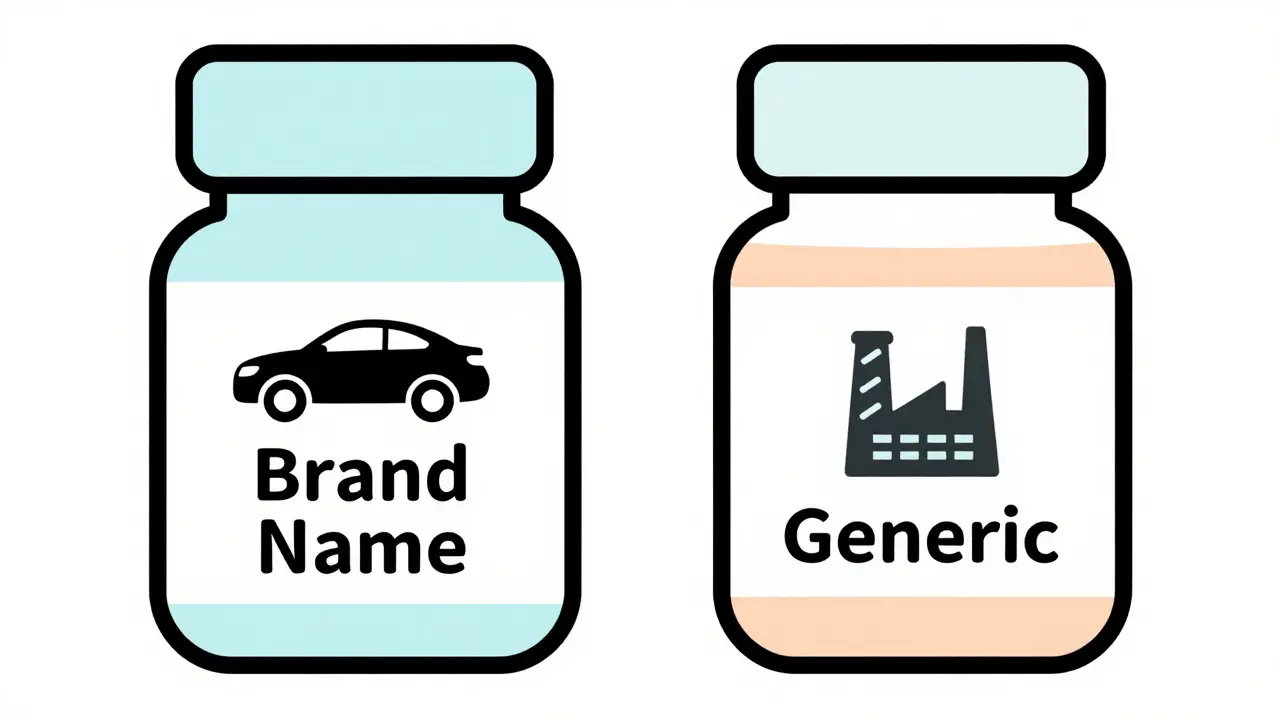
Why generic drugs cost a fraction of branded ones
Ever wonder why a bottle of generic ibuprofen costs $5 while the brand-name version costs $30-even though they’re the same thing? It’s not magic. It’s math. And the math behind generic drug manufacturing is simple: generic drugs avoid the massive costs that branded drugs carry, and they make up for it with volume, efficiency, and ruthless optimization.
Here’s the real breakdown. A brand-name drug like Lipitor took 12 years and $2.6 billion to develop. That’s money spent on labs, clinical trials, regulatory filings, and years of failed compounds. Generic manufacturers don’t do any of that. They wait. They watch. And when the patent expires, they step in-not to invent, but to copy. And that’s where the savings begin.
The $2.6 billion advantage
Branded drug companies have to prove their medicine is safe and effective from scratch. That means testing on thousands of patients over years, paying for expensive trials, and submitting reams of data to the FDA. The process can take over a decade.
Generic manufacturers? They only need to prove their version is bioequivalent. That means it delivers the same amount of active ingredient into the bloodstream at the same rate as the brand. No need for new clinical trials. No need to re-prove safety. Just a few hundred volunteers, a couple of months, and a few million dollars. The FDA says the average cost to get a generic approved? Between $2 million and $5 million. That’s less than 0.2% of what it costs to bring a new drug to market.
That difference isn’t just a cost cut. It’s a complete restructuring of the business model. Branded drugs are built like luxury cars-custom-engineered, heavily marketed, and priced to recoup investment. Generics are built like mass-produced sedans-reliable, efficient, and priced to move.
How production volume crushes unit costs
Once a generic drug is approved, the real cost magic happens on the factory floor. Generic manufacturers don’t make one or two versions-they make hundreds. And the more they make, the cheaper each pill becomes.
For every doubling of production volume, the cost per unit drops by about 18%. For a single drug with high demand-like metformin or atorvastatin-companies might produce over 40 billion tablets a year. At that scale, the cost of making one pill can be less than a penny. That’s not a guess. It’s from benchmarking studies by the Boston Consulting Group that tracked 15 major generic producers.
And it gets better. When a drug has six or more generic competitors, prices can fall over 95% below the original brand. That’s not speculation-it’s FDA data from 1,200 drug products. With two competitors, prices are already 54% lower. With 10? You’re looking at pennies.
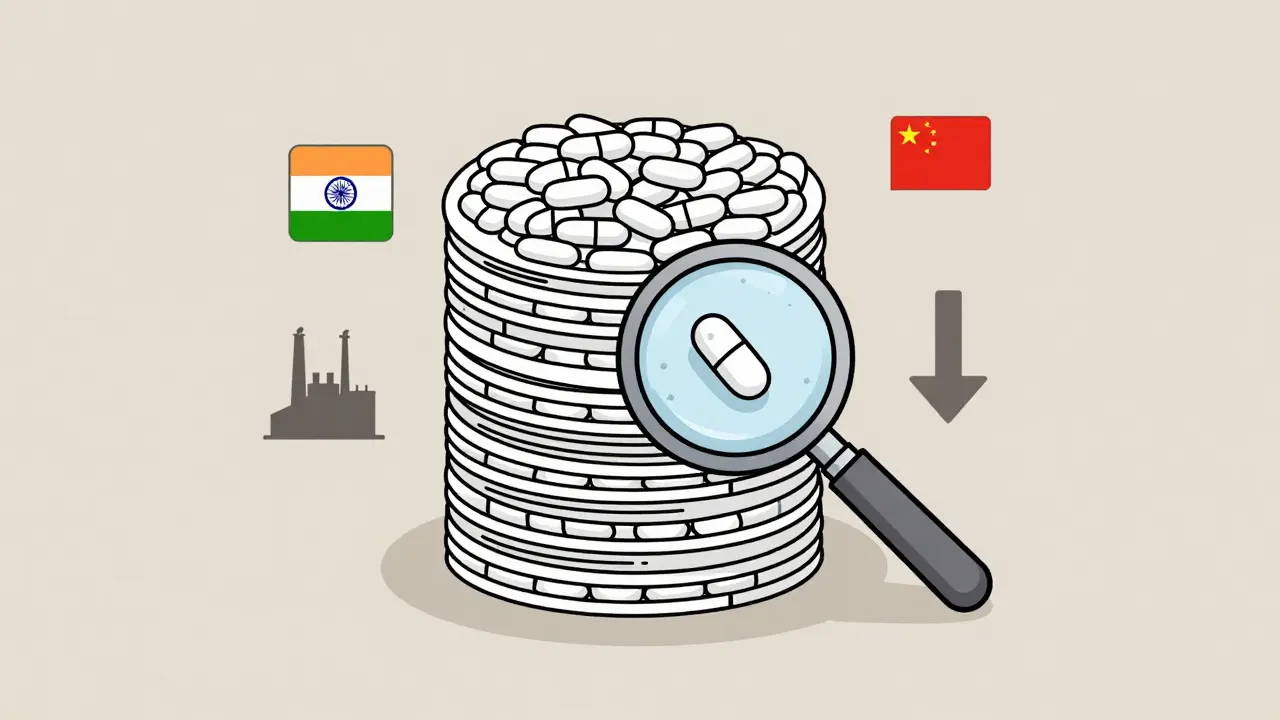
Where the money actually goes
Let’s say you buy a 30-day supply of generic lisinopril for $4. Where does that $4 go?
- Active Pharmaceutical Ingredient (API): About 50-60% of the cost. This is the actual medicine. But here’s the twist-API prices can swing 20-30% in a year based on where it’s made and what raw materials cost. Most APIs come from India and China, and supply chain shifts hit hard.
- Excipients: 10-15%. These are the fillers, binders, and coatings that make the pill hold together and look right. They’re cheap, but they have to be FDA-approved.
- Quality control: 5-8%. Every batch is tested. Every machine is calibrated. Every lab is audited. It’s not glamorous, but it’s non-negotiable.
- Packaging: 5-10%. Blister packs, bottles, labels, cartons. Even this gets optimized. Some companies use the same bottle for 20 different drugs.
- Marketing and sales: 1-3%. Unlike branded drugs that spend billions on TV ads and doctor visits, generics rely on pharmacies and insurance formularies. No billboards. No sales reps. Just low prices and volume.
That leaves maybe 20-30% as profit. And that’s after paying for factory maintenance, labor, and compliance. Most generic manufacturers operate on margins under 10%. Some, like Teva or Sandoz, make money by volume-not markup.
The supply chain game
One of the biggest reasons generics are cheap is because they don’t control the whole chain. Branded companies own the R&D, the patents, the marketing, and often the distribution. Generics? They just make the pill.
They don’t need to pay for advertising. They don’t need to pay doctors to prescribe. They don’t even need to build a sales team. Instead, they rely on pharmacy benefit managers (PBMs) and insurance networks to push their products. And because they’re cheaper, PBMs and insurers love them. They get rebates. They get preferred placement. And they pass the savings to patients.
That’s why 90% of all prescriptions in the U.S. are filled with generics-but they only make up 16% of total drug spending. You’re getting 9 out of 10 pills for less than 1 in 6 dollars. That’s not a glitch. That’s the system working as designed.
Where generics struggle
Not all drugs are easy to copy. Complex generics-like inhalers, injectables, or topical creams-are harder to replicate. Why? Because the delivery system matters as much as the drug. A generic inhaler doesn’t just need the right chemical. It needs the same spray pattern, the same particle size, the same pressure. That requires advanced engineering and testing. And that costs more.
Some generics are still expensive because only one or two companies can make them. That’s called a “monopoly of capability.” For example, when a drug requires sterile filling in a clean room with special equipment, only a handful of factories can do it. That limits competition, which keeps prices higher.
And then there’s the API problem. When a key ingredient comes from just one factory in China-and that factory shuts down for safety issues-the whole market feels it. That’s how drug shortages happen. The FDA counted 350 active shortages in 2022, many tied to generic drug supply chains that were stretched too thin.

The future: automation, regulation, and consolidation
The industry is changing. Companies are investing in continuous manufacturing-machines that turn raw powder into finished pills in one unbroken line. That cuts labor, reduces waste, and speeds up production. By 2027, automation could cut generic production costs by another 20-25%.
At the same time, regulations are tightening. The FDA’s new GDUFA III program is increasing fees to speed up approvals. That’s good news for patients-it means generics hit the market faster. But it also means smaller companies can’t afford to play. That’s pushing consolidation. The top 10 generic makers now control over half the global market.
And then there’s the Inflation Reduction Act. For the first time, Medicare can negotiate drug prices. That could push generic prices down another 10-15%. Some manufacturers are already preparing for it by cutting costs even further.
Meanwhile, biosimilars-generic versions of complex biologic drugs-are following the same path. Their production costs are dropping 15% per production doubling, just like small-molecule generics. The next wave of savings is coming.
What this means for you
If you’re paying for prescriptions, generics are your best friend. They’re not cheaper because they’re worse. They’re cheaper because they’re smarter. They don’t waste money on ads, on 10-year R&D cycles, or on monopolizing patents. They focus on one thing: making a safe, effective medicine as cheaply as possible.
Ask your pharmacist for the generic version. It’s not a compromise. It’s a smarter choice. And if you’re worried about quality? The FDA inspects every generic factory-same as branded ones. The standards are identical.
The system isn’t perfect. Supply chains are fragile. Profit margins are thin. But for the patient, the math still adds up. Generics save the U.S. healthcare system over $300 billion every year. And that number is only going up.
Are generic drugs as effective as brand-name drugs?
Yes. By law, generic drugs must contain the same active ingredient, strength, dosage form, and route of administration as the brand-name version. They must also be bioequivalent-meaning they work the same way in the body. The FDA requires this before approving any generic. Thousands of studies confirm that generics perform just as well as brand-name drugs in real-world use.
Why do generic pills look different?
Generic pills can look different because trademark laws prevent them from copying the exact shape, color, or logo of the brand-name drug. But the active ingredient is identical. The differences are only in the inactive ingredients-like dyes or fillers-which don’t affect how the drug works. Some people notice a change in taste or size, but that doesn’t mean the medicine is less effective.
Do generic drugs have more side effects?
No. Side effects come from the active ingredient, not the packaging or fillers. The FDA monitors adverse events for both branded and generic drugs equally. If a generic caused more side effects, it would be pulled from the market. There’s no evidence that generics are riskier. In fact, most side effect reports come from brand-name drugs simply because they’re prescribed more often early on.
Why are some generics still expensive?
Some generics stay expensive because few companies can make them. Complex drugs like inhalers or injectables require specialized equipment and expertise. If only one or two manufacturers can produce them, competition stays low-and prices stay high. Also, if the active ingredient comes from a single supplier and that supplier has a shortage, prices spike. These are exceptions, not the rule.
Can I trust generics made overseas?
Yes. The FDA inspects all manufacturing facilities-whether they’re in the U.S., India, China, or elsewhere. Over half of all generic drugs sold in the U.S. are made overseas, and they’re held to the same standards as U.S.-made drugs. The FDA conducts thousands of inspections each year. If a facility fails, it’s shut down. The system isn’t perfect, but it’s rigorous.
Will Medicare’s new drug price rules affect generic prices?
Yes. The Inflation Reduction Act allows Medicare to negotiate prices for certain drugs, including some generics. While the law targets high-cost brand-name drugs first, it creates pressure across the board. Generic manufacturers may face 10-15% price reductions in the coming years as payers demand lower costs. This could lead to more consolidation, but it will also push efficiency and innovation in production.
What to do next
If you’re on a prescription, ask your pharmacist: “Is there a generic version?” If they say no, ask why. Sometimes it’s because the drug is new. Sometimes it’s because the insurance plan doesn’t cover it. But often, it’s just inertia. Don’t assume the brand is better. Ask for the data. Ask for the cost. And if you’re paying out of pocket, always compare prices-some pharmacies offer generics for under $5 even without insurance.
And if you’re managing a chronic condition-diabetes, high blood pressure, high cholesterol-switching to generics can save you hundreds, even thousands, a year. That’s not a small thing. That’s life-changing money.
Kaylee Esdale
I used to buy brand-name ibuprofen out of habit until my pharmacist asked why I was throwing away money. Same pill. Same results. Just no fancy packaging. Now I save $25 a month and buy coffee with it. Life's small wins, ya know?
Chris Van Horn
The notion that generics are 'just as good' is a dangerous myth propagated by pharmaceutical lobbyists and FDA bureaucrats who have zero skin in the game. Bioequivalence is a statistical fiction-real-world pharmacokinetics vary wildly across populations, and the FDA's approval thresholds are laughably lax. This is not medicine-it's commoditized placebo engineering.
Peter Ronai
You people are missing the real story. The FDA doesn't inspect factories like you think. They send a guy with a clipboard for two days. Half the generic pills in the U.S. come from India where the water is dirty and the inspectors are bribed. You think your $4 lisinopril is safe? It's a lottery. And don't even get me started on the Chinese API factories that shut down overnight and cause nationwide shortages. This system is rigged.
Anu radha
I am from India. Many of my cousins work in generic drug factories. They care a lot. They know someone’s life depends on each pill. It’s not just business. It’s honor. I am proud of them.
Sachin Bhorde
Bro, the API cost curve is wild-when China had that lockdown in 2022, the price of metformin API spiked 300% overnight. Factories had to pivot to continuous manufacturing just to stay afloat. Now with GDUFA III, the approval window's down to 8 months. Big players are gobbling up small ones. We're heading toward an oligopoly. But hey-at least the unit cost per pill is still under a cent. That’s the real win.
Joe Bartlett
I work in a UK pharmacy. We switch every patient to generics unless there's a clinical reason not to. Saves the NHS millions. Same active ingredient. Same results. The brand-name ones are just expensive marketing. Simple as that.
Marie Mee
I think the FDA is in cahoots with Big Pharma to keep us sick. Why else would they allow generics that are made in places with no clean water? My friend’s cousin took a generic and had a seizure. No one talks about that. They just say 'it's bioequivalent'. But what if your body doesn't like the dye? What if the pill has trace heavy metals? They don't test for that. They don't want you to know.
Salome Perez
I’ve worked in global health for over two decades, and I can tell you this: generic drugs have saved millions of lives in low- and middle-income countries. The manufacturing standards are stringent, the inspections rigorous, and the impact profound. To dismiss them as inferior is not only inaccurate-it’s ethically irresponsible. The real tragedy isn’t the pill’s color. It’s the people who can’t afford to even ask for the brand. Generics aren’t a compromise. They’re justice.