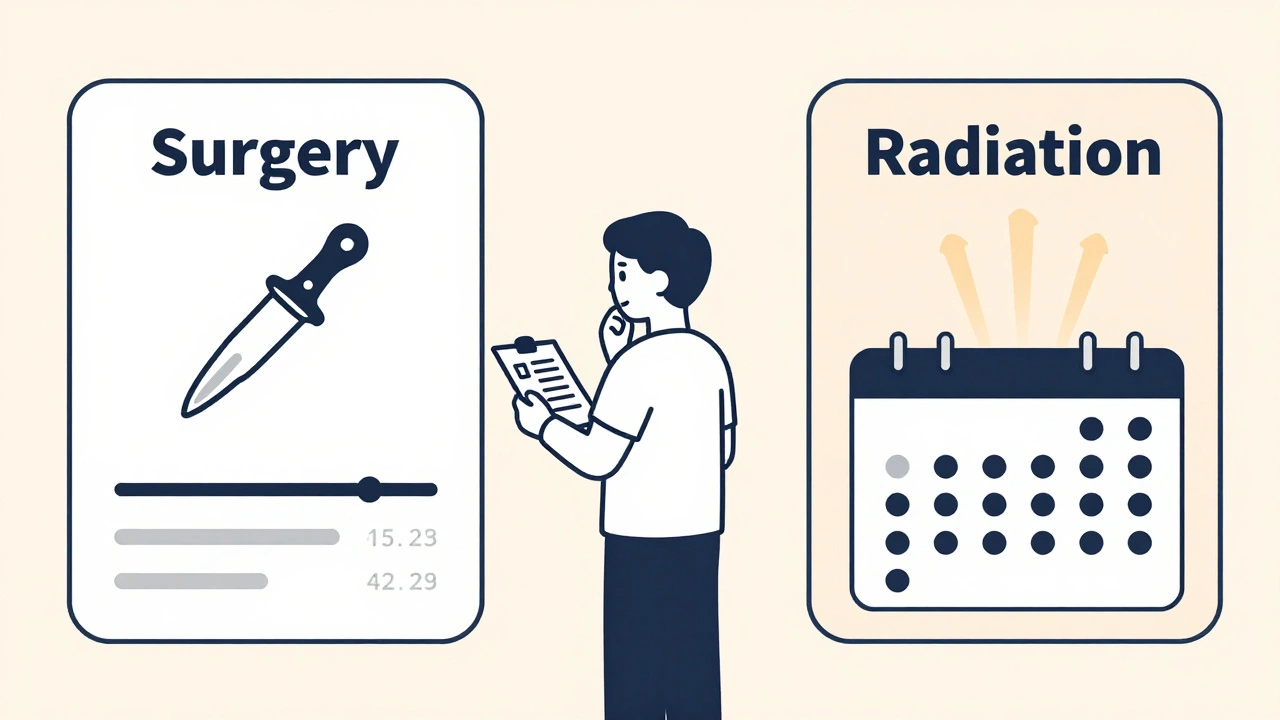
When you’re told you have localized cancer, the first big question isn’t just radiation therapy or surgery-it’s which one lets you keep living your life with the least disruption and the best chance of staying cancer-free. There’s no one-size-fits-all answer. What works for one person might not be right for another, even if they have the same type and stage of cancer. The choice comes down to your body, your priorities, and the facts behind each option.
What Does Local Control Even Mean?
Local control means stopping the cancer where it started, before it spreads. For cancers like prostate or early-stage lung cancer, the tumor hasn’t moved to lymph nodes or distant organs yet. That’s when radiation and surgery become your two main tools. Neither is a cure-all, but both can be very effective when used correctly.Surgery removes the tumor and some surrounding tissue in one go. Radiation uses high-energy beams to destroy cancer cells over time without cutting into your body. Both aim for the same outcome: no cancer left behind in the area it started. But how they get there-and what they leave behind-can be very different.
Prostate Cancer: The Numbers Behind the Choice
For prostate cancer, the debate has raged for years. The big 10-year study called ProtecT, which tracked over 1,600 men, found that survival rates were nearly identical between surgery and radiation: 96.8% for surgery, 95.7% for radiation. That sounds like a tie. But look closer, and the story changes.Men who had surgery were less likely to see the cancer come back in the prostate area-12.9% vs. 13.4% for radiation. But here’s the catch: those numbers came mostly from men with low-risk cancer. If you’re high-risk, the data shifts. A separate analysis of 91,000 patients showed that after 15 years, 62% of men who had surgery were still alive, compared to 52% who had radiation. That’s a 10-point gap. Why? Because surgery gives doctors a full look at the tumor-exactly how aggressive it is, whether it’s spread beyond the prostate. That info helps decide if you need more treatment later.
On the flip side, radiation doesn’t require cutting into your body. But it does mean showing up every weekday for 7 to 9 weeks. Each visit takes about 15 to 30 minutes, but the schedule adds up. If you live far from a treatment center, that’s hours of driving every week for nearly two months. Surgery, by contrast, is a single procedure. Hospital stay? One to three days. Recovery? Most people are back to light activity in two to four weeks.
The Side Effects You Can’t Ignore
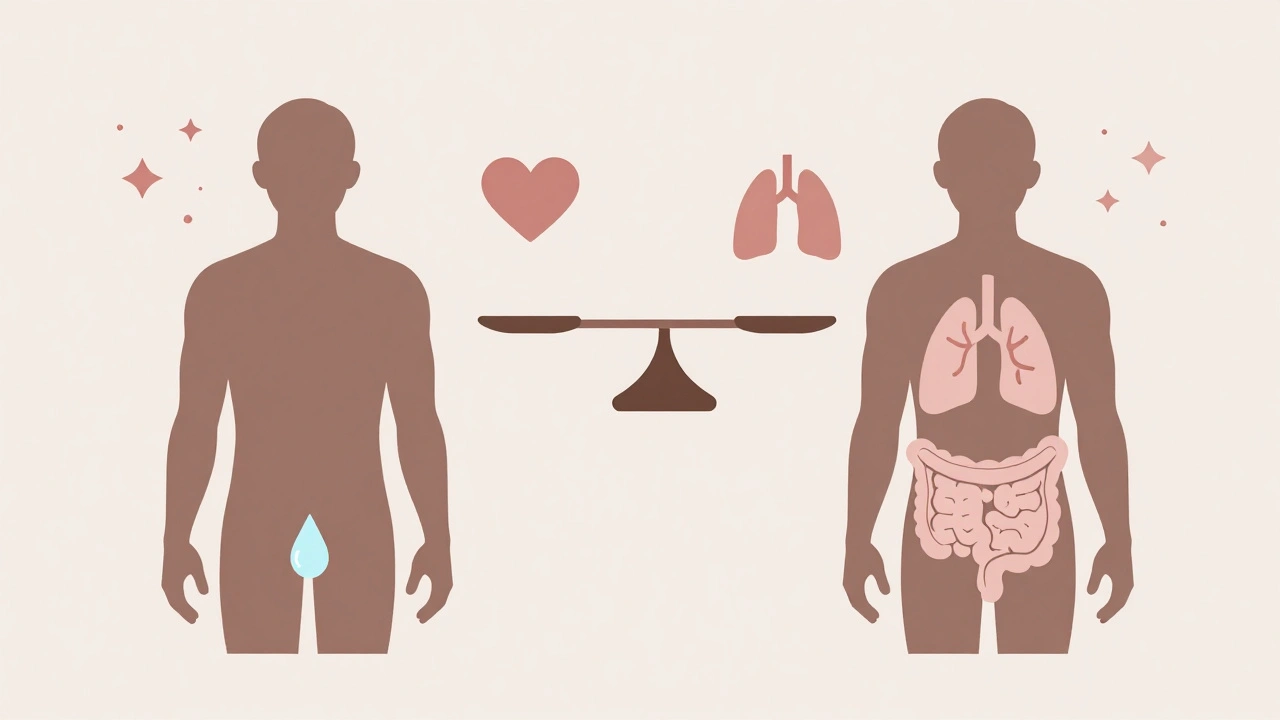
This is where people make their real decision-not just about survival, but about quality of life.After surgery, urinary leakage is common. In low-risk cases, 14% of men still had leakage 10 years later. For high-risk patients, that number jumps to 25%. Erectile dysfunction hits about 60% of men after surgery within the first year, though some recovery happens over time. Bowel issues? Rare-only 3% of surgical patients had serious problems after 10 years.
Radiation flips the script. Urinary leakage? Only 4% after 10 years for low-risk men. But bowel problems? 8% of radiation patients had serious issues like chronic diarrhea or rectal bleeding. That’s more than double the surgery group. And while sexual side effects from radiation are less immediate, they still happen-about half of men report trouble over time.
Here’s the thing: radiation side effects often show up slowly. You might feel fine during treatment, then notice changes months or years later. Surgery side effects hit hard right away but often improve. Neither is easy. But knowing what’s likely to happen helps you prepare.
Lung Cancer: Surgery Still Leads-But Radiation Has a Place
For early-stage non-small cell lung cancer, surgery is still the gold standard-if you’re healthy enough for it. A study of over 30,000 patients found that those who had surgery had a 71.4% five-year survival rate. Those who got stereotactic body radiation therapy (SBRT)-a powerful, focused form of radiation-had 55.9%. That’s a big difference.But here’s the key: SBRT was used mostly for people who couldn’t have surgery. Maybe they had heart disease, COPD, or were too frail. When you compare patients who were equally healthy, surgery wins. That’s why guidelines say: if you can have surgery, you should. But if you can’t, SBRT isn’t a second choice-it’s a proven, effective alternative. Five-year survival for medically inoperable patients still hits 40-50%, which is far better than doing nothing.
Surgery for lung cancer means removing part of a lung. Recovery takes 6 to 8 weeks. Hospital stay? 3 to 7 days. SBRT? No hospitalization. You come in, get treated in 1 to 5 sessions, and go home. Side effects? Less fatigue, no pain from incisions, but possible lung inflammation or scarring over time. For older patients or those with other health problems, SBRT might be the smarter, safer play.
What Experts Really Say
Dr. Matthew Cooperberg from UCSF put it plainly: “There’s relatively little high-quality evidence on which to base current treatments.” He’s not saying the treatments don’t work. He’s saying we don’t have perfect data for every kind of patient. That’s why you need more than one opinion.Guidelines from the National Comprehensive Cancer Network and the American Society of Clinical Oncology now say: every patient with localized prostate cancer should talk to both a urologist and a radiation oncologist before deciding. Not just one. Both. Why? Because surgeons see the benefits of removal. Radiation oncologists see the benefits of avoiding surgery. Neither has a financial stake in pushing one option. They just see different sides of the same coin.
At Cedars-Sinai, Dr. Christopher King reminds patients: “Radiation isn’t what people imagine.” Modern machines target cancer with millimeter precision. You’re not being blasted with random radiation. It’s mapped to your body, adjusted for breathing, and delivered only when you’re in the exact right spot. It’s not scary-it’s smart.
Practical Life Factors Matter More Than You Think
You can have the best survival stats in the world, but if treatment breaks your life, it’s not worth it.If you work full-time, 7 weeks of daily radiation might mean taking unpaid leave, arranging childcare, or quitting your job temporarily. Surgery means one big block of time off-maybe 4 weeks total-but you’re done. No more daily trips. For people with long commutes, limited transportation, or no family nearby, radiation can feel like a burden.
On the other hand, if you’re scared of surgery, or have a history of poor healing, radiation might feel less intimidating. Some people can’t handle anesthesia. Others have scar tissue from past surgeries that makes another operation risky. Radiation avoids those issues.
Cost? In most countries with public healthcare, both are covered. But in places where out-of-pocket costs matter, radiation can add up-dozens of visits mean dozens of copays. Surgery is one big bill, but often covered under a single procedure code.

What’s Next? Focal Therapy, Proton Beams, and Personalized Choices
The future is getting more personal. For prostate cancer, focal therapy is being tested-treating just the part of the gland with cancer, not the whole thing. It’s still experimental, but early results show less incontinence and sexual side effects. The PARTICLE trial, tracking patients until 2025, could change how we think about treatment.Proton beam therapy, a type of radiation that stops at the tumor instead of passing through the body, is being used more often. It’s expensive and not available everywhere, but for tumors near the spine or brain, it’s a game-changer. For prostate cancer, early data suggests it might reduce bowel side effects compared to traditional radiation.
But here’s the bottom line: none of these new tools replace the need for good old-fashioned conversation. You need to know your cancer’s risk level. You need to know your body’s limits. And you need to know what matters most to you-living longer, or living well right now.
How to Decide: A Simple Checklist
You don’t need to be an expert. Just ask yourself these questions:- Is my cancer low-risk, intermediate, or high-risk? (Ask for your Gleason score or TNM stage.)
- Do I have other health problems that make surgery risky? (Heart disease, lung issues, diabetes?)
- Can I commit to daily visits for 7-9 weeks? Or do I need to get it done fast?
- Which side effects scare me more: urinary leakage or bowel problems?
- Do I value keeping my prostate? Or am I okay removing it if it means lower recurrence?
- Have I spoken to both a surgeon and a radiation oncologist-not just one?
If you answered “yes” to any of the last two, you’re on the right track. The goal isn’t to pick the “best” treatment. It’s to pick the one that fits your life.
Is radiation safer than surgery for prostate cancer?
Neither is inherently safer-it depends on your health and priorities. Surgery carries risks of immediate side effects like urinary leakage and erectile dysfunction. Radiation has fewer immediate risks but can cause long-term bowel issues. For low-risk prostate cancer, both have similar survival rates. For high-risk cancer, surgery may offer better long-term survival. The safest choice is the one that matches your body and lifestyle.
Can I have both radiation and surgery?
Yes, but it’s rare and usually only done if one treatment fails. If cancer comes back after radiation, surgery becomes much riskier due to scar tissue. If cancer returns after surgery, radiation can still be used, but with higher risk of side effects. Most doctors avoid combining them unless absolutely necessary.
Why do some studies say surgery is better and others say they’re the same?
It’s about who was studied. The ProtecT trial focused mostly on low-risk prostate cancer patients, where survival is high no matter the treatment. The UCSF study included more high-risk patients, where surgery showed a clear survival advantage. Always ask: what kind of patient was this study based on? Your case might be very different.
Is SBRT as good as surgery for lung cancer?
For patients who are healthy enough for surgery, no-surgery gives better survival. But for those who can’t have surgery due to age, heart disease, or lung problems, SBRT is an excellent alternative. Five-year survival with SBRT is still 40-50%, which is far better than no treatment. It’s not a replacement-it’s a lifeline for people who otherwise have no options.
How do I know if I’m a candidate for surgery?
Your surgeon will check your heart and lung function, overall fitness, and whether the cancer is still contained. If you’re physically able to handle anesthesia and recover from major surgery, you’re likely a candidate. If you have severe COPD, heart failure, or other major health issues, surgery may be too risky-even if the cancer looks treatable.
What if I choose active surveillance instead?
Active surveillance is a valid option for very low-risk prostate cancer-especially if you’re older or have other health issues. It means monitoring with regular tests instead of immediate treatment. About 25% of men on surveillance eventually need treatment because the cancer grows. But for many, it means avoiding side effects altogether. It’s not ignoring cancer-it’s choosing when to act.
Next Steps: What to Do Right Now
Don’t rush. But don’t wait either. Here’s what to do this week:- Ask your oncologist for your cancer’s exact stage and risk group (low, intermediate, high).
- Request referrals to both a urologist (if prostate) or thoracic surgeon (if lung) and a radiation oncologist.
- Write down your top three concerns: side effects, time commitment, cost, fear of surgery, etc.
- Bring those concerns to both consultations. Don’t let one doctor speak for the other.
- Use tools like the Prostate Cancer Foundation’s decision aid to compare outcomes based on your profile.
The right choice isn’t the one with the best stats. It’s the one that lets you live your life-with confidence, clarity, and control.
Ashley Elliott
I just wanted to say thank you for laying this out so clearly. I’ve been drowning in medical jargon for weeks, and this felt like someone finally turned on the lights.
Chad Handy
Look, I get that people want to make this sound like a personal choice, but let’s be real-big pharma and hospital systems are pushing radiation because it’s a recurring revenue stream. Surgery is a one-and-done procedure, so hospitals make less money off it. That’s why you see so many radiation oncologists pushing their own tech while downplaying the long-term data. And don’t even get me started on proton beam therapy-$150K per patient and barely better outcomes than traditional radiation. It’s a luxury scam dressed up as innovation.
Augusta Barlow
Wait-so you’re telling me the government and big hospitals aren’t just trying to control what we do with our bodies? I mean, radiation is easier to monitor, right? Like, they can track every single session, collect data, and tie it to insurance algorithms. Surgery? Once it’s done, they lose control. And what about the fact that radiation side effects show up years later? That’s perfect for them-by then, you’re already in their system for something else. It’s not about cancer, it’s about surveillance. I’ve seen the documents. They’re not treating you-they’re testing.
Joe Lam
Wow. Just… wow. You actually cited real studies? That’s almost impressive. Most people on here just regurgitate TikTok med-bros. But let’s be honest-this post is still a glorified brochure for the American Cancer Society’s PR team. The ProtecT trial? Over 1,600 men? That’s a drop in the ocean compared to real-world data. And you didn’t mention the fact that 70% of prostate cancer patients in the US are over 65-so why are we comparing survival rates as if we’re talking about 30-year-olds? This is a post for people who think they can optimize death like a spreadsheet.
Jenny Rogers
It is both ethically and epistemologically imperative that patients be granted access to multidisciplinary consultation prior to undergoing any definitive intervention for localized malignancy. The ontological weight of such a decision cannot be reduced to a checklist, nor can it be commodified into a binary choice between two mechanistic modalities. One must engage in a hermeneutic of the self-reflecting not only upon biological parameters, but upon existential priorities, cultural conditioning, and the phenomenology of bodily integrity. To reduce this to ‘which side effects scare you more?’ is not merely reductive-it is a moral failure of medical pedagogy.
Rachel Bonaparte
Okay, but have you heard about the new AI-driven radiation targeting system they’re rolling out in 12 states? It’s called ‘RadianceAI’-and guess what? It’s owned by the same company that makes the MRI machines hospitals buy. They’re not just optimizing treatment-they’re optimizing profit margins. And the worst part? The doctors don’t even know they’re being guided by algorithms trained on data from patients who didn’t survive. I found a leaked internal memo from Memorial Sloan Kettering. It says ‘prioritize treatment adherence over long-term outcomes’-I’m not kidding. If you’re getting radiation, ask them if they’re using AI. If they hesitate? Run.
Jessica Baydowicz
Y’all are overcomplicating this. Cancer is scary, but your life doesn’t have to stop. Pick the option that lets you keep laughing with your kids, going to work, or hiking with your dog. If surgery means you’re back on the trail in 3 weeks? Do it. If radiation lets you sleep in your own bed every night? Do that. No one’s judging you for choosing comfort. You’re not a statistic-you’re a human. And your joy matters more than any survival percentage.
Shofner Lehto
I’ve been a nurse for 22 years, and I’ve seen both sides. I’ve held hands during radiation sessions where people showed up in pajamas because they were too tired to change. I’ve also sat with guys who couldn’t pee for weeks after surgery and cried because they felt broken. Neither option is easy. But here’s what I tell every patient: your doctor doesn’t know what your life looks like. So ask yourself: what’s one thing you can’t live without? Keep that in mind when you’re deciding. And bring a friend to the appointments. You won’t remember half of what they say.
val kendra
Prostate cancer stats are a mess because they lump low-risk and high-risk together. If you’re Gleason 6 and your PSA is 3.2? Active surveillance is totally fine. But if you’re Gleason 8 with extracapsular extension? Surgery’s your best shot. Stop treating all prostate cancer like it’s the same. Also-SBRT for lung cancer? It’s not ‘second choice’-it’s the only choice for 40% of people. Stop acting like surgery is the only real treatment. People deserve options, not dogma.
George Graham
I lost my dad to lung cancer. He was 72, had COPD, and chose SBRT. He was back watching his grandkids play soccer two days later. I used to think surgery was ‘stronger,’ but seeing him live those last 3 years with minimal disruption? That’s what strength looks like. Don’t let fear of ‘not doing enough’ make you choose something that steals your life instead of saving it. He didn’t want to be a patient-he wanted to be a grandpa. And he got that.
John Filby
Just had my first consult with a radiation oncologist today. She showed me a 3D model of my prostate with the tumor highlighted-like a video game. I was like… wait, this is actually kinda cool? I thought radiation was just ‘zapping stuff.’ Turns out it’s like a sniper rifle with GPS. And she didn’t push it. She just said ‘if you’re scared of surgery, this is totally valid.’ Felt seen for the first time. Still deciding, but wow-this stuff has come a long way.
Elizabeth Crutchfield
im not a doctor but i had prostate cancer and did radiation and honestly the bowel stuff was way worse than i thought itd be like i had to plan every trip out of the house like it was a military op lol
Ben Choy
My sister went through this with breast cancer-lumpectomy + radiation. She said the radiation was worse emotionally than the surgery. The waiting, the isolation, the feeling of being a lab rat… she cried every time she drove to the clinic. Surgery was scary, but over. Radiation felt endless. Just… something to think about. It’s not just physical.
Emmanuel Peter
So you’re telling me you’re gonna let a bunch of doctors with conflicting interests and outdated studies decide your life? That’s not a choice-that’s surrender. You need to find a functional medicine doctor who runs genomic panels and looks at your microbiome. Radiation and surgery are blunt instruments. The real answer is diet, fasting, hyperbaric oxygen, and curcumin. The system doesn’t want you to know this because it’s not profitable. You’re being sold a lie.