Calcineurin Inhibitor Side Effect Calculator
Select your medication to see side effect risks and management tips.
Nephrotoxicity
Kidney damage risk. Both drugs cause acute and chronic kidney injury.
Management Tip:
Keep trough levels within target range: 100-200 ng/mL for cyclosporine. Monitor creatinine monthly.
Neurotoxicity
Tremors, Parkinsonism, brain fog
Management Tip:
Reduce dose to 3-5 ng/mL if tremors occur. May resolve in 4 weeks.
New-Onset Diabetes
Diabetes risk after transplant
Management Tip:
Check fasting glucose every 3 months. Use SGLT2 inhibitors if blood sugar rises.
Gastrointestinal Issues
Nausea, diarrhea, weight loss
Management Tip:
Take with food. Consider anti-nausea medications if severe.
Hirsutism & Gingival Hyperplasia
Excess hair growth, swollen gums
Management Tip:
Good oral hygiene. Consider dental consultation if gums bleed.
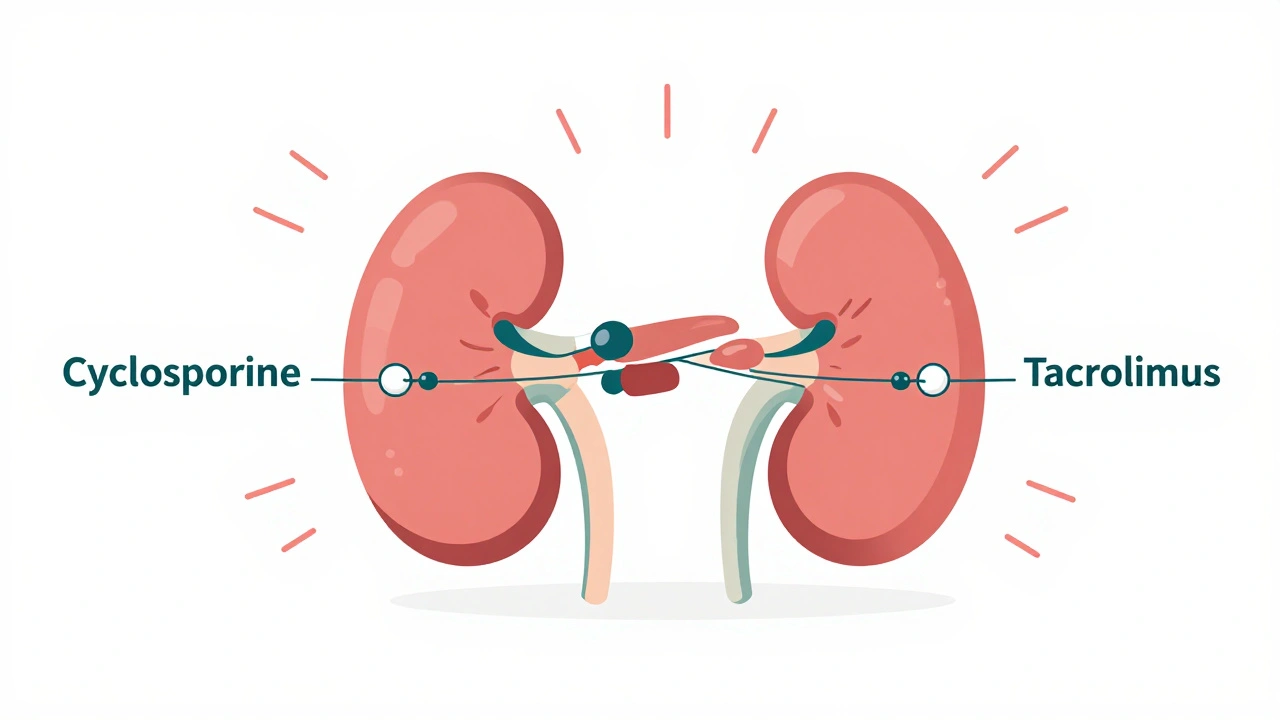
When you get a kidney, liver, or heart transplant, your body doesn’t know it’s supposed to accept the new organ. It sees it as an invader and tries to attack it. That’s where calcineurin inhibitors come in. These drugs - mainly cyclosporine and tacrolimus - are the backbone of transplant care. They stop your immune system from rejecting the organ. But they don’t just block rejection. They also bring a long list of side effects that can change your daily life.
How Calcineurin Inhibitors Work
Cyclosporine and tacrolimus both work by blocking calcineurin, a protein your T-cells need to activate. No calcineurin? No immune response. That’s good for the transplant. But calcineurin isn’t just involved in rejection. It plays a role in kidney function, insulin production, nerve signaling, and even your blood pressure. So when you shut it down, other systems pay the price.
Cyclosporine was the first of these drugs, approved in 1983. Tacrolimus came later, in 1994. Today, nearly 85% of kidney transplant patients in the U.S. take tacrolimus. Why? Because it works better at preventing rejection. But better results don’t mean fewer problems. In fact, tacrolimus often brings worse side effects.
Nephrotoxicity: The Biggest Threat to Your Kidneys
Both drugs damage your kidneys - and that’s the most dangerous side effect of all. You’re taking them to save a transplanted kidney, but they can slowly destroy your own.
Acute nephrotoxicity happens early. Your creatinine levels rise 20-50% above normal. This isn’t always permanent. It’s often caused by the drugs tightening blood vessels in the kidneys, reducing blood flow. It can be reversed if caught early.
Chronic nephrotoxicity is scarier. Over years, it leads to scarring - interstitial fibrosis and tubular atrophy. A landmark study in the New England Journal of Medicine found that chronic calcineurin inhibitor use caused 38% of late kidney graft failures. That means nearly four in ten transplants that fail after five years are damaged not by rejection, but by the very drugs meant to protect them.
Doctors manage this by keeping drug levels as low as possible. Trough levels for tacrolimus are kept between 5-10 ng/mL. For cyclosporine, it’s 100-200 ng/mL. Go higher? Risk goes up. Go lower? Rejection risk rises. It’s a tightrope walk.
Neurotoxicity: Tremors, Parkinsonism, and Brain Fog
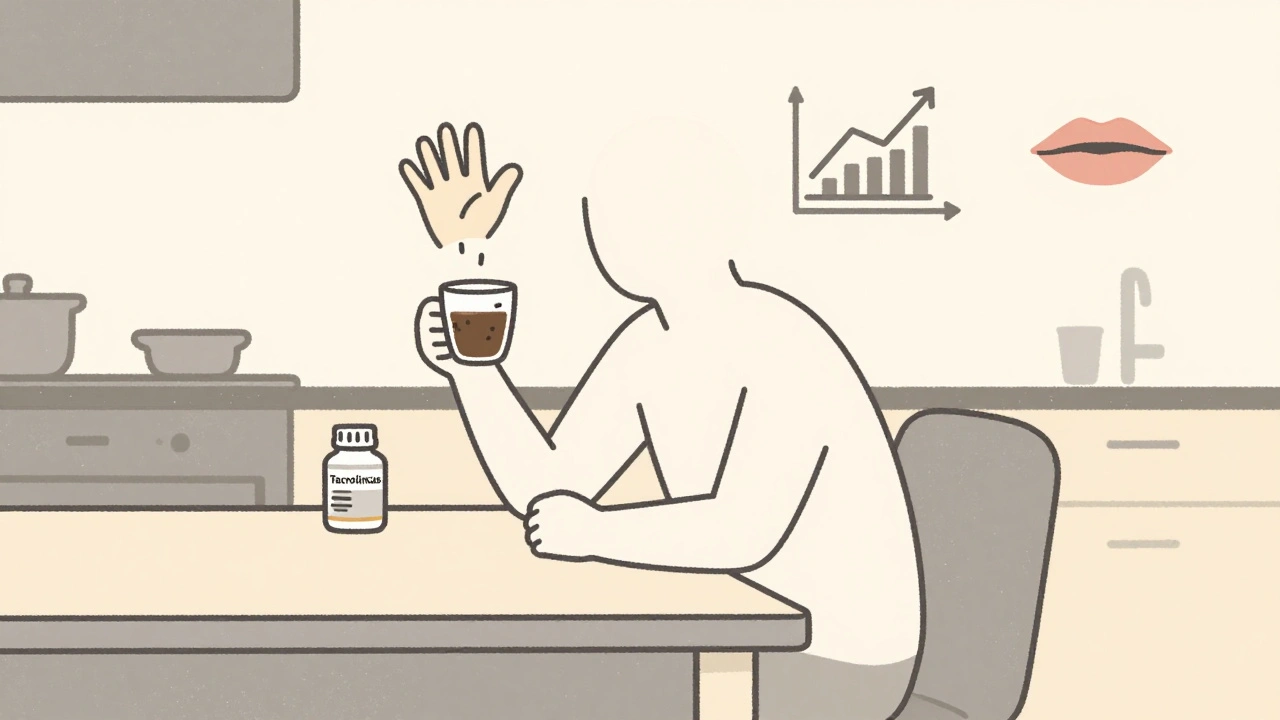
Tacrolimus is far more likely than cyclosporine to mess with your nervous system. About 30-70% of tacrolimus users get tremors - shaky hands, difficulty holding a cup, writing, or buttoning a shirt. With cyclosporine, it’s only 10-25%.
But tremors aren’t the worst. There are cases of severe parkinsonism - slow movement, stiffness, tremors at rest - triggered by tacrolimus. One patient developed full-blown parkinsonism two weeks after starting the drug. When switched to cyclosporine, symptoms vanished. Eight months later, they came back. That’s how powerful this effect is.
Even subtler issues are common. Up to 20% of tacrolimus users develop mild cognitive problems: trouble remembering names, losing focus, feeling mentally foggy. That’s why some transplant centers now do formal neurocognitive tests at three months.
Doctors have a trick: lowering the dose. Reducing tacrolimus from 8-10 ng/mL down to 3-5 ng/mL resolves tremors in 78% of patients within four weeks. It’s not always possible - too low and rejection risk climbs. But for many, it’s worth trying.
Diabetes: Tacrolimus’s Hidden Trap
One of the most life-changing side effects is new-onset diabetes after transplant (NODAT). About 15-30% of tacrolimus users develop it. For cyclosporine, it’s 5-15%.
Why? Tacrolimus directly damages insulin-producing beta cells in the pancreas. It blocks the calcineurin-NFAT pathway, which those cells need to release insulin properly. The result? High blood sugar, insulin shots, diet changes, and constant monitoring.
Doctors now act early. If a patient’s blood sugar starts creeping up, they’re put on an SGLT2 inhibitor - a diabetes drug that also protects the heart and kidneys. In one trial, this cut diabetes progression by 38%. That’s not just managing a side effect - it’s preventing long-term damage.
Other Side Effects: What You’ll Actually Notice Every Day
Let’s talk about the everyday stuff - the things that make you feel like you’re not yourself.
Cyclosporine: If you’re on this drug, you might notice hair growing where you don’t want it - face, arms, back. That’s hirsutism. It affects 20-30% of users. Your gums might swell, bleed, and look puffy. Gingival hyperplasia. It’s not dangerous, but it’s embarrassing. Many patients avoid smiling in photos.
Tacrolimus: This one hits your gut harder. Nausea? 30-45% of users. Diarrhea? 25-40%. It’s not just uncomfortable - it can lead to dehydration and weight loss. Some patients stop taking it because they can’t tolerate the stomach issues.
Both drugs cause high blood pressure (50-70% of users), high potassium (20-35%), and low magnesium (40-60%). Magnesium drops so often that most patients need supplements to keep levels above 1.8 mg/dL. Without it, you get muscle cramps, heart rhythm problems, and fatigue.
Real People, Real Struggles
Behind every statistic is a person. On transplant forums, patients describe life with these drugs.
One woman on the American Transplant Foundation forum said, “I can’t hold my grandkids because my hands shake so bad. I’m 42 and feel like I’m 70.”
Another man on Reddit wrote, “I lost 15 pounds in two months because I couldn’t eat anything without nausea. I stopped looking in the mirror because of the hair on my face.”
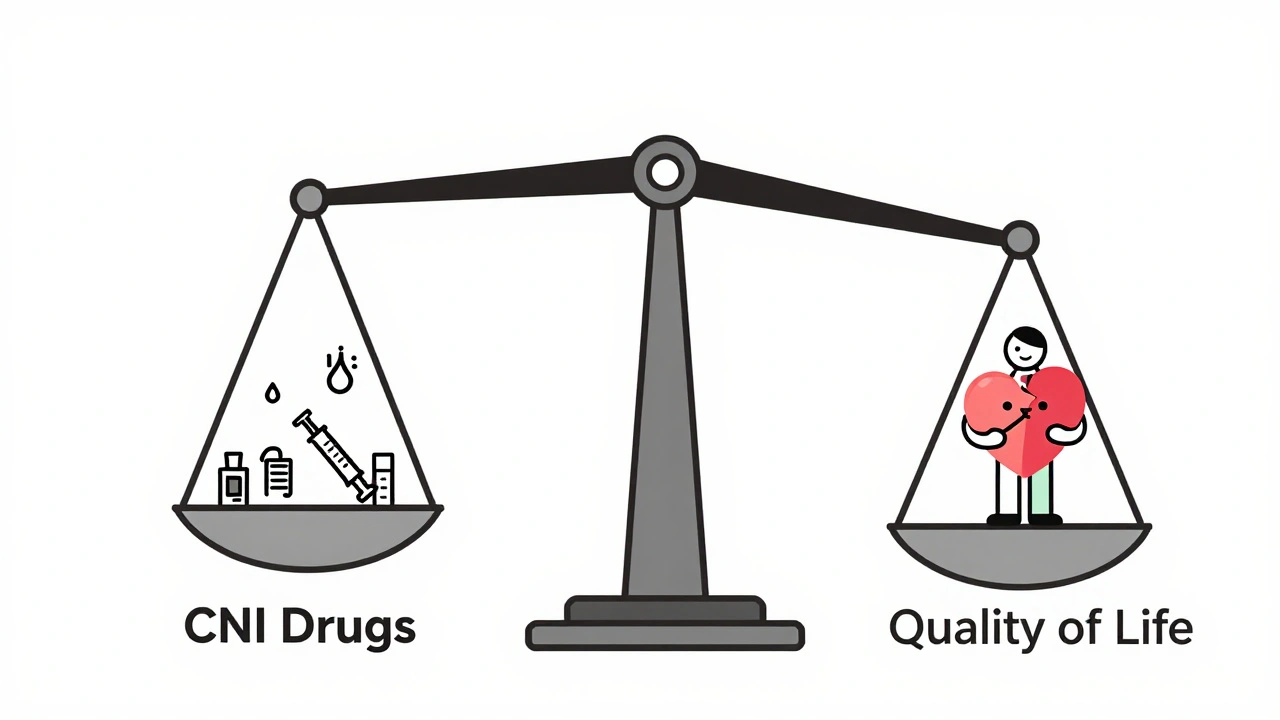
A 2022 study using the Transplant Effect Questionnaire found that side effects from calcineurin inhibitors lowered quality of life scores by 15-22 points on a 100-point scale. That’s like going from “doing fine” to “struggling daily.”
And here’s the kicker: 78% of patients surveyed by the National Kidney Foundation said they’d switch to a different drug - if it worked just as well but didn’t wreck their body.
What’s Changing? New Options Are Here
Doctors aren’t just accepting these side effects anymore. They’re fighting back.
One new drug, voclosporin, was approved in 2021 for lupus nephritis. It causes 30% less high blood pressure than cyclosporine. It’s not yet used for transplants, but it shows what’s possible.
Even better: CNI-free regimens. Belatacept, a drug that works completely differently, was tested in the 2023 CONVERT trial. Patients on belatacept had the same graft survival as those on tacrolimus - 91.2% vs 92.5% at three years. But their kidney function was far better: eGFR of 58.3 vs 49.1. Fewer diabetics. Fewer high blood pressure cases. Fewer neurological issues.
Now, for low-risk patients, doctors are trying early CNI withdrawal. The NIH-funded CIRT-T2 trial is testing whether you can stop calcineurin inhibitors after just a few months. Early results? 89% graft survival with 40% fewer side effects.
The European Medicinal Agency now recommends CNI minimization for half of all transplant patients by 2025. The goal isn’t just survival anymore. It’s living well.
What Should You Do?
If you’re on cyclosporine or tacrolimus, here’s what matters:
- Get your levels checked regularly. Trough levels are your safety net. Don’t skip blood tests.
- Monitor your kidneys. Monthly creatinine checks. If it’s rising, talk to your team - don’t wait.
- Watch your blood sugar. If you’re on tacrolimus, get fasting glucose every 3 months. Early action prevents diabetes.
- Take magnesium. Most patients need it. Ask your doctor for a prescription or supplement.
- Ask about alternatives. If side effects are wrecking your life, ask: “Is there a lower-dose option? Can I switch? Is a CNI-free regimen possible for me?”
These drugs saved your transplant. But they shouldn’t steal your life. The latest science says: less is often more. Your care team should be working with you - not just managing side effects, but reducing them.
You didn’t get a transplant just to survive. You got it to live. And you deserve to live well.
Eddie Bennett
Been on tacrolimus for 7 years post-kidney transplant. The tremors were brutal at first-couldn’t hold a coffee cup without spilling. Lowered my dose from 6 to 4 ng/mL after my nephrologist agreed it was safe. Tremors? Gone. Brain fog? 80% better. Still take magnesium daily. Life’s not perfect, but it’s livable.
Vivian Amadi
Ugh. I hate when people act like these drugs are ‘necessary evils.’ They’re not. They’re just outdated. Pharma’s been milking this for 40 years and we’re still stuck with side effects that ruin quality of life. Wake up.
Michelle Edwards
Thank you for writing this. I’m a transplant mom and I’ve seen my daughter go from smiling to hiding in her room because of the facial hair and shaking hands. You’re not alone. There’s hope.
Lisa Stringfellow
So you’re telling me the drug that’s supposed to save your kidney is slowly killing it? And the ‘solution’ is just… lower the dose? Brilliant. Let’s just hope you don’t reject the organ while you’re trying to not die from the side effects. Classic medical irony.
Kaitlynn nail
Wow. So basically we’re trading one life for another. Cool. I guess living with diabetes, tremors, and hair on your chest is the new ‘winning’ after transplant. Deep.
David Palmer
My cousin’s on cyclosporine and his gums look like he’s got a permanent case of the munchies. He won’t smile in pics. I told him to ask about switching. He said his doc laughed at him. That’s not a doctor. That’s a vending machine.
Queenie Chan
Let’s not romanticize this. Tacrolimus isn’t ‘better’-it’s just more efficient at wrecking your pancreas and your nervous system. Cyclosporine? At least it gives you a beard to hide behind. Aesthetic compensation for biological betrayal.
Neelam Kumari
Of course it’s worse. Western medicine always picks the most toxic option because it’s cheaper to test. In India, we use Ayurvedic herbs to modulate immunity-no tremors, no diabetes. But no one wants to hear that, do they? Profit > patient.
Nikki Smellie
Did you know the FDA approved tacrolimus after a 12-week trial with 47 patients? The long-term effects were never properly studied. This is a controlled experiment on millions. The real question: who authorized this? And why aren’t they in jail?
Courtney Blake
LOL at people acting like this is new info. I’ve been screaming this since 2018. You think your ‘nephrologist’ cares? They get paid per patient, per test, per script. They don’t want you off the drug. They want you on it forever. It’s not medicine-it’s a business model.
Stephanie Maillet
It’s heartbreaking, isn’t it? We’re so obsessed with survival that we forget to ask: ‘Is this living?’ These drugs extend life-but they steal the texture of it. The joy of holding a grandchild. The dignity of not needing magnesium supplements to stop cramping. We’ve turned healing into a compromise… and called it progress.
Rebecca Dong
WAIT-so you’re telling me the drug that’s supposed to protect my new kidney is ALSO the reason I’m diabetic and shaking? And now they’re saying ‘maybe we can stop it after a few months’? Why didn’t they say this BEFORE I lost 20 lbs and got a feeding tube? I feel like I was used as a guinea pig. Someone’s gonna pay for this.
Regan Mears
Just want to say: if you’re reading this and you’re struggling-you’re not broken. You’re not weak. You’re surviving something most people can’t even imagine. And the fact that you’re still here, still fighting, still asking questions? That’s courage. Keep going. You’re not alone.
Aileen Ferris
belatacept?? who the f is that? i thought we were stuck with these toxic drugs forever. this is the first time i’ve heard something that sounds like real hope. why isn’t this all over the news??
Sarah Clifford
So what you’re saying is… we’re all just lab rats for Big Pharma? And the ‘solution’ is to just… wait for them to get around to fixing it? I’m out. I’d rather die than live like this.