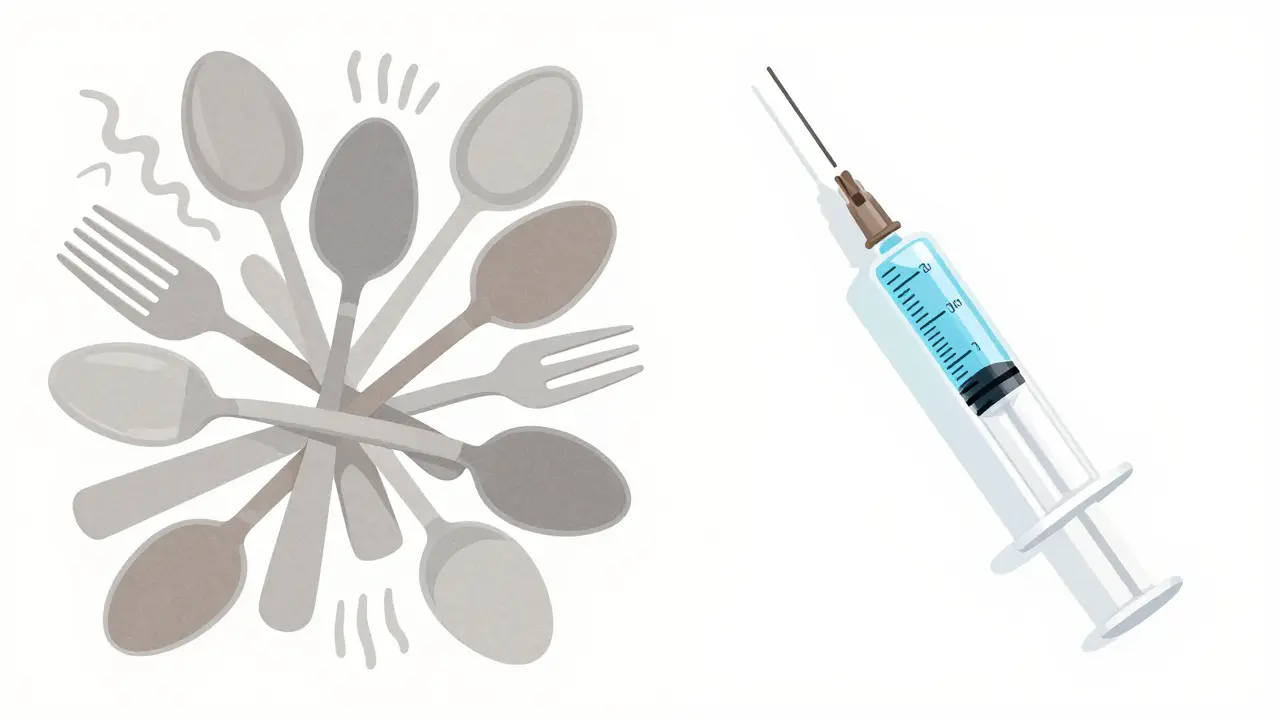
Picture this: your child has a fever, and you grab the bottle of liquid medicine from the cabinet. The label says "5 mL," but you don't have the little plastic cup or syringe that came with it. So, you reach into the drawer, grab a regular teaspoon, and scoop up what looks like a full spoonful. It seems harmless, right? But here is the scary truth: that kitchen spoon might actually hold three times-or half-the amount the doctor prescribed.
This isn't just a minor mistake; it is one of the most common causes of medication errors in children. For decades, experts have warned against using household cutlery to measure pediatric medications, which are liquid drugs specifically formulated for children requiring precise dosage calculations based on weight and age. Yet, despite warnings from major health organizations, many parents still do it. Why? Because it feels convenient. But convenience can be dangerous when it comes to a child’s health.
The Hidden Danger of Kitchen Spoons
We tend to think of a "teaspoon" as a standard unit of measurement. In cooking, maybe. In medicine, absolutely not. A medical teaspoon is defined as exactly 5 milliliters (mL). However, if you look at the spoons sitting in your silverware drawer, they vary wildly in size. Some are tiny, holding only 3 mL, while others are large, holding up to 7 mL.
This creates a massive variance. If you use a small spoon for a dose that requires 5 mL, your child gets an underdose, meaning the medicine won't work effectively. If you use a large spoon, they get an overdose, which can lead to serious side effects. According to research published in Pediatrics by the National Institutes of Health (NIH), using teaspoons or tablespoons doubled parents' chances of administering an incorrect dose. Nearly 40% of parents incorrectly measured their intended dose when using these utensils.
| Tool Type | Accuracy Level | Best Used For | Risk Factor |
|---|---|---|---|
| Kitchen Teaspoon | Low (3-7 mL variance) | Soup, Stirring | High (Up to 40% error) |
| Dosing Cup | Moderate | Doses > 5 mL | Medium (Hard to read meniscus) |
| Oral Syringe | High (0.1 mL precision) | All doses, especially < 5 mL | Low (Most accurate) |
| Medicine Dropper | High | Infants/Tiny doses | Low |
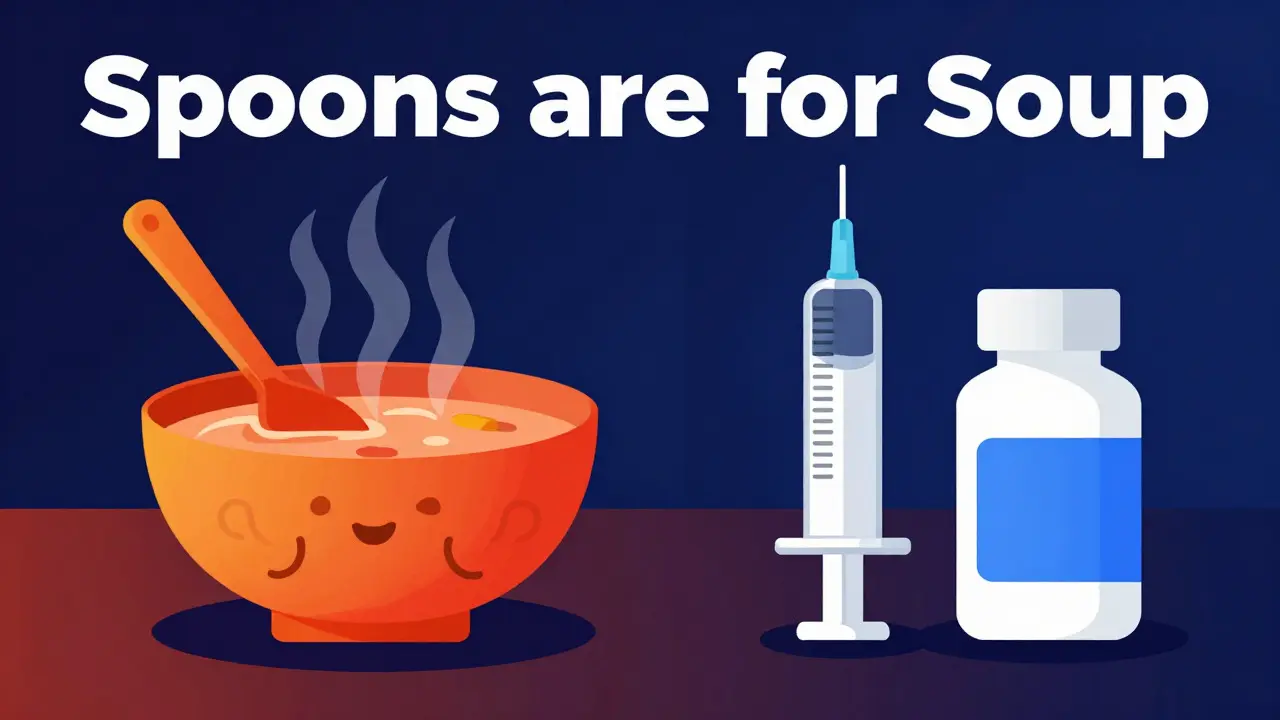
The Centers for Disease Control and Prevention (CDC) runs a campaign called "Spoons are for Soup" to drive this point home. Their message is simple: Milliliters (mL) are for medicine. Using a tablespoon instead of a teaspoon can deliver three times the intended dose. That kind of error can turn a mild headache treatment into a potential emergency room visit.
Why Precision Matters More for Kids
Children are not just small adults. Their bodies process medications differently. They are significantly more sensitive to drug concentrations because of their lower body weight and developing organ systems. A dosing error that might give an adult a slight stomach ache could cause severe toxicity or ineffective treatment in a toddler.
Dr. Shonna Yin, lead author of the NIH-funded study, noted that a big part of the problem is parents confusing medicine spoons with kitchen spoons. Many people assume all teaspoons are equal. Errors drop dramatically when parents use devices calibrated in milliliters, such as medicine droppers and oral syringes. The Eunice Kennedy Shriver National Institute of Child Health and Human Development (NICHD) reports that poison control centers receive more than 10,000 calls annually related to incorrect dosing of liquid medications for children. Most of these could be prevented with the right tool.
The Best Tool: Oral Syringes
If you want to ensure your child gets the exact right amount, the gold standard is the oral syringe, which is a calibrated medical device designed for precise delivery of liquid medications into the mouth, typically marked in milliliters. Unlike cups or spoons, oral syringes allow you to measure down to 0.1 mL increments. This is crucial because many pediatric prescriptions aren't neat round numbers like 5 mL or 10 mL. Often, the dose is something specific like 3.5 mL or 6.2 mL based on the child's exact weight.
A 2023 study in Frontiers in Public Health confirmed that oral syringes account for the least percentage of imprecise dosing. They are particularly superior for doses that are not multiples of 5 mL. Dosing cups often only have markings at 5, 10, 15, and 20 mL intervals, making it nearly impossible to accurately measure smaller, specific doses. With a syringe, you pull the plunger back to the exact line, ensuring consistency every time.
How to Measure Medicine Correctly
Having the right tool is only half the battle. How you use it matters just as much. Here is a step-by-step guide to getting it right:
- Check the Label: Ensure the prescription is written in milliliters (mL). If it says "tsp" or "teaspoon," ask your pharmacist to clarify the mL equivalent. The FDA and American Academy of Pediatrics (AAP) recommend milliliter-only labeling to reduce confusion.
- Use the Provided Device: Always use the syringe, dropper, or cup that comes with the medicine. If it didn't come with one, ask your pharmacist for one. Don't improvise.
- Measure at Eye Level: Hold the syringe or cup so the measurement lines are level with your eyes. Looking from above or below can distort the reading, leading to errors.
- Fill Accurately: For syringes, pull the plunger slowly until the top of the liquid matches the correct mL mark. For drops, count carefully if using a dropper.
- Administer Gently: Safe Kids Worldwide recommends squirting the medicine gently between your child's tongue and the side of the cheek, rather than aiming for the back of the throat, which can trigger gagging.
Olivia Bishop, a Pharmacy Resident, explained that using milliliters ensures we're getting the patient the correct dose. If we underdose, the infection isn't treated. If we overdose, we risk side effects. It’s a balance that requires precision.
What to Do If You Don’t Have a Measuring Device
It happens. The box is lost, the syringe broke, or you’re out late at night. What then? Do not grab a kitchen spoon. Instead, call your local pharmacy. Many pharmacies offer 24-hour services or have emergency contacts. Alternatively, visit a nearby urgent care or hospital pharmacy. They will have sterile, calibrated devices available.
If you must wait until morning, consider whether the medication is critical. For non-urgent symptoms, waiting a few hours for a proper dose is safer than giving an inaccurate one now. Keep a spare oral syringe in your medicine cabinet at all times. They are inexpensive and widely available at any drugstore.
The Push for Standardization
Despite the AAP issuing its formal recommendation against household spoons in 1978, about 75% of Americans still rely on kitchen teaspoons. This persistence highlights a gap in public education. The good news is that change is happening. Pharmaceutical manufacturers are increasingly adopting milliliter-only labels. The FDA has strengthened its stance, emphasizing that standardized dosing tools are essential components of pediatric safety.
Studies show that when medications are labeled exclusively in milliliters and provided with appropriate measuring devices, error rates decrease by approximately 20 percentage points. Healthcare systems are also integrating dosing education into routine visits, ensuring parents know how to use syringes before they leave the clinic.
Frequently Asked Questions
Is a teaspoon really that different from 5 mL?
Yes. While a medical teaspoon is defined as 5 mL, household teaspoons vary significantly in capacity, ranging from 3 mL to 7 mL. This variance can lead to underdosing or overdosing by up to 40%, which is risky for children.
Can I use a dosing cup for small amounts of medicine?
Dosing cups are less accurate for small amounts, especially those under 5 mL or not multiples of 5 mL. Cups often lack fine gradations, making it hard to read precise levels. Oral syringes are recommended for better accuracy in these cases.
What should I do if my child spits out the medicine?
If your child spits out the medicine immediately after administration, consult your pharmacist or doctor before re-dosing. Generally, if it was spat out within seconds, you may need to repeat the dose, but professional advice is best to avoid accidental overdose.
Why does the CDC say "Spoons are for Soup"?
This is a public health campaign slogan to remind caregivers that kitchen utensils are not standardized for medical use. The phrase emphasizes that milliliters (mL) and calibrated devices should be used exclusively for medicine to prevent dosing errors.
Are oral syringes safe for babies?
Yes, oral syringes are safe and recommended for infants. They allow for gentle, controlled delivery of small volumes directly into the side of the mouth, reducing the risk of choking compared to forcing liquid from a cup or spoon.