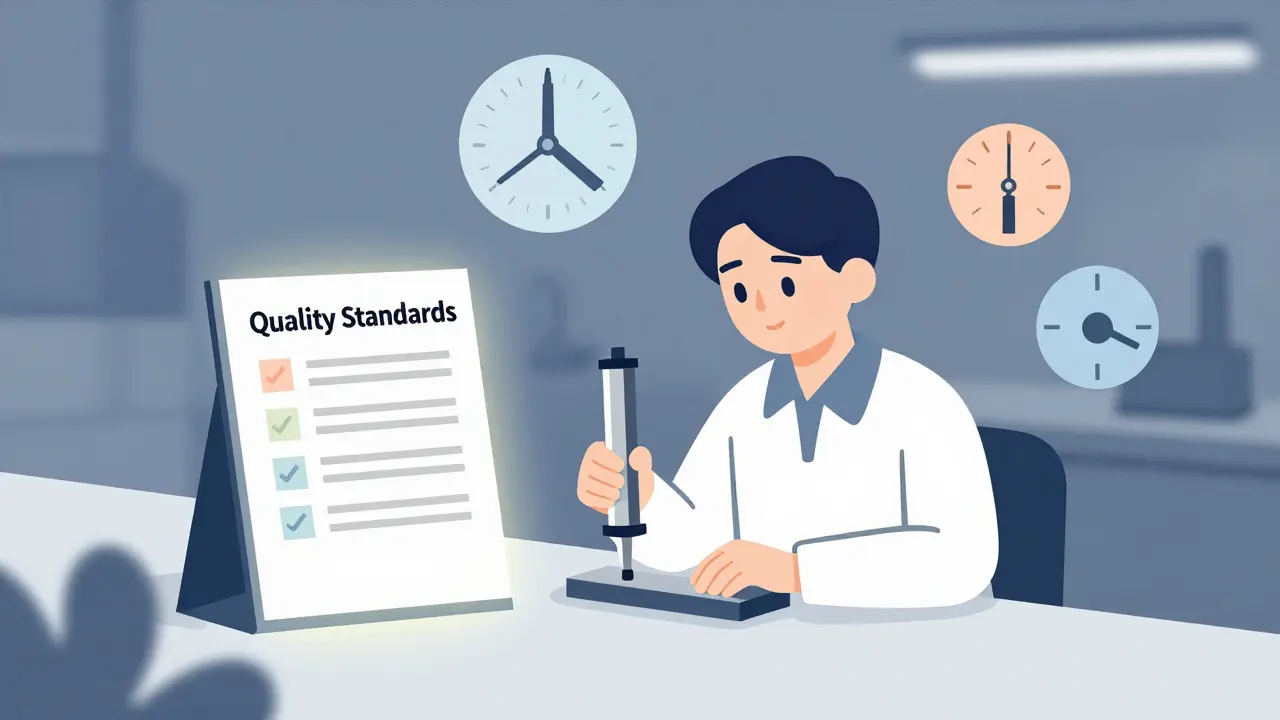
When a product leaves a factory, it shouldn’t be a gamble. You don’t want a medical device failing mid-surgery, a car part breaking on the highway, or a smartphone battery overheating. That’s why quality control testing isn’t optional-it’s the backbone of any manufacturing operation that wants to survive. It’s not just about catching bad units at the end of the line. It’s about stopping defects before they even happen.
Define Quality Standards Before You Start
Too many manufacturers jump into production without clearly saying what "good" looks like. You can’t inspect your way to quality if you don’t know the target. Every product must have measurable standards: dimensions, surface finish, electrical performance, chemical purity, even color. For example, in electronics, color consistency is measured on the CIELAB scale, and a difference (ΔE) under 2.0 is considered acceptable. For machined metal parts, surface roughness (Ra) usually falls between 0.8 and 3.2 micrometers. Tolerances vary: ±0.005mm for precision components, ±0.5mm for general parts.
These numbers aren’t guesses. They come from engineering specs, regulatory rules (like FDA 21 CFR Part 211 for drugs or ISO 13485 for medical devices), and customer expectations. Documenting them in a master control plan ensures everyone-from the machine operator to the quality engineer-is working from the same playbook. Skipping this step leads to confusion, rework, and costly recalls.
Implement the Right Inspection Methods
Not every product needs 100% inspection. That’s expensive and often unnecessary. Instead, manufacturers use risk-based sampling. For non-critical parts, ANSI/ASQ Z1.4-2013 sampling plans determine how many units to check based on batch size and defect tolerance. In electronics, MIL-STD-105E sets acceptable quality levels (AQL): 0.65% for major defects, 1.5% for minor ones.
For high-risk items-like implants or aviation components-100% inspection is mandatory. Tools vary too. Calipers and micrometers handle dimensional checks. Spectrometers verify chemical composition per ASTM E415. Electrical testers measure resistance within ±10% tolerance. Tensile testers confirm strength stays within 5% of spec. Surface gloss is measured in gloss units (GU), and roughness in micrometers. The key is matching the tool to the risk. Using a handheld gauge to check a microchip’s internal circuit? That won’t work. You need automated optical inspection (AOI) or X-ray imaging.
Train Your Team Like Professionals
Even the best process fails if the person running it doesn’t know how. Training isn’t a one-hour PowerPoint. It’s hands-on, role-specific, and repeated. A machine operator handling high-precision parts needs 24-40 hours of training on calibration, sampling, and defect identification. Quality engineers typically hold ASQ Certified Quality Engineer (CQE) credentials. Operators should be certified too-targeting 95%+ proficiency.
At pharmaceutical companies, training includes strict documentation practices: how to fill out logbooks, how to report deviations, how to follow 21 CFR Part 11 for electronic records. At electronics plants, staff learn IPC-A-610 standards for solder joint acceptance. When training is rushed, errors creep in. ASQ’s 2022 survey found that 68% of facilities struggled with inconsistent operator adherence. That’s not a technology problem-it’s a people problem.
Monitor Processes in Real Time
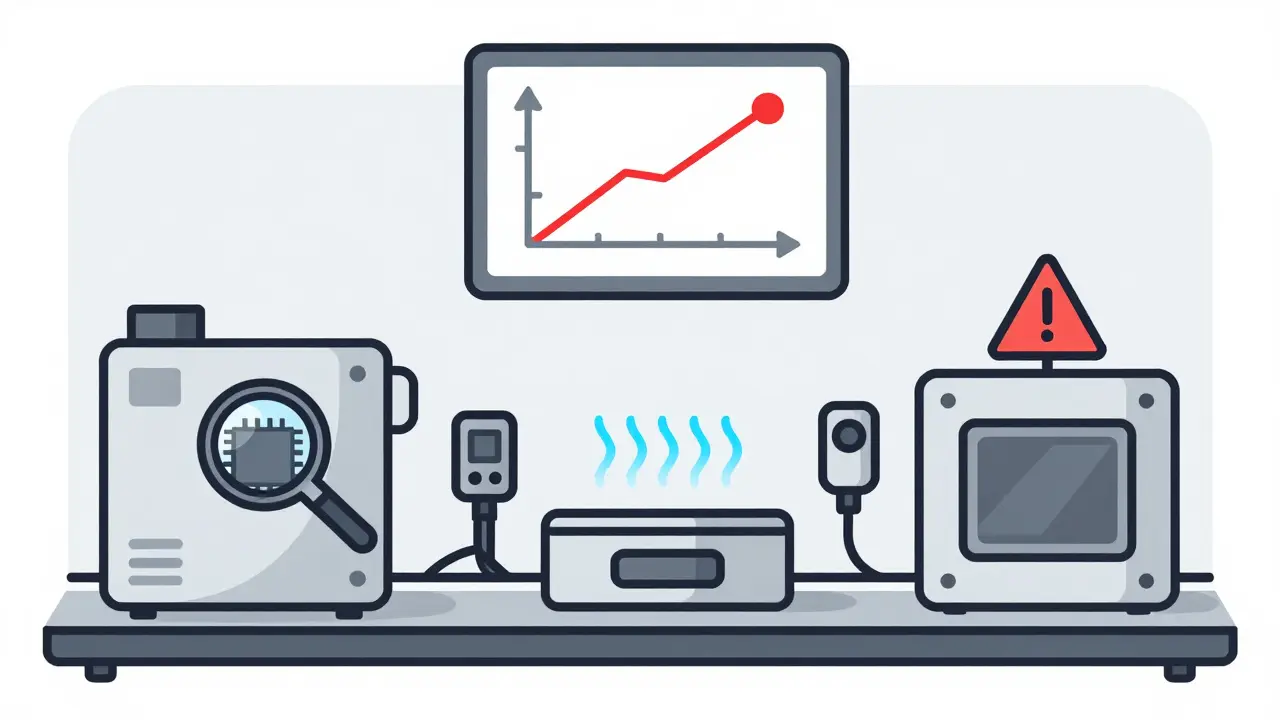
Waiting until the end of the line to find defects is like checking your car’s brakes after it’s already skidding. Modern manufacturing uses real-time monitoring. Sensors on production lines track temperature, pressure, vibration, and speed. Data flows into dashboards that show trends, not just snapshots.
Statistical Process Control (SPC) tools like X-bar and R charts monitor variation. If a process drifts beyond 3σ control limits, the system flags it. Capability indices (Cp and Cpk) tell you if the process is capable-values above 1.33 mean you’re in the green. Companies like Siemens use IoT sensors to feed live data into digital twins, allowing them to predict defects before they occur. In their Amberg plant, defect detection speed improved by 27% using this method.
But don’t just collect data-act on it. A 2023 McKinsey report showed manufacturers using real-time probing reduced defect escape rates by 63%. That’s not magic. It’s discipline.
Analyze Results with Purpose
Numbers alone don’t fix problems. You need context. That’s where software like Minitab or JMP comes in. These tools don’t just calculate averages-they reveal patterns. Is a defect clustered around a specific shift? A particular machine? A batch of raw material from Supplier X?
Dr. Linda Zhang of NexPCB warns that over-relying on statistical sampling without understanding the process leads to 22% higher false negatives. In other words, you think you’re catching defects, but you’re missing them because you’re not looking at the full picture. A single outlier might be a sign of a worn tool, not random noise. Root cause analysis isn’t optional. FDA Form 483 observations in 2021 showed 43% of violations came from poorly validated test methods. If your test doesn’t actually detect the defect you think it does, you’re not controlling quality-you’re pretending to.

Take Corrective Action-Fast
When something goes wrong, you have 72 hours. That’s the standard for pharmaceutical and medical device manufacturers under PDA guidelines. A deviation isn’t just logged-it’s investigated. Why did the dimension drift? Was the tool misaligned? Did the material batch change? Was the operator fatigued?
Corrective Action (CA) and Preventive Action (PA) together form CAPA. It’s not paperwork for the audit. It’s a system to stop the same mistake from happening again. That might mean recalibrating a machine, updating a work instruction, retraining staff, or switching suppliers. If you don’t fix the root cause, you’re just spinning your wheels. A 2022 ASQ report found manufacturers with strong CAPA systems cut scrap and rework costs by 32.7% compared to those with weak ones.
And don’t forget documentation. Every step must be traceable. Pre-numbered logbooks, electronic records with audit trails, signed approvals-all required by ISO 9001:2015 and FDA rules. In 2021, 41% of FDA warning letters cited inadequate calibration systems. That’s not a technical failure. It’s a procedural one.
Why This Matters More Than Ever
The global quality control testing market is worth $12.7 billion and growing at 6.3% annually. Why? Because regulators are tightening, customers are demanding more, and technology is changing fast. The EU’s MDR 2017/745 and FDA’s new Quality Management Maturity initiative now look beyond compliance-they assess culture. Are you just checking boxes? Or are you building a mindset where every worker feels responsible for quality?
AI is changing the game. Thirty-seven percent of Fortune 500 manufacturers now use AI-powered visual inspection, up from 12% in 2020. Digital twins, blockchain for immutable records, augmented reality for guided inspections-these aren’t sci-fi anymore. Toyota’s AR testing improved inspection accuracy by 22%. Boeing cut assembly defects by 31% using digital twins.
But here’s the truth: no amount of AI replaces a clear standard, trained staff, and disciplined follow-up. Walter Shewhart and W. Edwards Deming didn’t just invent tools-they built a philosophy. Quality isn’t found at the end of the line. It’s built into every step. The best manufacturers today aren’t the ones with the fanciest robots. They’re the ones who never stopped asking: "How do we make this better?"
What’s the difference between quality control and quality assurance?
Quality assurance (QA) is about building processes to prevent defects-like training, documentation, and procedure design. Quality control (QC) is about checking the output-inspecting, measuring, and testing products. QA is the system; QC is the check. You need both.
How often should QC equipment be calibrated?
Calibration frequency depends on the tool, usage, and industry. High-precision instruments in medical or aerospace may need monthly checks. General workshop tools like calipers often require quarterly calibration. The key is having a documented schedule based on manufacturer guidelines and historical performance. FDA warning letters in 2021 showed 41% of violations came from poor calibration practices.
Can small manufacturers afford proper QC testing?
Yes, but it starts small. A small shop under 50 employees can implement basic QC in 4-8 weeks. Focus on critical steps: define clear standards, train operators, use simple sampling plans, and document deviations. You don’t need expensive software. A spreadsheet with timestamps, measurements, and signatures can be enough. The goal isn’t perfection-it’s consistency.
What happens if you skip quality control testing?
You’ll pay more later. Scrap, rework, returns, warranty claims, and recalls cost far more than prevention. A 2022 ASQ report showed companies with weak QC spent 3-5x more on quality-related costs than those with strong systems. In regulated industries, skipping QC can lead to FDA warning letters, shutdowns, or lawsuits. It’s not a risk-it’s a countdown.
Is ISO 9001:2015 still relevant in 2026?
Absolutely. ISO 9001:2015 is the global baseline for quality management systems. While the draft ISO 9001:2025 will emphasize digital tools and AI validation, the core principles-customer focus, leadership, process approach, and continual improvement-remain unchanged. If you’re not compliant with ISO 9001:2015, you’re already behind. It’s not a badge-it’s a minimum requirement.
Next Steps for Manufacturers
If your QC process feels patchy, start here: pick one critical product line. Define its quality standards in writing. Train the team on those standards. Install one real-time monitoring tool-even a simple data logger. Track defects for two weeks. Then, investigate the top three causes. Fix them. Document everything. Repeat. You don’t need to overhaul everything at once. You just need to start.
Matt Alexander
Quality control isn't rocket science, but it sure beats flying blind. I've seen factories skip steps because they're 'too busy'-then get hit with a recall that costs more than a year's training budget. Just define your standards, train people like they matter, and don't ignore the data. Simple. Effective. No magic needed.
Start with one line. One standard. One trained operator. Build from there. You don't need AI to fix what you haven't bothered to document.
Gretchen Rivas
Calibration schedules matter. Not because of paperwork-but because a micrometer that's off by 0.01mm makes 1000 bad parts before anyone notices.
Stephen Vassilev
Who funds these 'quality control' consultants? Who owns the patents on ISO 9001? Who benefits when small manufacturers go bankrupt trying to comply? The real system isn't about quality-it's about control. Big players use standards to crush competition under red tape. The FDA doesn't care if your product works-they care if you filled Form 211-B correctly. That's not quality. That's compliance theater.
Mike Dubes
Man, I love this post. Totally agree. You don't need fancy robots to do QC right. I work at a small shop with 12 people and we just use a google sheet with timestamps, pics of defects, and who checked it. We call it 'The Wall of Shame'-but it works. We cut our returns by 60% in 3 months.
Training? Yeah, we do 15 mins a day, not 40 hours. Just show 'em what bad looks like. Let 'em hold the piece. Feel the rough edge. Smell the burnt plastic. You don't need a certificate to know something's wrong. Your hands know.
Helen Brown
Did you know the FDA has a hidden database of all companies that got warning letters? It's not public. They use it to blacklist suppliers. If you're on it, no big client will touch you-even if you fix everything. This whole system is rigged. They want you scared. They want you dependent on consultants. They want you too busy fixing paperwork to innovate. The real goal? Keep small players out. Quality? That's just the excuse.
John Cyrus
You people talk about training like it's optional. If your operator can't read a micrometer you have no business making medical devices. No excuses. No 'small shop' nonsense. Either you're competent or you're a liability. Period. ISO 9001 isn't a suggestion. It's the floor. If you're not there you're already failing
John Smith
Let me tell you what real quality looks like. I worked at a plant where the boss said 'if it looks right, ship it.' We had a 37% return rate. Then we hired a guy who used to work at Boeing. He walked in, looked at the calipers, and said 'these are older than my kid.' We replaced them. Trained everyone. Started using X-bar charts. Three months later? Returns dropped to 2%.
It ain't about tech. It's about pride. When your name is on the checklist, you don't cut corners. You build it like your kid’s gonna use it. That's the secret. No software. No audit. Just damn pride.
Sharon Lammas
There’s something quiet about quality work. It doesn’t shout. It doesn’t need applause. It’s in the silent moment when a part passes inspection and no one notices-because it just works. No drama. No fanfare. Just consistency.
I think we’ve confused quality with spectacle. We chase AI and digital twins because they feel impressive. But the real magic? A well-trained person who pauses before they move on. Who asks, 'Does this feel right?' That’s the heart of it. Not the tool. The hand.
marjorie arsenault
If you’re a small manufacturer, don’t wait for permission to do this right. Start today. Pick one part. One step. One person to train. Write down what good looks like-even on a napkin. Take a photo of a good part and a bad one. Tape them to the wall. Talk about them every morning. That’s your QA system.
You don’t need a consultant. You need courage. And a little discipline. The rest? It’ll follow.
Deborah Dennis
So let me get this straight-you think training someone for 24 hours is enough? That’s cute. In my 20 years in aerospace, we did 160 hours of training before they touched a tool. And we had daily competency checks. If you’re cutting corners because it’s 'too expensive,' you’re not a manufacturer-you’re a gamble with a warehouse.
Shivam Pawa
SPC is foundational. But CpK >1.33 is not the goal-it’s the baseline. True mastery is when your Cpk hits 2.0 and you still audit the process. Because even perfect systems drift. The real test isn’t the chart-it’s whether you still question it. That’s the difference between compliance and excellence.
Diane Croft
This is exactly what I needed to hear. I’ve been stuck in 'we’ve always done it this way' mode. But reading this? I’m starting with one line next week. Just one. And I’m training the team myself. No excuses. Thank you.
Donna Zurick
I love how you said quality is built into every step. That’s the vibe. Not a checklist. Not a department. It’s in the way someone pauses before they sign off. That’s the culture. And it starts with one person choosing to care.
Tobias Mösl
AI inspection? Digital twins? Please. These are distractions. The real crisis is that 68% of operators aren’t properly trained. Why? Because executives don’t want to pay for it. They want to outsource. They want to automate. They want to hide behind algorithms. But no algorithm can replace a human who cares. And if your culture doesn’t value that-you’re already dead. You just haven’t filed the bankruptcy papers yet.
tatiana verdesoto
Reading this made me think of my uncle’s machine shop. He never had ISO. Never had fancy tools. But every morning, he’d walk the floor and ask, 'What’s not right today?' And he’d fix it. No form. No audit. Just presence.
Maybe quality isn’t about systems. Maybe it’s about showing up.