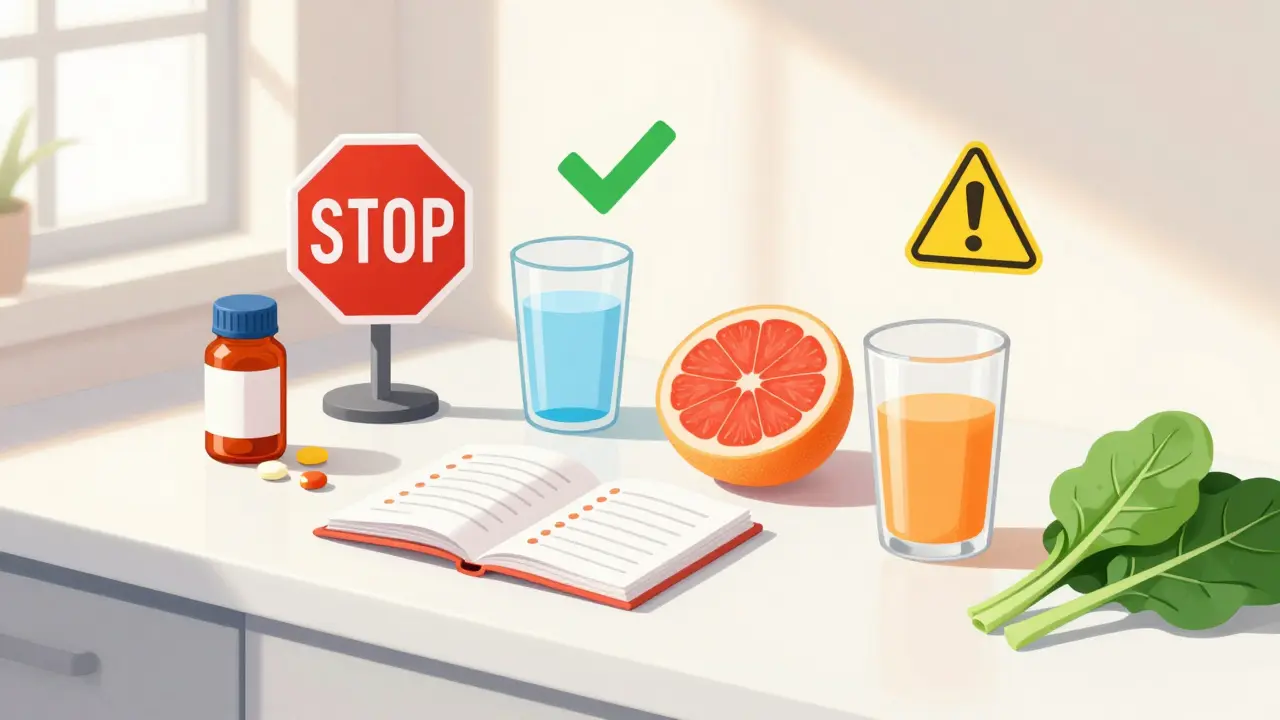
Managing your medications doesn’t stop at remembering when to take them. If you’re on more than one prescription, supplement, or even over-the-counter drug, you’re likely at risk for something most people don’t think about: food and medication interactions. These aren’t just rare side effects-they’re common, dangerous, and often preventable. A simple checklist, kept at home and updated regularly, can be the difference between staying healthy and ending up in the emergency room.
Why Your Kitchen Could Be Riskier Than Your Medicine Cabinet
You might think your pills are safe as long as you take them with water. But what you eat can change how your body handles medicine. Grapefruit juice, for example, can make statins like simvastatin up to 500% more potent, leading to muscle damage or kidney failure. Dairy products can block antibiotics like ciprofloxacin from being absorbed. Even something as simple as a spinach salad can interfere with blood thinners like warfarin-not because it’s dangerous, but because inconsistent intake throws your dose off balance.The FDA reports that 12% of the 1.3 million emergency visits each year linked to drug reactions involve food interactions. That’s over 150,000 people annually. And it’s not just older adults. Nearly half of Americans over 40 take three or more medications daily. If you’re one of them, you’re already at higher risk.
What Goes on Your Checklist?
A good food and medication interaction checklist isn’t just a list of pills. It’s a living document with five essential parts:- Medication details: Brand name, generic name, dosage (e.g., “warfarin 5mg”), purpose (e.g., “prevents blood clots”), and schedule (e.g., “every morning at 8 AM”).
- Food and drink interactions: List exactly what to avoid or time separately. Don’t say “avoid citrus.” Say “no grapefruit juice, Seville oranges, or pomelo at any time.”
- Risk level: Label each interaction as High, Moderate, or Low. High means stop immediately. Moderate means separate by 2+ hours. Low means monitor.
- Source and date: Write where you got the info: “Per NZ Formulary, updated July 15, 2024” or “FDA Drug Safety Communication #2024-087.” This keeps you honest.
- Emergency contacts: Your pharmacist’s number, your doctor’s office, and one family member who knows your meds.
Don’t forget to include supplements. A daily multivitamin with vitamin K can undo warfarin’s effect. St. John’s Wort can make birth control, antidepressants, or heart meds useless. Even herbal teas like green tea can interfere with blood pressure drugs.
How to Build It Step by Step
Start with a quiet 45 minutes. Gather everything you take:- Collect all pills, capsules, liquids, patches, and supplements in their original containers. Don’t skip the gummies or the fish oil.
- For each item, write down the five elements above. If you’re unsure about an interaction, look it up using trusted sources: the New Zealand Formulary (free online), the FDA’s My Medicines PDF template, or the SEFH Drug-Food/Herb Interaction Guide (available as laminated cards).
- Assign a risk level. High-risk examples: grapefruit with statins, tyramine-rich foods (aged cheese, cured meats) with MAO inhibitors like tranylcypromine, and dairy with tetracycline antibiotics. Moderate: spinach with warfarin (keep intake consistent, don’t avoid it). Low: most fruits and vegetables with common meds.
- Write the date you created it. Update it every time you start, stop, or change a medication.
- Print two copies. Keep one on your fridge. Give the other to your pharmacist or primary care provider.
Pro tip: Document how you prepare food. Raw spinach has more vitamin K than cooked. A cup of steamed kale has nearly double the vitamin K of raw. These details matter.
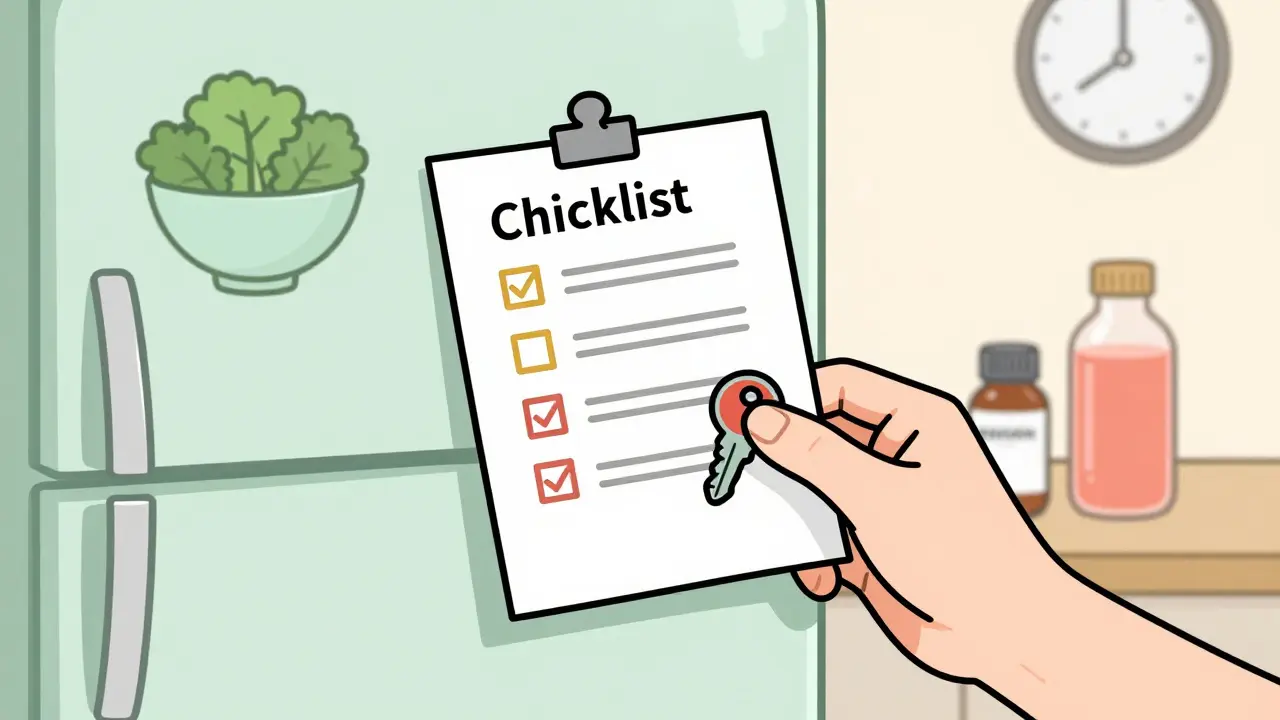
Paper vs. Digital: Which Works Better?
There’s no single right way. It depends on your life.Paper checklists (like the FDA’s downloadable template) win for simplicity and reliability. They work during power outages, in rural areas, or when you’re visiting a doctor who doesn’t use digital records. Over 90% of seniors over 75 use paper lists. They’re also easier to show quickly in an emergency.
Digital apps like Medisafe or MyTherapy can alert you to interactions in real time and sync with pharmacy databases. A 2023 study found they cut medication errors by 42% compared to paper. But they require a smartphone, regular updates, and internet access. And they’re not perfect-some apps don’t recognize regional foods. One user reported their app didn’t know that bok choy behaves like spinach with warfarin.
Many people use both: a printed checklist on the fridge, and a digital backup. That’s the sweet spot.
Real Stories, Real Risks
On Reddit, a man shared how his checklist saved him. He took tacrolimus after a kidney transplant. He drank grapefruit juice every morning. His checklist flagged the interaction. He stopped-and avoided acute kidney failure. Another user, on Drugs.com, said her app didn’t warn her about fermented soy products, which triggered a dangerous spike in blood pressure because she was on an MAO inhibitor.These aren’t rare cases. A 2023 FDA review found that 28% of checklist errors happened because people didn’t update them after changing meds. If you added a new blood pressure pill last month and forgot to update your list, you’re at risk right now.
How to Keep It Updated (Without Getting Overwhelmed)
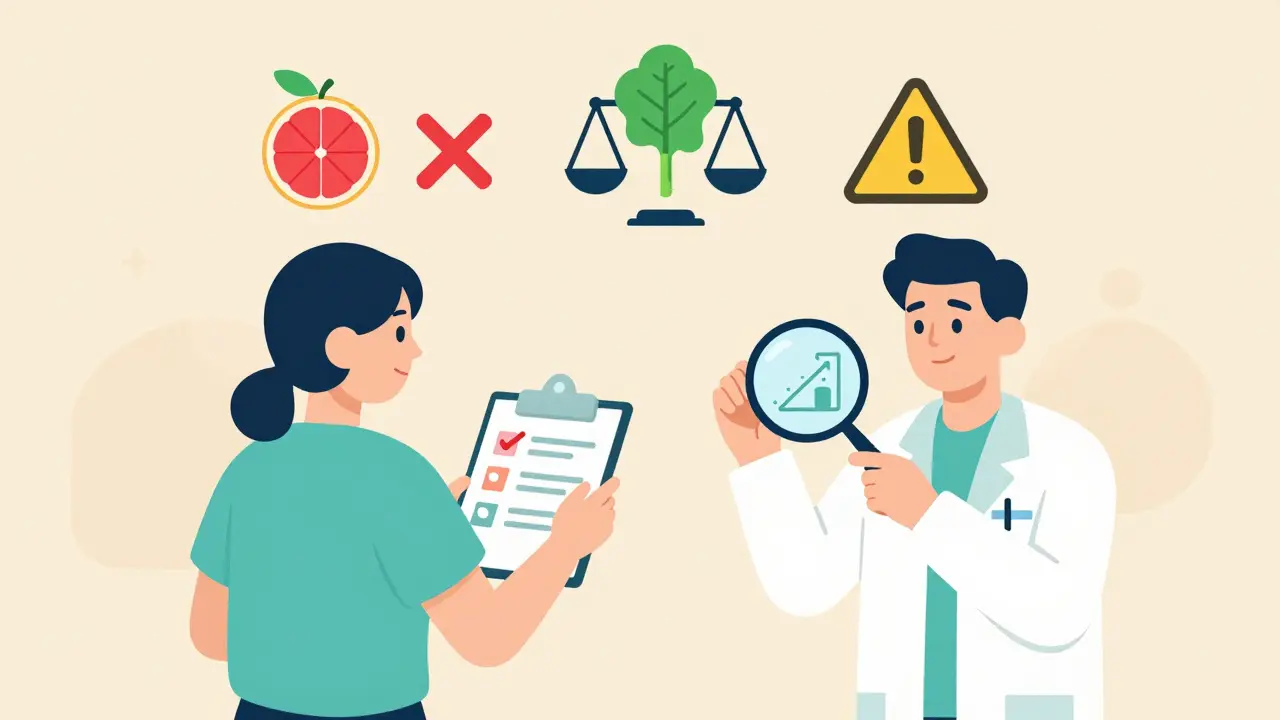
The biggest mistake? Letting it sit.Set a reminder: every time you refill a prescription, review your checklist. That’s your natural update trigger. If you get a new med, add it before you take the first dose. If you start eating more kale, update the interaction note. Don’t wait.
Also, review it with your pharmacist during your next Medication Therapy Management (MTM) visit. These are free for Medicare and many private insurers. Pharmacists will spot gaps you missed. One study showed patients who did this had 65% fewer errors.
Use color coding. Red for high risk. Yellow for moderate. Green for low. Stick a note on your fridge: “Check every refill.”
What to Avoid
Don’t rely on Google searches. Don’t trust random health blogs. Don’t assume “natural” means safe. St. John’s Wort isn’t a harmless herb-it’s a drug that interferes with over 50 medications.Avoid vague notes like “avoid citrus” or “don’t eat too much.” Be specific: “No grapefruit, Seville oranges, or pomelo. No more than 1 cup of cooked spinach daily.”
And never skip the emergency contact. If you collapse at 2 AM and your partner doesn’t know what you’re on, every minute counts.
Final Thought: This Isn’t Just a List. It’s a Lifeline.
The American Pharmacists Association calls the food-medication checklist “the single most effective patient-controlled intervention” for preventing drug reactions. It’s not complicated. It doesn’t cost money. And it doesn’t require tech skills.Start today. Gather your meds. Open the NZ Formulary website. Write down one interaction you didn’t know about. Add it to your list. Update the date. Put it on the fridge.
You’re not just organizing pills. You’re protecting your body from silent, avoidable dangers.
Can I use a regular medication list instead of a food and medication interaction checklist?
No. A regular medication list only tells you what you take. A food and medication interaction checklist tells you what to avoid eating or drinking with those meds. They serve different purposes. If you’re on warfarin, grapefruit, or antibiotics, you need the detailed interaction info-not just a pill count.
What’s the most dangerous food-drug interaction I should know about?
Grapefruit juice with statins (like simvastatin or atorvastatin) is one of the most dangerous. It can increase drug levels by 300-500%, leading to muscle breakdown and kidney failure. Another is tyramine-rich foods (aged cheese, cured meats, tap beer) with MAO inhibitors (like tranylcypromine), which can cause a sudden, life-threatening spike in blood pressure. Both are well-documented by the FDA and Medsafe.
Do I need to avoid all vitamin K if I’m on warfarin?
No. You need to eat a consistent amount every day. Sudden changes in vitamin K intake (like eating lots of kale one week and none the next) make warfarin less predictable. The goal isn’t to avoid it-it’s to keep your intake steady. A daily cup of cooked spinach or kale is fine, as long as you do it every day.
How often should I update my checklist?
Update it every time you start, stop, or change a medication, supplement, or dosage. Also update it if you change your diet significantly-like starting a new smoothie routine or eating more leafy greens. Review it every month. The FDA found that 68% of errors happen because checklists are outdated.
Can my pharmacist help me build this checklist?
Yes-and they should. Many pharmacies offer free Medication Therapy Management (MTM) sessions. Pharmacists are trained to spot interactions you might miss. Bring your current meds and your checklist. They’ll help you correct mistakes, add missing info, and explain risks in plain language. Studies show patients who do this have 65% fewer medication errors.
Morgan Dodgen
lol so basically the government wants us to keep a fucking spreadsheet on our fridge like we're in some dystopian medscape? 🤡
Meanwhile, Big Pharma is just waiting for you to miss a dose so they can sell you the next one. Grapefruit juice? Yeah, it 'interacts'-with your wallet. I've been taking statins with orange juice for 8 years. Still alive. Probably because I don't believe in 'interactions'-only profit motives.
Also, why is the NZ Formulary the gold standard? Are we outsourcing our health advice to a country that thinks 'kiwi' is a fruit AND a person? 🥝
Philip Mattawashish
You're all missing the point. This isn't about checklists. It's about control. Who decided that your kitchen is now a clinical trial zone? Who gave the FDA the right to dictate that your spinach salad is a 'moderate risk'? This is pharmaceutical colonization of the home. They don't want you healthy-they want you dependent. Every time you update your checklist, you're signing another waiver to your autonomy. And don't get me started on 'pharmacists'-they're just the new priests of the pill temple. 🙏💊
Tom Sanders
I just wrote down my meds on a napkin and stuck it to the fridge with a magnet. If I forget to take my pills, I’m probably too tired to care anyway. Why are we turning this into a full-blown project? I don’t need a color-coded system. I need coffee and a nap.
Jazminn Jones
The structural inadequacy of this proposed methodology is frankly alarming. While the checklist paradigm demonstrates surface-level utility, it fails to account for the epistemological fragmentation of pharmacovigilance in the post-industrial healthcare landscape. The reliance on paper-based documentation-particularly in a demographic cohort with demonstrably low digital literacy-exacerbates systemic inequities. Moreover, the NZ Formulary, while empirically robust, is not internationally harmonized with the WHO Model List of Essential Medicines, thereby introducing potential translational bias. One must also interrogate the ontological status of 'risk levels'-are they ontic or epistemic? And who legitimizes their taxonomy?
Stephen Rudd
You people are obsessed with paper lists because you're scared of technology. I use an app that syncs with my smart fridge. It scans my groceries, cross-references my meds, and auto-sends alerts. Your 'printed checklist' is a relic. And no, bok choy doesn't behave like spinach-your source is outdated. The FDA hasn't updated their database since 2021. I've got real-time data from the Australian Therapeutic Goods Administration. You're all using 3-year-old info. Go update your sources before you give advice.
Erica Santos
Oh wow. A checklist. How revolutionary. Next you'll tell us to wash our hands before touching our own faces. 🙄
Let me guess-you also tie your shoes in a double knot and alphabetize your spice rack. This isn't healthcare. It's performance art for anxious middle-class retirees. You're not protecting your life-you're performing it. For the fridge. For the pharmacist. For the algorithm. You're not a patient. You're a data point with a laminated card.
George Vou
i read this whole thing and i still dont get why i cant just take my pills with water like normal people. why do i need to know if my kale is steamed or raw? its just veg. and st johns wort? sounds like something a witch would brew. i dont even know what that is. and why is everyone so scared of grapefruit? i like it. its tasty. i think this whole thing is overhyped. also i spelled 'interaction' wrong in my notes but i think i got the idea. 🤷♂️
Mantooth Lehto
I used to take warfarin and I ate spinach every day. I didn't care. I just went to my lab every week. That's how it's supposed to work. You don't need a checklist-you need a doctor who listens. I had a pharmacist tell me to 'avoid vitamin K' and I nearly starved. I'm alive because I trusted my INR numbers, not a fridge note. Also, if you're scared of your food, maybe you should stop taking meds and start therapy. 💔
Neeti Rustagi
I appreciate the thoroughness of this guide. However, I must respectfully point out that cultural context is often overlooked. In India, turmeric is consumed daily in curries and teas, yet its interaction with anticoagulants is rarely documented in Western checklists. Similarly, neem-based supplements, commonly used for immunity, may potentiate hypoglycemic effects. A truly inclusive checklist must account for regional dietary patterns. I recommend cross-referencing with Ayurvedic pharmacopeias alongside the NZ Formulary. Knowledge should be global, not just Anglo-American.
Dan Mayer
i think this is all kinda dumb. i take my meds with milk every time. i dont care if its 'blocks absorption'-i just do it. and if my blood pressure spikes, i'll call my doc. why are we turning this into a science project? also i think 'tyramine' is spelled with a 'y' not an 'i' but idk. i'm not a pharmacist. 🤷♂️
Janelle Pearl
I just want to say-this made me cry a little. Not because it's complicated, but because it’s so simple, and so many of us are too scared to start. I used to forget my meds. I used to panic when my doctor changed my dose. Then I made a checklist. Just one page. I put it on the fridge next to my kid’s drawing. Now, when I’m confused, I look at it. And I feel safe. You don’t need to be perfect. You just need to begin. One interaction. One update. One breath. You’ve got this.
Samantha Fierro
The framework presented here is methodologically sound and aligns with best practices in clinical pharmacology. However, I would like to emphasize the importance of integrating this checklist into the Electronic Health Record (EHR) ecosystem. A paper-based system, while accessible, is inherently non-interoperable. Without API integration with pharmacy dispensing systems, the checklist becomes a static artifact rather than a dynamic clinical tool. I recommend that healthcare institutions develop a standardized digital template with QR code access, linked to real-time formulary updates. This would not only enhance safety but also reduce administrative burden on providers.
Robert Bliss
I made a checklist after my grandma had a bad reaction. It took me an hour. Now I update it when I refill my blood pressure med. I don't overthink it. I just write it down. I keep it on the fridge. My wife knows where it is. I don't need apps or color codes. Just a pen and a piece of paper. And a little peace of mind. 😊