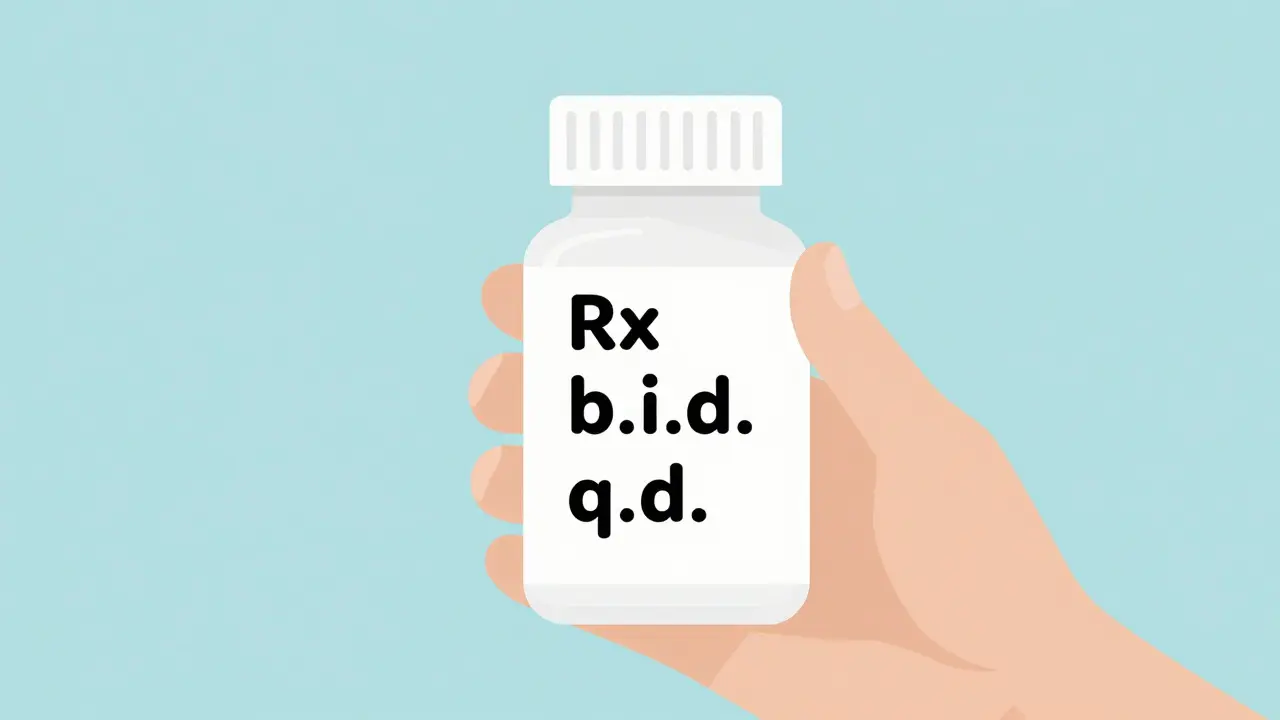
Have you ever picked up a prescription bottle, stared at the tiny black text on the label, and felt like you were reading a secret code? You are not alone. Those cryptic strings of letters-b.i.d., p.o., or even just Rx-are remnants of a medical language that dates back centuries. While these abbreviations were originally designed to save time for doctors and pharmacists, they can be a major source of confusion for patients today. Worse yet, misinterpreting them can lead to serious medication errors.
In this guide, we will break down the most common prescription label abbreviations and pharmacy symbols. We’ll explain what they mean, why some are being banned for safety reasons, and how you can protect yourself when picking up your next dose of medicine.
The Origin of Medical Shorthand
To understand why our prescriptions look the way they do, we have to look back at history. The symbol Rx is derived from the Latin word 'recipe,' which means 'take'. It was first documented in prescription notation in 1598. Back then, physicians across Europe used Latin as a universal language to ensure everyone understood the instructions, regardless of their native tongue. This practice streamlined communication in an era before standardized medical education.
However, times have changed. What started as a tool for clarity has become a potential hazard. According to the Institute for Safe Medication Practices (ISMP), abbreviation-related errors account for 6.8% of all medication errors in U.S. hospitals. The tension between brevity and clarity is real. While writing "q.d." takes less time than writing "daily," the risk of it being misread as "q.i.d." (four times daily) creates a dangerous gap in patient safety.
Common Dosage and Frequency Abbreviations
When you look at the directions section of your label, you will likely see Latin-based abbreviations indicating how often to take your medication. Here are the most frequent ones you need to know:
- b.i.d. (bis in die): Twice daily.
- t.i.d. (ter in die): Three times daily.
- q.i.d. (quater in die): Four times daily.
- q.d. (quaque die): Daily.
- prn (pro re nata): As needed.
While b.i.d. and t.i.d. are widely accepted, q.d. is a major red flag in modern healthcare. The ISMP reports that q.d. was involved in 21.7% of frequency-related errors because it can easily be mistaken for q.i.d.. If you meant to take a pill once a day but read it as four times a day, the consequences could be severe. For this reason, many health systems now mandate writing out "daily" instead of using the abbreviation.
Administration Routes: How to Take the Meds
Knowing *when* to take medicine is only half the battle; knowing *how* is equally important. Prescription labels often include abbreviations for the route of administration:
- p.o. (per os): By mouth.
- p.r. (per rectum): Rectally.
- SC / SQ / SubQ: Subcutaneous (under the skin).
- SL: Sublingual (under the tongue).
Confusion here can lead to ineffective treatment or injury. For example, insulin intended for subcutaneous injection might be accidentally administered sublingually if SC is misread as SL. The American Hospital Association documented 1,873 such cases in a single year. Always double-check with your pharmacist if the instruction isn't immediately clear.
Anatomical Locations: Eyes and Ears
If you have eye drops or ear drops, pay close attention to the side specified. These abbreviations are notorious for causing errors:
- o.d. (oculus dexter): Right eye.
- o.s. (oculus sinister): Left eye.
- a.d. (auris dexter): Right ear.
- a.s. (auris sinister): Left ear.
The American Academy of Ophthalmology found that o.d. and o.s. were implicated in 12.3% of ophthalmic medication errors. Imagine putting steroid drops in your left eye when they were prescribed for your right eye due to inflammation. The mix-up between o.d. (right eye) and OD (often shorthand for overdose in other contexts) adds another layer of risk. In community pharmacies, eye and ear abbreviations are responsible for nearly 20% of dispensing errors.
The "Do Not Use" List: High-Risk Abbreviations
Because of the risks mentioned above, regulatory bodies have stepped in. The Joint Commission maintains an official "Do Not Use" list of high-risk abbreviations that should never appear in prescriptions. As of January 2023, this list includes:
| Abbreviation | Meaning | Why It's Banned |
|---|---|---|
| U or u | Unit | Can be mistaken for "0" (zero) or "cc" or "4". Caused 12.3 deaths in PA alone (2018-2022). |
| IU | International Unit | Can be mistaken for "IV" (intravenous) or the number "10". |
| Q.D. or QD | Daily | Can be mistaken for "Q.I.D." (four times daily). |
| Q.O.D. or QOD | Every other day | Can be misread as "QD" (daily). |
| Trailing zero (X.0 mg) | Dosage | The decimal point may be missed, leading to a 10-fold overdose (e.g., 1.0 mg read as 10 mg). |
| Lack of leading zero (.X mg) | Dosage | The decimal point may be missed, leading to a 10-fold underdose (e.g., .5 mg read as 5 mg). |
Note the rule about zeros: always write 0.5 mg, never .5 mg. And never write 1.0 mg; just write 1 mg. These small formatting rules prevent massive dosing errors.

Medication Type and Condition Abbreviations
You may also see abbreviations describing the form of the drug or the condition being treated:
- OTC: Over-the-counter.
- ODT: Orally disintegrating tablet (dissolves in mouth).
- LAI: Long-acting injection.
- OCD: Obsess-compulsive disorder.
- OSA: Obstructive sleep apnea.
A survey by ResourcePharm found that 78.4% of pharmacists consider recognizing OTC critical for patient counseling. Meanwhile, psychiatric condition abbreviations like OCD have a 15.6% misinterpretation rate in primary care settings, according to the AMA Council on Science and Public Health. Context matters immensely here.
Regional Differences and the Shift to Plain English
Not all countries handle abbreviations the same way. The UK’s National Health Service took a drastic step in 2019 by eliminating nearly all prescription abbreviations, mandating English-only prescriptions except for standard metric units like mg and mL. This move resulted in a 28.7% reduction in dispensing errors, as reported in the British Journal of Clinical Pharmacology.
In contrast, the U.S. uses a more nuanced approach. While electronic prescribing systems (like Epic Systems' CPOE) are reducing errors by 43.2%, 67.8% of community pharmacies still encounter problematic abbreviations from prescribers using hybrid paper-electronic systems. The trend, however, is clear: the World Health Organization’s 2023 Global Patient Safety Challenge mandates the elimination of all non-English abbreviations in prescriptions by 2030.
How to Protect Yourself
As a patient, you are the last line of defense. Here is how to stay safe:
- Ask for clarification: If you see an abbreviation you don’t recognize, ask your pharmacist to spell it out. There is no shame in asking, "Does this mean I take it twice a day?"
- Check the label against the verbal instructions: When the pharmacist hands you the bottle, repeat the instructions back to them. "So, one pill by mouth every morning, correct?"
- Look for plain English labels: Many major chains like Walmart and CVS now convert abbreviations to plain English on patient-facing labels. If your label still has heavy shorthand, consider asking if a clearer version is available.
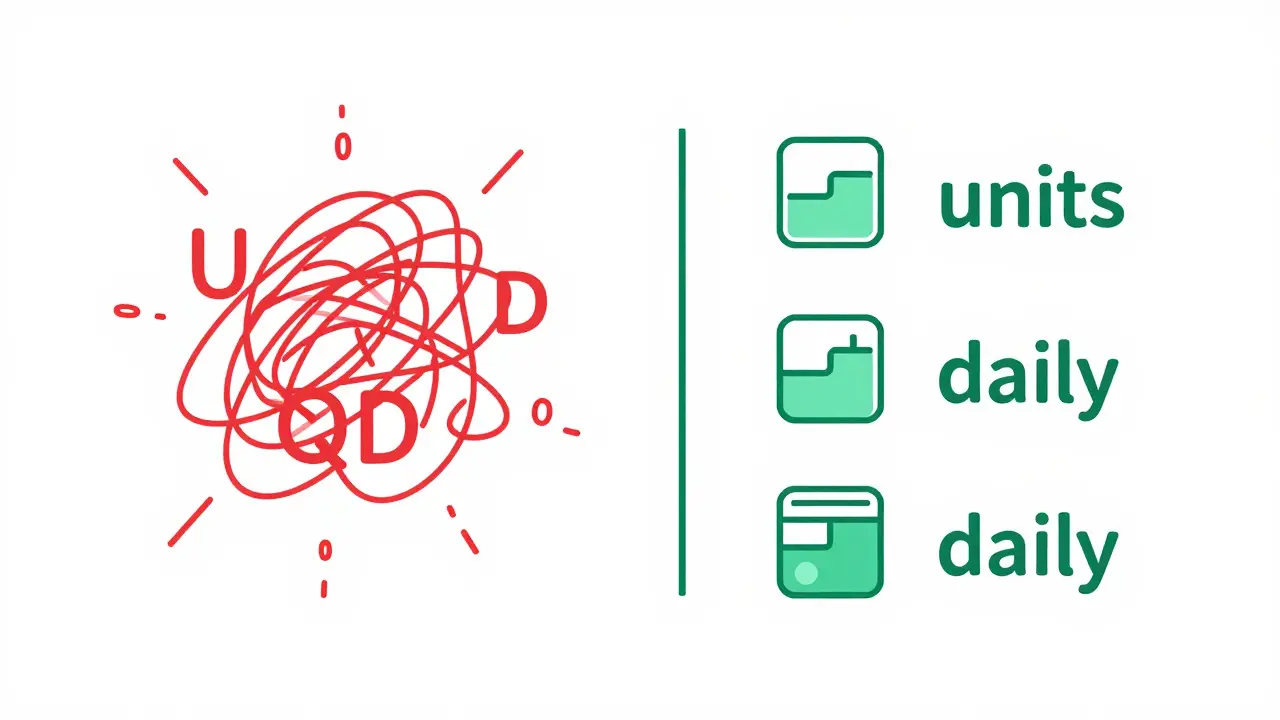
- Watch for high-risk drugs: Be extra vigilant with insulin (watch for "U" vs "units"), morphine (watch for "MS" vs magnesium sulfate), and eye/ear drops.
The goal is simple: clear communication saves lives. By understanding these codes, you take control of your health and reduce the risk of error.
What does Rx mean on a prescription?
Rx is a symbol derived from the Latin word "recipe," which means "take." It has been used since the late 16th century to indicate the start of a prescription order. Today, it is universally recognized as the symbol for a medical prescription.
Is b.i.d. twice a day?
Yes, b.i.d. stands for the Latin phrase "bis in die," which translates to twice daily. It is one of the few frequency abbreviations that remains widely accepted and considered safe for use on prescription labels.
Why is q.d. banned on prescriptions?
The abbreviation q.d. (meaning daily) is banned by the Joint Commission because it can be easily misread as q.i.d. (four times daily). This confusion has led to significant medication errors, including overdoses. It is safer to write "daily" in full.
What is the difference between o.d. and o.s.?
These abbreviations refer to eyes. o.d. stands for "oculus dexter" (right eye), and o.s. stands for "oculus sinister" (left eye). Confusing these two is a common cause of medication errors in ophthalmology.
Should I worry about trailing zeros on my prescription?
Yes. Trailing zeros (like 1.0 mg) are prohibited because the decimal point can be missed, leading someone to read 1.0 as 10. This results in a 10-fold overdose. Prescriptions should simply say 1 mg. Similarly, leading zeros are required (0.5 mg, not .5 mg) to prevent underdosing.
Are pharmacy abbreviations going away?
Gradually, yes. The World Health Organization aims to eliminate non-English abbreviations by 2030. The UK has already largely eliminated them, seeing a drop in errors. In the U.S., electronic prescribing systems are increasingly converting shorthand to plain English to improve safety.
What does prn mean?
Prn stands for the Latin phrase "pro re nata," which means "as needed." It indicates that the medication should be taken only when symptoms arise, rather than on a fixed schedule.
What is MSO4 on a prescription?
MSO4 is a dangerous abbreviation that can stand for either Morphine Sulfate or Magnesium Sulfate. Because the treatments are vastly different, many pharmacies now require the full name to be spelled out to prevent life-threatening errors.