Medication Timing Calculator
Thyroid & Antibiotic Timing Guide
This tool calculates safe timing between magnesium supplements and medications based on clinical guidelines. Always consult your healthcare provider.
Many people take magnesium supplements for muscle cramps, sleep, or digestion-yet few realize how easily it can mess with their thyroid meds or antibiotics. If you’re on levothyroxine (Synthroid, Levoxyl, or generic) or taking antibiotics like ciprofloxacin or doxycycline, taking magnesium at the same time can make both drugs useless. This isn’t a minor concern. It’s a common mistake that leads to rising TSH levels, untreated hypothyroidism, or antibiotic failure-all preventable with simple timing.
Why Magnesium Interferes with Thyroid Medication
Levothyroxine, the synthetic form of the thyroid hormone T4, needs to be absorbed in your small intestine to work. Magnesium, especially in forms like hydroxide, carbonate, or citrate, binds to it in your gut like glue. This creates a complex your body can’t absorb. Research shows this can drop levothyroxine absorption by 25% to 35%. That’s not a small dip-it’s enough to push your TSH from normal into the hypothyroid range.One 2021 study in the Journal of Clinical Endocrinology & Metabolism tracked patients who took magnesium and levothyroxine together. Their TSH levels jumped from an average of 2.1 to 5.8 mU/L within just a few months. That’s like going from feeling fine to exhausted, gaining weight, and struggling to think clearly-all because of a supplement they thought was harmless.
Not all magnesium is the same. Magnesium oxide, often used for constipation, has a weaker interaction-some studies show under 10% absorption loss. But magnesium hydroxide (found in antacids like Mylanta) and magnesium citrate are heavy binders. Even magnesium glycinate, which is gentler on the stomach, still interferes enough to cause problems in sensitive people. The American Association of Clinical Endocrinologists says to assume all forms interact unless proven otherwise.
How Long to Wait Between Magnesium and Levothyroxine
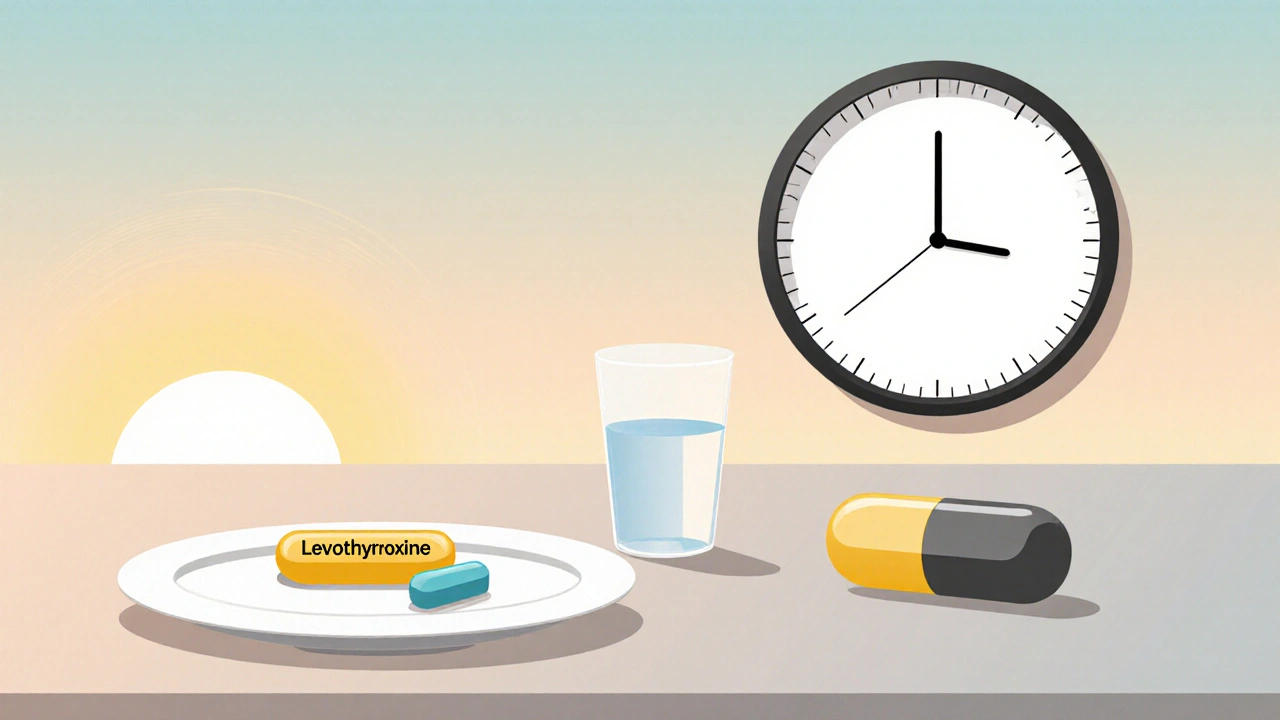
The standard advice from the Endocrine Society and the American College of Clinical Pharmacy is simple: wait at least 4 hours.Here’s how to make it work in real life:
- Take levothyroxine first thing in the morning, on an empty stomach, with a full glass of water.
- Wait 45 to 60 minutes before eating or drinking anything else.
- Take your magnesium supplement at dinner, or better yet, right before bed-this gives you a 6- to 8-hour gap.
Why 4 hours? It’s not arbitrary. That’s how long it takes for your stomach to empty and for the drugs to move past the absorption zone. Taking magnesium at night also avoids the risk of it interfering with your morning dose. Many patients report better sleep when they take magnesium at bedtime-so this schedule solves two problems at once.
There’s one exception: liquid formulations like Tirosint or Unithroid. These bypass some of the gut binding because they’re absorbed differently. Studies show only an 8-12% drop in absorption when taken with magnesium. If you’re still struggling with TSH levels despite spacing, talk to your doctor about switching. It’s not a miracle fix, but it helps.
Magnesium and Antibiotics: The Hidden Risk
If you’re on antibiotics, the timing gets even more critical. Magnesium doesn’t just mess with thyroid meds-it can ruin your antibiotics too.Tetracyclines (doxycycline, minocycline) and fluoroquinolones (ciprofloxacin, levofloxacin) are the big ones. They work by binding to magnesium in your gut, forming a chelate that your body can’t absorb. The FDA says ciprofloxacin absorption drops by up to 50% when taken with magnesium supplements. That means your infection might not clear-and you could end up with antibiotic resistance.
Here’s the spacing rule for antibiotics:
- Take antibiotics at least 2 hours before magnesium.
- Or wait 6 hours after taking magnesium before taking the antibiotic.
For example: If you take ciprofloxacin at 8 a.m., don’t take magnesium until 2 p.m. or later. If you take magnesium at 8 p.m., wait until 2 a.m. to take your antibiotic-obviously not practical. So the best plan is to take antibiotics in the morning and magnesium at night.
Good news: Penicillins (like amoxicillin) and macrolides (like azithromycin) don’t interact with magnesium. If you’re on one of these, you’re safe. But if you’re unsure, always check the label or ask your pharmacist.

What About Other Supplements?
Magnesium isn’t the only troublemaker. Calcium, iron, and even antacids like aluminum hydroxide do the same thing. If you’re taking multiple supplements, you need a schedule.Here’s a simple daily plan that works for most people:
- 7:00 a.m. - Levothyroxine (empty stomach, water only)
- 8:00 a.m. - Breakfast
- 10:00 a.m. - Iron supplement (if prescribed)
- 12:00 p.m. - Calcium supplement with lunch
- 6:00 p.m. - Magnesium supplement with dinner
- 10:00 p.m. - Antibiotic (if needed, and only if spaced correctly)
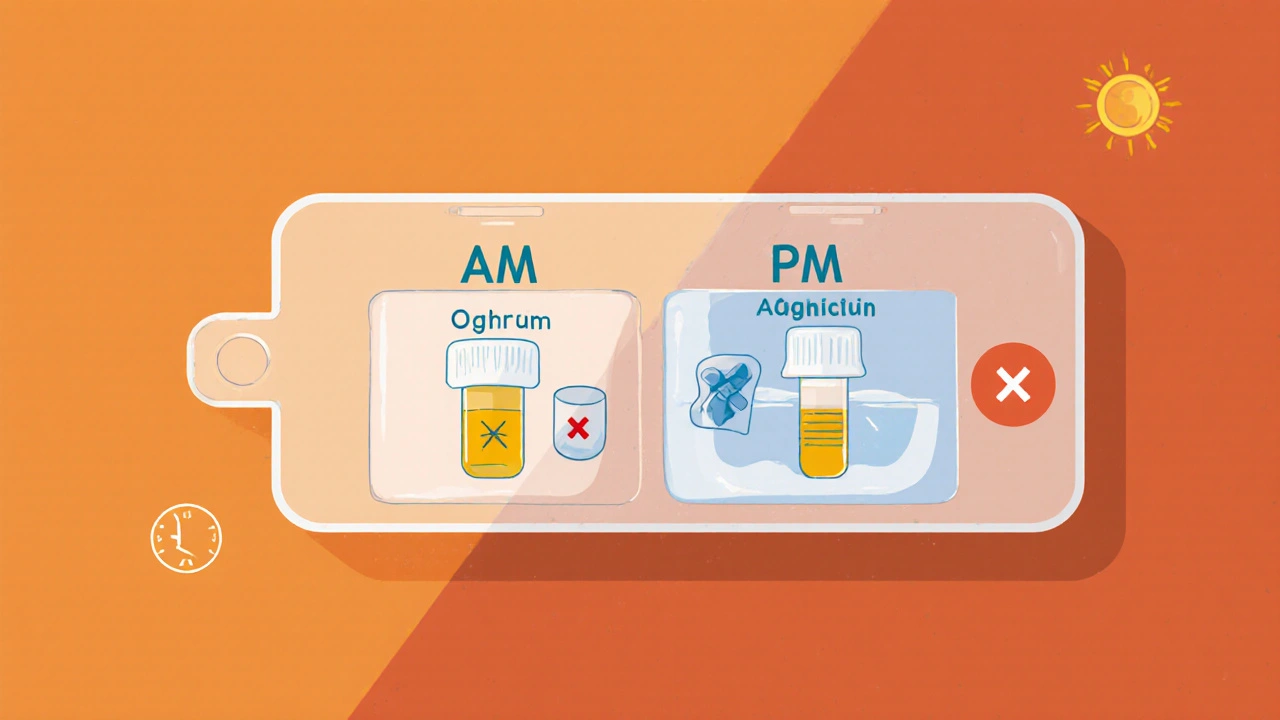
This keeps everything separated by at least 2-4 hours. Many patients use pill organizers with AM/PM compartments to stay on track. One user on Drugs.com said, “Since I started using a two-compartment pill box, my TSH has been perfect for nine months.”
What If You Accidentally Take Them Together?
If you forgot and took magnesium with your thyroid med or antibiotic, don’t panic. One mistake won’t ruin everything. But don’t do it again.Here’s what to do:
- Don’t double up on your next dose. That’s dangerous.
- Take your next dose at the regular time, spaced correctly.
- Watch for symptoms: fatigue, brain fog, rapid heartbeat, or worsening infection.
- Get your TSH or antibiotic blood levels checked in 4-6 weeks if you’re concerned.
Most people don’t notice the drop right away. That’s why it’s so sneaky. Your doctor might think your thyroid condition is getting worse-when it’s just a supplement timing issue.
Real Stories: What Happens When You Ignore This
A Reddit user from r/Hypothyroidism shared that after taking 300 mg of magnesium glycinate with Synthroid for months, their TSH jumped from 1.8 to 14.2. They felt awful-depressed, cold, swollen. It took 8 weeks of proper spacing to get back to normal. They called it “the worst 3 months of my life.”Another patient, a 58-year-old woman on doxycycline for a sinus infection, took her magnesium at breakfast with her thyroid med. The infection didn’t improve. Her doctor thought it was antibiotic resistance. Only after reviewing her supplement list did they realize the timing was wrong. She restarted the antibiotic with proper spacing-and cleared the infection in 4 days.
These aren’t rare. A 2023 survey of 483 patients found that 62% said their doctor never warned them about magnesium interactions. That’s unacceptable. You have to be your own advocate.
What’s New in 2025?
The field is evolving. New time-release levothyroxine formulations like Chronocell’s LevoThyrin are being tested and show no interaction with magnesium in early trials. That could be a game-changer for people who struggle with timing.Also, more supplement brands are now labeling their products with warnings like “Take 4 hours apart from thyroid medication.” In 2023, 68% of top-selling magnesium supplements had this label, up from just 20% in 2020. Pharmacists at CVS and Walgreens now hand out free “Thyroid Medication Timing Cards” with your prescription. They’re simple, visual, and effective.
Still, the biggest barrier isn’t science-it’s adherence. A 2023 NEJM study found only 58% of patients kept up the 4-hour spacing after a year. That’s why apps like Medisafe and MyThyroid now offer custom reminders. One study showed users with app reminders had 89% adherence-almost double the control group.
Final Advice: Make It Simple, Make It Stick
You don’t need to memorize complex chemistry. Just follow this:- Thyroid med first thing in the morning-empty stomach, wait an hour.
- Magnesium at night-dinner or bedtime.
- Antibiotics? Take them in the morning, and skip magnesium until after.
- Use a pill organizer. Set phone alarms. Ask your pharmacist for a timing card.
If you’re still having symptoms despite spacing, ask for a TSH test. Don’t assume it’s your thyroid getting worse. It might just be your supplement timing.
Thyroid health and infection treatment are too important to leave to chance. A few minutes of planning saves weeks of fatigue, confusion, and unnecessary meds.
Yash Hemrajani
So let me get this straight - we’re now treating magnesium like it’s nuclear waste? I take it with my coffee and still have more energy than my yoga instructor. Also, who approved this 4-hour rule? The FDA? Or some endocrinologist who’s never eaten a banana?
My TSH’s been stable for years. I don’t need a spreadsheet to tell me when to swallow pills. Just chill.
Jermaine Jordan
This is not just medical advice - this is a lifeline. For years, I suffered from debilitating fatigue, brain fog, and unexplained weight gain - all because I thought ‘natural’ meant ‘safe.’
When I finally spaced my levothyroxine from my magnesium, my energy returned like a sunrise after a 3-month eclipse. My TSH dropped from 8.9 to 1.7 in six weeks. This isn’t theory - it’s transformation. If you’re reading this and still taking them together - please, for your own sake - stop. Right now. Your future self will thank you.
Chetan Chauhan
magensium? is that like magensim? or is it magneesium? anyway i think this whole thing is a scam by big pharma to sell more pills. i took my thyroid med and mag with breakfast for 5 years and im fine. also my cat takes it too and she purrs louder now. so…
maybe the real problem is doctors who cant spell?
Pranab Daulagupu
Chelation dynamics are critical here. The divalent cation interference with tetracycline-class antibiotics and levothyroxine is well-documented in pharmacokinetic literature. The 4-hour window aligns with gastric emptying half-life thresholds.
That said, individual variability in GI motility and pH may modulate this. Consider therapeutic drug monitoring if compliance is inconsistent. Magnesium glycinate’s lower binding affinity makes it a viable candidate for reduced separation - but only if serum levels are tracked.
Sean Slevin
Wait… so… we’re all just… pawns in a biochemical game of chess? Magnesium - the gentle mineral that calms nerves, aids sleep, eases cramps - is now the villain? And levothyroxine? The noble knight? And antibiotics? The knights in shining armor… who get poisoned by their own allies?
And we’re supposed to live by a schedule? Like robots? With alarms? Pill boxes? What happened to just… trusting our bodies? Or is this the new religion? The Church of Proper Timing?
I feel like I’ve been lied to my whole life.
Chris Taylor
Man, I did this for months. Took my Synthroid and my magnesium gummies at the same time. Thought I was being smart - ‘oh, I’ll just take them with breakfast.’
Turned out I was just slowly turning into a zombie. Constant exhaustion, zero motivation. My doctor was like, ‘Weird, your levels are off.’
Spaced it out like this post says? Holy crap. I felt human again in two weeks. Don’t be me. Learn from my dumbass.
Melissa Michaels
While the clinical evidence supporting temporal separation is robust, it is equally important to acknowledge patient adherence challenges. Many individuals are managing multiple medications with complex regimens.
Pharmacist-led counseling and visual scheduling tools have demonstrated significant improvements in compliance. Institutions that integrate these strategies report higher rates of therapeutic efficacy and reduced emergency visits due to suboptimal hormone or antibiotic levels.
Education, not fear, is the most effective intervention.
Nathan Brown
It’s funny - we’ve spent centuries trying to understand the body’s rhythms. Circadian cycles, lunar phases, digestion windows… and now we’re told to time pills like a rocket launch.
But what if the real problem isn’t magnesium? What if it’s that we’ve disconnected from natural cycles? We wake at 6 a.m. on alarm clocks, eat processed food, and then wonder why our bodies rebel?
Maybe the solution isn’t more scheduling… but less control.
…or maybe I’m overthinking it. I don’t know anymore. 🤔
Matthew Stanford
For anyone feeling overwhelmed by all this - you’re not alone. I used to stress about getting the timing perfect. Then I started using a pill organizer with AM/PM slots. Set a reminder on my phone. Now I don’t even think about it.
You don’t need to be perfect. Just consistent. One small habit change can save you months of suffering.
And if you’re still unsure? Talk to your pharmacist. They’re the unsung heroes of this whole thing.
Olivia Currie
I cried reading this. Not because I’m dramatic - but because I spent SIX MONTHS thinking I was failing at life. My thyroid was ‘getting worse.’ My doctor kept upping my dose. I was exhausted. My hair fell out. I felt like a ghost.
Then I found this post. Spaced my magnesium. Four weeks later - I slept through the night. For the first time in years.
You saved me. Thank you.
Curtis Ryan
so i took my mag with my abx and now my infection is back?? wait no i just got lazy and forgot to take the abx again but still i think this post is kinda sus because my cousin took mag with everything and she’s a marathon runner??
also i use a chewable form is that different?? someone help
Rajiv Vyas
Let me guess - this is all a Big Pharma plot to sell you more expensive thyroid meds and ‘special’ magnesium that doesn’t interact. They don’t want you to know that magnesium is a natural detoxifier and that your body can handle it just fine.
Also, levothyroxine is synthetic and unnatural - that’s why it doesn’t work right. Go natural. Eat seaweed. Stop trusting doctors. They’re paid by the pills.
And why is there a ‘2025’ update? Are we in a sci-fi novel now?
farhiya jama
Ugh. More self-help medical advice. I don’t care. I take what I want when I want. If I feel bad, I’ll go to the doctor. Until then, I’m not turning my life into a pharmacy schedule.
Also, I hate pill organizers. They’re ugly.
Ifeoma Ezeokoli
Wow. This is so helpful. I’m from Nigeria and my doctor never told me this. I’ve been taking magnesium with my thyroid med since I started treatment two years ago. I thought my tiredness was just stress.
I’m changing my routine tonight. Thank you for explaining it so clearly. I feel seen.
Daniel Rod
Just wanted to say - if you’re reading this and you’re scared, you’re not broken. You’re just trying to take care of yourself in a system that makes it confusing.
Small steps matter. One pill. One hour. One night of better sleep.
❤️ You got this.