
For decades, the standard recipe for approving a generic drug was simple: recruit a group of young, healthy men, give them the brand-name drug, then the generic version, and measure how much medicine ended up in their blood. If the numbers matched within a tight range, the generic got the green light. It was efficient, it was cheap, and it assumed that if a drug worked for a man, it would work for everyone else.
That assumption is cracking under the weight of modern science. We now know that age and sex significantly alter how our bodies process medications. A liver that slows down with age or hormonal fluctuations in women can change the speed and extent of drug absorption. Ignoring these factors doesn't just create statistical noise; it risks leaving millions of patients-especially older adults and women-with drugs that might be less effective or more prone to side effects than expected.
The regulatory landscape is shifting fast. Agencies like the U.S. Food and Drug Administration (FDA) are moving away from one-size-fits-all study designs toward models that reflect the actual people taking the medicine. Understanding these changes isn't just for pharmaceutical scientists; it’s crucial for anyone interested in why generic drugs sometimes behave differently in real life compared to clinical trials.
The Old Standard vs. The New Reality
To understand where we are going, we have to look at where we’ve been. Historically, bioequivalence (BE) studies were designed to minimize variability. The logic was that by using homogeneous groups-young, male, non-smoking volunteers with normal body mass indices-researchers could isolate the effect of the drug formulation itself. Any difference in blood concentration levels would be due to the pill, not the person.
Bioequivalence is a comparison of the rate and extent to which the active ingredient becomes available at the site of drug action when administered at the same molar dose in the same therapeutic form. The goal is to prove that a generic product performs identically to the reference listed drug (the brand name).
However, this "healthy male" model created a blind spot. As noted in a 2018 paper in the Journal of Pharmacy and Therapeutics and Clinical Pharmacology, BE studies were conducted almost exclusively on this demographic, even for drugs intended primarily for women or the elderly. This led to inconsistencies. For example, levothyroxine, a common thyroid medication used by predominantly female patients, often showed poor representation of women in its BE studies. With only about 25% female participation in some trials, despite 63% of users being female, the data didn't fully capture how women metabolize the drug.
The turning point came as evidence mounted regarding sex-dependent pharmacokinetics. Women generally have lower gastric pH, different body fat percentages, and distinct enzyme activity profiles compared to men. These biological differences mean that the same dose of a drug can result in different peak concentrations and elimination rates. Regulatory bodies realized that proving equivalence in men did not automatically guarantee equivalence in women or older adults.
What the Regulators Are Saying Now
The gap between historical practice and scientific reality has forced major regulatory agencies to update their guidelines. The most significant shift is coming from the FDA, which released draft guidance in May 2023 titled "Bioequivalence Studies with Pharmacokinetic Endpoints for Drugs Submitted Under an ANDA." This document marks a departure from previous recommendations, moving toward stricter requirements for demographic representation.
| Regulatory Body | Age Requirement | Sex Representation | Subject Health Status |
|---|---|---|---|
| FDA (USA) | 18+ years; specific rules for elderly (60+) and pediatric extrapolation | Approximately 50:50 ratio required unless scientifically justified otherwise | Healthy volunteers OR general population (if stable chronic conditions don't interfere) |
| EMA (Europe) | 18+ years | Subjects "could belong to either sex"; no strict balance mandate, but risk to women of childbearing potential must be considered | Strictly healthy volunteers |
| ANVISA (Brazil) | 18-50 years | Equal male-female distribution across sequences required | Strictly healthy, non-smoking volunteers |
| Health Canada | 18-55 years | Generally balanced, though specific mandates vary by submission | Healthy volunteers |
The FDA’s 2023 stance is notably flexible yet demanding. It allows for "general population" enrollment-meaning adults with stable chronic conditions like hypertension or diabetes-provided those conditions and their medications do not interfere with the drug being tested. This is a huge step forward for representativeness. However, it comes with a catch: if you want to exclude a sex or age group, you need a robust scientific justification. You can’t just say it’s easier or cheaper.
In contrast, the European Medicines Agency (EMA) maintains a stricter focus on healthy volunteers. Their 2010 guideline, still largely in effect, states that subjects should be selected to permit the detection of differences between products. While they acknowledge that subjects can be of either sex, they do not mandate a 50:50 split. This creates a divergence in global standards. A generic approved in Europe based on a male-heavy trial might face scrutiny if submitted to the FDA without additional data or justification.
ANVISA, Brazil’s health surveillance agency, takes a middle ground with rigid parameters. They require equal male-female distribution but limit the age range to 18-50 years. This excludes the elderly entirely from the primary BE assessment, relying instead on other safety data to support use in older populations.
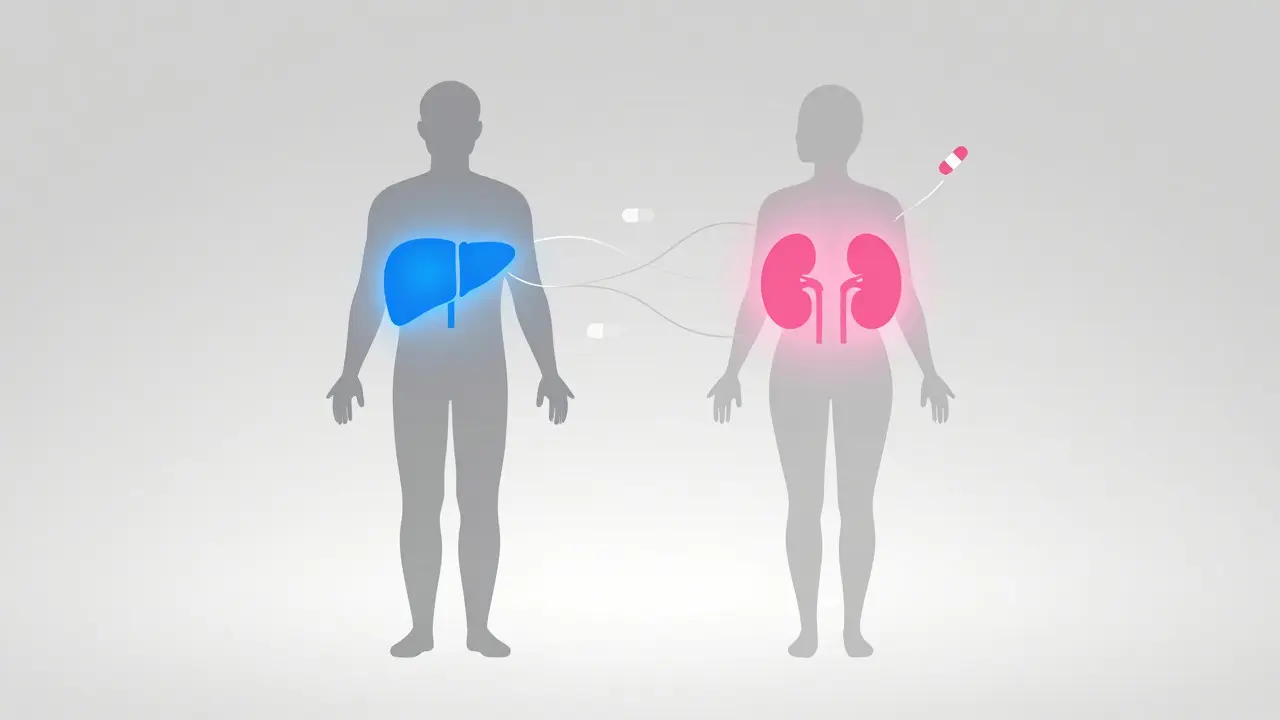
Why Age Matters More Than You Think
Aging is not just a number; it’s a physiological overhaul. As people enter their 60s, 70s, and beyond, several key pharmacokinetic parameters shift:
- Gastrointestinal Changes: Blood flow to the gut decreases, and gastric emptying slows down. This can delay the time it takes for a drug to reach peak concentration (Tmax).
- Hepatic Metabolism: Liver mass and blood flow decline, reducing the first-pass metabolism of many drugs. This means more of the active ingredient might remain in the system, potentially increasing the risk of toxicity.
- Renal Excretion: Kidney function naturally deteriorates with age, leading to slower clearance of drugs eliminated through urine.
These changes mean that a generic drug that appears equivalent to a brand-name drug in a 25-year-old might show slightly different exposure levels in an 80-year-old. The FDA acknowledges this. In their guidance, they note that while BE assessments in adults can often support pediatric or geriatric use, special justification is required when physiological differences are profound.
Dr. Robert Lionberger of the FDA pointed out in 2022 that extrapolating BE data to populations with different physiological characteristics requires careful thought. For narrow therapeutic index (NTI) drugs-medications where a small change in dose can lead to treatment failure or toxicity (like warfarin or lithium)-this is critical. If a generic behaves differently in the elderly due to altered absorption kinetics, the consequences can be severe.
Currently, there is no universal requirement to conduct separate BE studies solely in the elderly. Instead, sponsors must demonstrate that the formulation does not rely on mechanisms that would be disproportionately affected by aging. However, the trend is moving toward including older subjects (60+) in BE trials when feasible, or providing detailed pharmacokinetic modeling to bridge the gap.
The Sex Gap in Pharmacokinetics
If age changes how drugs move through the body, sex changes the map entirely. For years, women were excluded from early-phase clinical trials due to concerns about hormonal variability and potential teratogenicity (birth defects). This exclusion carried over into BE studies, creating a data vacuum.
We now know that sex differences are significant. Women tend to have higher body fat percentages and lower total body water, which affects the volume of distribution for lipophilic (fat-loving) versus hydrophilic (water-loving) drugs. Hormonal cycles also influence enzyme activity. For instance, estrogen can inhibit certain cytochrome P450 enzymes, slowing down the breakdown of drugs like midazolam or caffeine.
Dr. David Chen of the FDA’s Office of Generic Drugs highlighted a complex issue in 2018: while intra-subject variability (how much a single person’s response varies from day to day) is not strictly sex-dependent, females often exhibit higher overall variability in pharmacokinetic parameters. This higher variability makes it statistically harder to prove bioequivalence in women. A study that passes easily with a group of men might fail if run on women simply because the confidence intervals widen.
This leads to a paradox. To ensure generics are safe for women, we need more women in trials. But because women have higher variability, we need larger sample sizes to achieve statistical power. Larger trials cost more. Consequently, many sponsors historically stuck to male-only or male-dominated trials to save money and avoid failure risks.
The 2023 FDA draft guidance tackles this head-on. It requires applicants to include similar proportions of males and females (approximately 50:50) if the drug is intended for both sexes. If a sponsor wants to deviate from this, they must provide a scientific justification. This puts the burden of proof on the manufacturer to explain why a skewed population is acceptable.

Statistical Pitfalls and Study Design Challenges
Adding diversity to BE studies introduces statistical complexity. One of the biggest challenges is the "sex-by-formulation interaction." This occurs when the difference between the generic and brand-name drug depends on the sex of the subject. For example, a generic might be perfectly equivalent in women but slightly inferior in men.
A 2017 study by Ibarra et al. demonstrated this risk. In a small trial with only 14 subjects, the point estimate for males was 79.38%, suggesting bioinequivalence, while females showed 95.42%, indicating equivalence. However, this was likely a statistical artifact caused by small sample size. When the study was repeated with 36 subjects, the extreme values balanced out, and the drug was deemed equivalent for both sexes.
This highlights a critical rule of thumb: small BE studies (n=12-24) are highly susceptible to false positives or negatives when subgroup analyses are performed. To reliably detect sex-specific differences, studies need adequate power. Most experts recommend enrolling at least 36 participants to account for dropouts and ensure sufficient statistical rigor.
Sponsors are responding with better design strategies:
- Stratified Randomization: Ensuring that each sequence (e.g., Test-Reference vs. Reference-Test) has an equal number of men and women.
- Pre-specified Subgroup Analyses: Planning ahead to analyze PK parameters by sex, rather than digging through data after the fact.
- Increased Sample Sizes: Accepting higher recruitment costs to gain statistical confidence.
Recruitment remains the biggest hurdle. Sites report that gender-balanced studies take 40% longer to recruit, partly due to lower participation rates among women in clinical trials and stricter inclusion criteria (such as contraception requirements). The FDA prohibits pregnancy and lactation during BE studies, requiring female participants to practice abstinence or use effective contraception. This adds logistical friction that doesn’t exist for male participants.
Where Do We Go From Here?
The industry is in a transition phase. According to a 2022 survey by the Generic Pharmaceutical Association, 68% of Contract Research Organizations (CROs) now implement proactive female recruitment strategies. Yet, only 29% routinely track sex-specific pharmacokinetic parameters. There is still a gap between hiring diverse participants and analyzing the data for diversity.
Looking ahead, the National Academies of Sciences, Engineering, and Medicine recommended in 2021 the development of sex-specific bioequivalence criteria for narrow therapeutic index drugs. This could mean tighter acceptance ranges for women or separate labeling requirements based on sex.
Emerging research continues to uncover surprising disparities. A 2023 University of Toronto study found that 37% of commonly tested drugs had 15-22% higher clearance rates in males versus females. These findings will likely drive further regulatory evolution, pushing agencies to move beyond "average" human physiology toward personalized precision in generic drug approval.
For patients, this means greater assurance that the generic in their hand works as well as the brand name, regardless of their age or gender. For manufacturers, it means higher upfront costs but reduced long-term liability and better market alignment. The era of the "standard male volunteer" is ending, replaced by a more nuanced, representative approach to bioequivalence.
Do all generic drugs need to be tested on women and the elderly?
Not necessarily all, but most. If a drug is indicated for use in both sexes, the FDA now requires approximately equal representation of males and females in bioequivalence studies. For elderly populations, while separate BE studies aren't always mandatory, sponsors must justify why adult data applies to older adults, especially for drugs with narrow therapeutic indices. The trend is toward greater inclusion rather than exclusion.
Why were women historically excluded from bioequivalence studies?
Women were excluded primarily due to concerns about hormonal variability affecting drug metabolism and the risk of pregnancy during trials. Regulators wanted to minimize variables to make it easier to detect differences between drug formulations. Additionally, fears of teratogenicity (birth defects) led to strict exclusion criteria. Modern guidelines now recognize that this exclusion created a data gap that compromises patient safety.
How does age affect drug absorption?
Aging slows down gastric emptying and reduces blood flow to the gastrointestinal tract, which can delay the time it takes for a drug to reach peak concentration. It also reduces liver mass and kidney function, leading to slower metabolism and excretion. These changes can result in higher drug levels in the blood for longer periods, increasing the risk of side effects if the dosage isn't adjusted or if the generic formulation behaves differently.
What is a "sex-by-formulation interaction"?
This occurs when the bioequivalence between a generic and a brand-name drug depends on the sex of the patient. For example, a generic might perform identically to the brand in women but show lower absorption in men. Detecting this requires sufficiently large sample sizes and pre-planned statistical analyses. Small studies often miss these interactions, leading to false conclusions about a drug's equivalence.
Are EMA and FDA guidelines the same regarding demographics?
No, there are key differences. The FDA (as of 2023 draft guidance) explicitly requires balanced sex representation (approx. 50:50) for drugs used by both sexes and allows general population enrollment. The EMA focuses on healthy volunteers and states subjects "could belong to either sex" without mandating a strict balance. ANVISA (Brazil) requires equal sex distribution but limits age to 18-50. These differences can complicate global generic drug approvals.